
Every week, there is a new “game-changing” AI platform promising instant rankings, perfect content, and effortless visibility in Google and AI search results. I have tested enough of them to know that most do not live up to the hype.
Over the past couple of years, I have used AI tools for almost every part of my workflow.
Content creation. On-page optimization. Keyword research. Competitor analysis. Link building.
Some tools genuinely impressed me. Many were forgettable. Only a handful earned a permanent spot in my stack.
This article is not a roundup of every AI optimization tool on the market. It is a breakdown of the best AI SEO tools I personally use and keep coming back to.
Link building cheat sheet
Respona
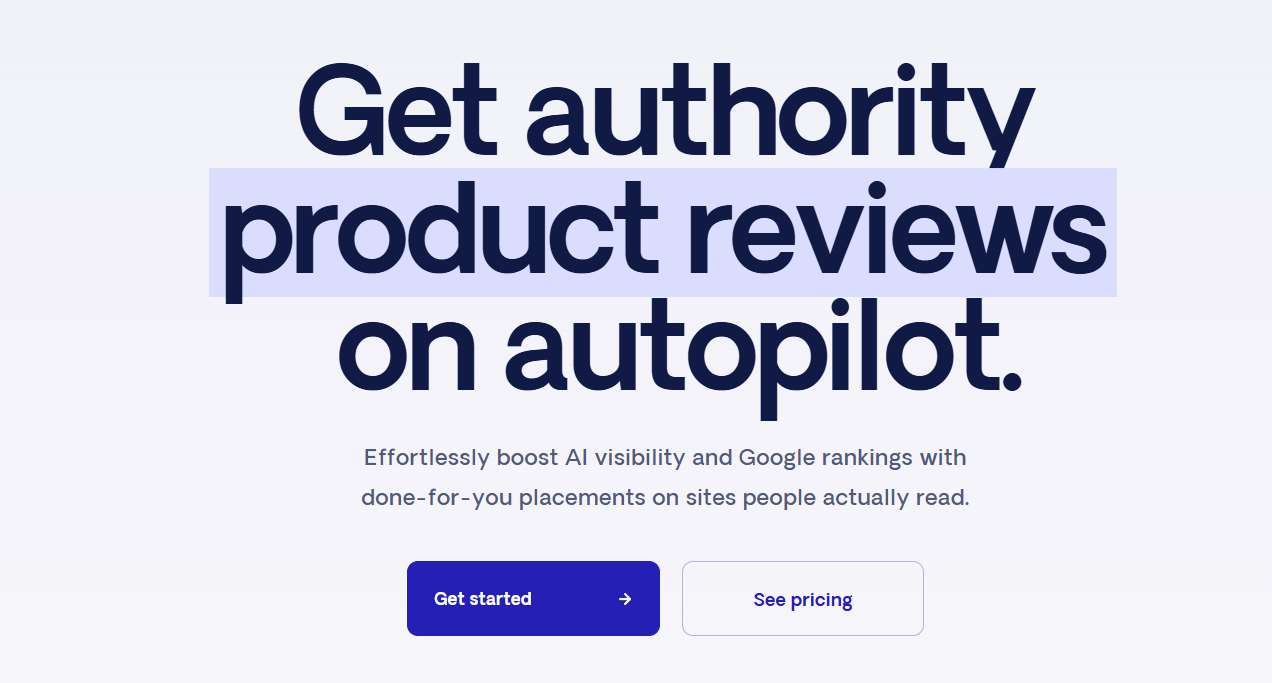
Link building is still one of the strongest signals for getting cited in AI search engines and answer engines, so it belongs on this list.
We built Respona because great content alone is not enough. Without backlinks from relevant, authoritative websites, even well-optimized pages struggle to rank where AI systems and search engines pull their sources from.
Respona works on a done-for-you model. You place an order, and our team handles everything required to secure backlinks. That includes prospecting, outreach, content creation, and placement. You don’t manage campaigns or send emails. We deliver the links.
Authority still comes first, especially with AI Overviews. If your content is not ranking in the top results, it will not be surfaced or cited. Backlinks remain one of the core signals that push pages into those positions.
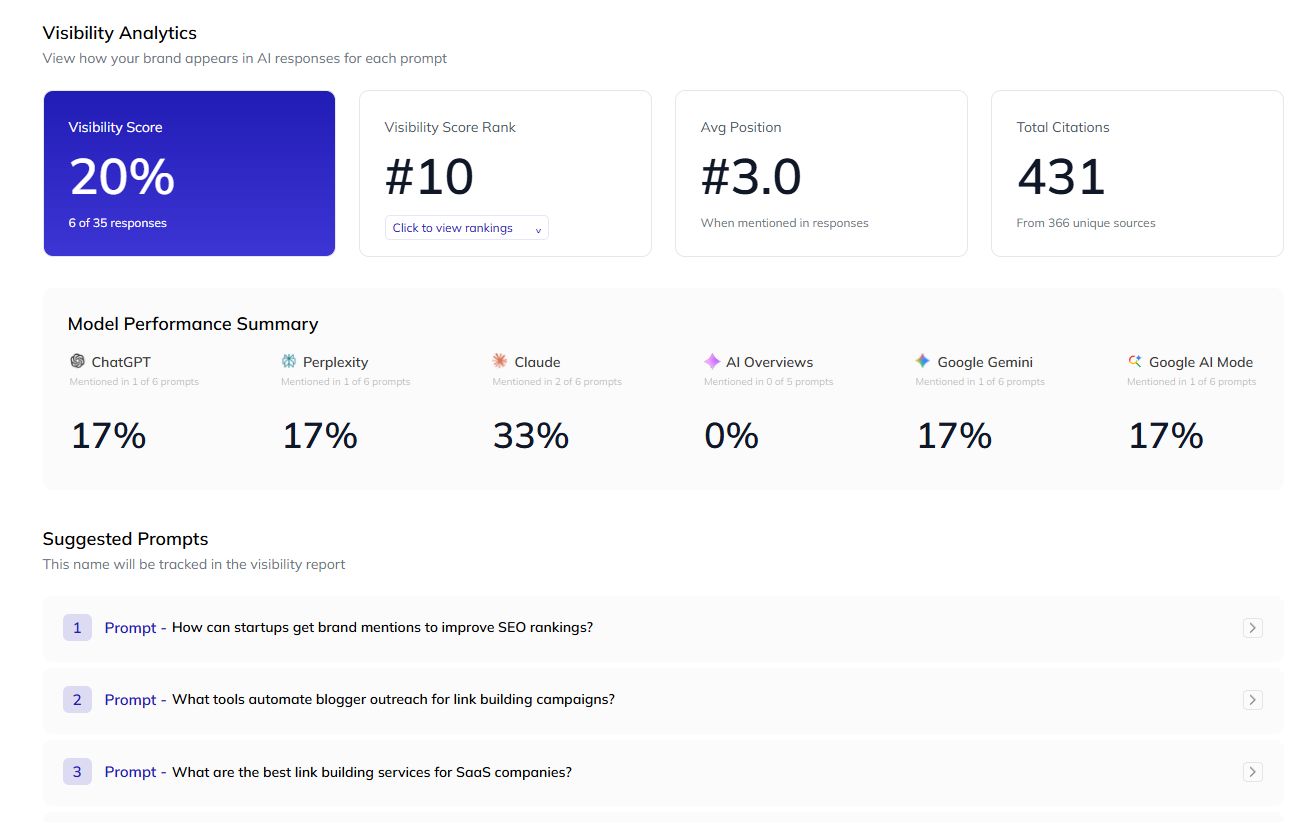
Our Campaigns feature helps you track not only your visibility in answer engines, but also find exact articles that get quoted for commercial queries that are relevant to you specifically – the perfect link building targets.
Our focus is on relationship-driven placements such as guest posts, link insertions, and listicle placements on real websites with organic traffic. The goal is to build links that actually move rankings, not inflate metrics.
The platform itself is mainly there to submit campaigns and track progress. Execution is handled entirely by our team, so you can scale link acquisition without building an in-house outreach operation.
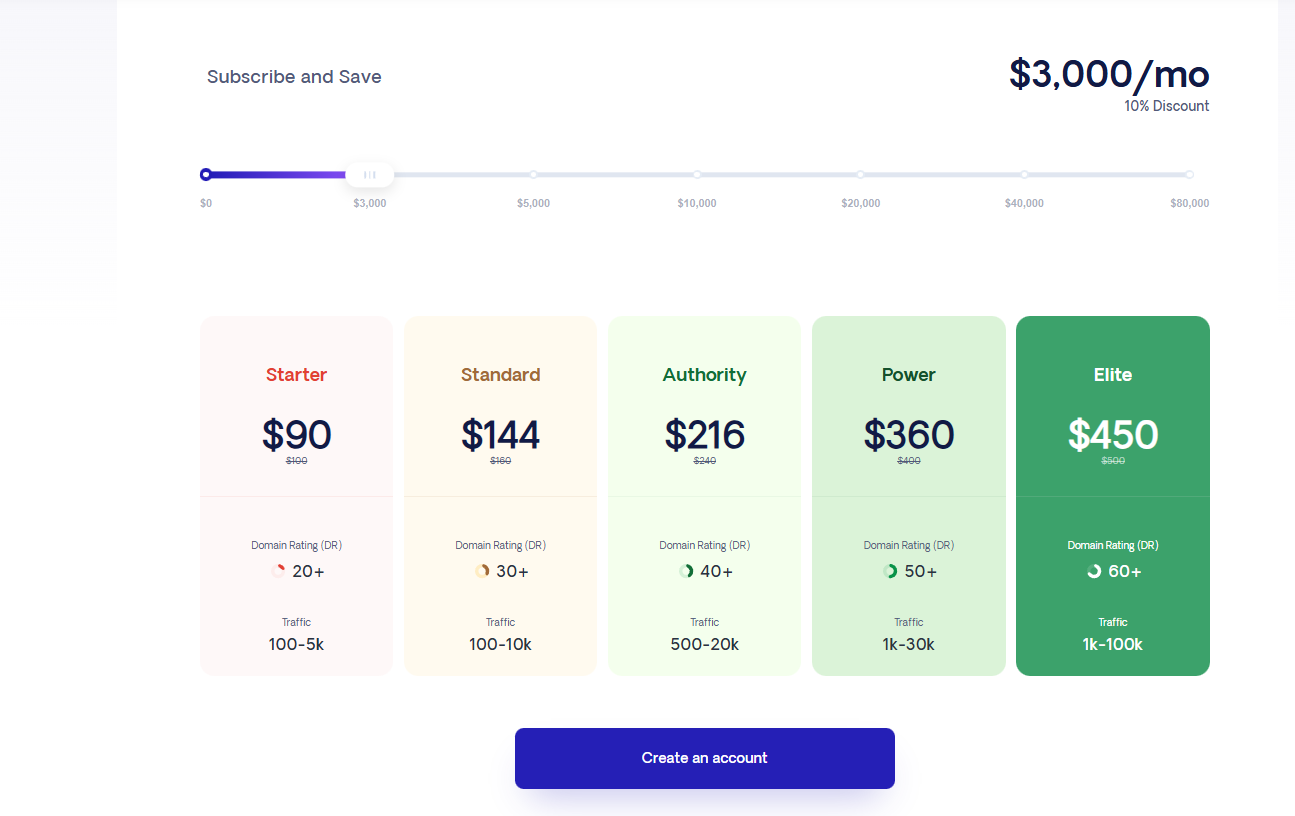
If you want your content to rank higher and actually show up in AI-powered search results without spending months on outreach yourself, our done-for-you link building is the fastest path there.
Surfer SEO
I mainly use Surfer to answer one question. What does Google already expect to see on a page ranking for this topic? Instead of guessing, Surfer analyzes the current top results and turns that into clear, actionable guidelines.
The Content Editor is where I spend most of my time. It gives me a live score based on keyword usage, topical coverage, headings, and structure. I do not treat the score as a goal by itself, but it is a helpful sanity check while writing.
If I am missing an important subtopic or overusing a term, Surfer makes that obvious very quickly.
I also rely heavily on Surfer’s NLP-driven keyword suggestions. These are not just random related terms. They are based on what already ranks, which makes them useful for covering a topic comprehensively without drifting off intent.
This is especially helpful when writing longer guides or pillar pages where topical depth matters.
One feature I underestimated at first is the SERP Analyzer. Being able to see patterns across top-ranking pages, such as average word count, heading structure, and content type, helps me decide whether a page should be a short answer, a deep guide, or something in between before I start writing.
Undetectable AI
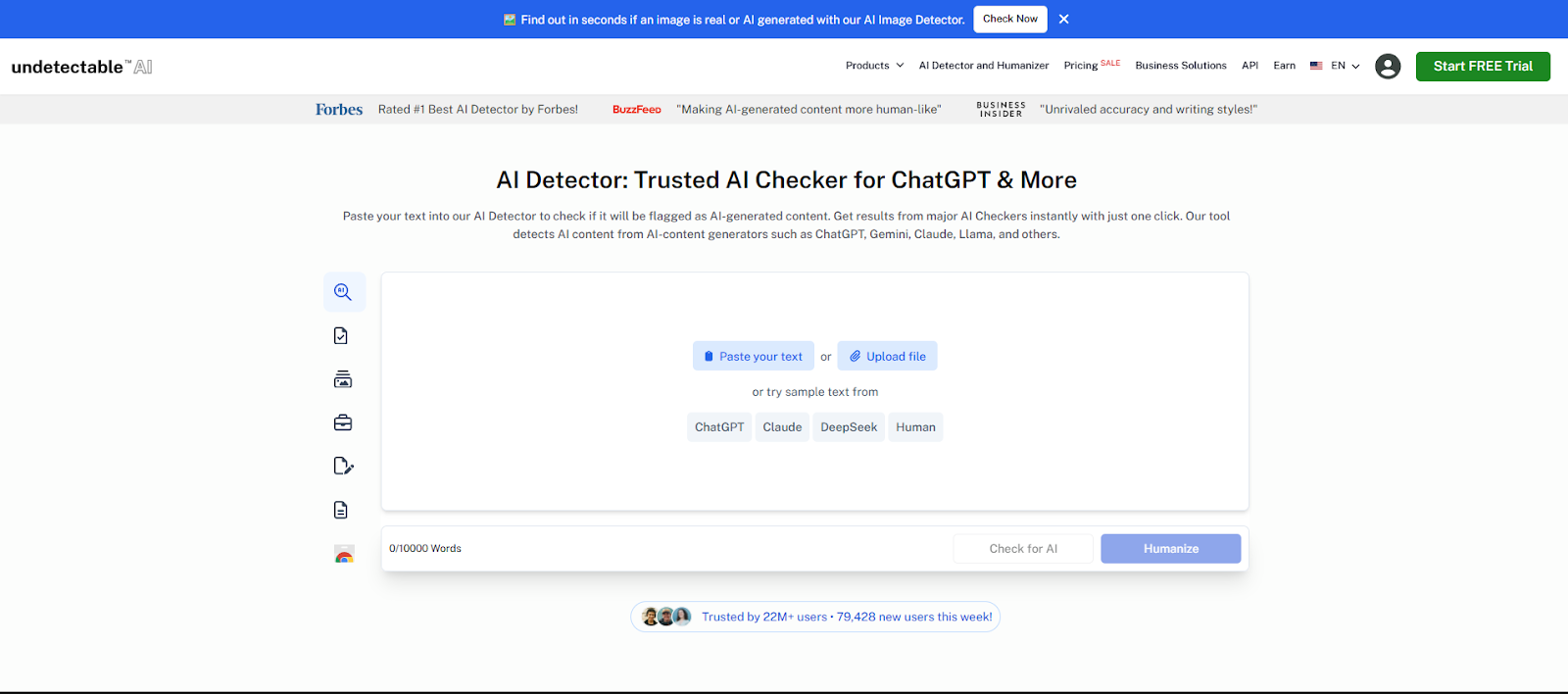
I started using Undetectable AI after running into a specific problem with AI-generated content. Even when ChatGPT or Claude produced solid drafts, the writing sometimes had that unmistakable AI signature. Repetitive phrasing, overly formal transitions, predictable sentence patterns. Readers could tell, and worse, AI detection tools definitely could.
That matters more now than it did a year ago. Some publishers run every submission through AI detectors before considering it. Google has not explicitly penalized AI content, but there is enough uncertainty that I would rather not risk it, especially for client work or guest posts where editorial standards are strict.
Undetectable AI’s advanced AI humanizer solves this by rewriting AI-generated text to sound more human. I do not use it on everything, but when I need content to pass detection tools or simply read more naturally, it is the fastest solution I have found.
What I appreciate most is the built-in AI detection checker. Before publishing anything, I can test the rewritten content against multiple detection models to see how it scores. This removes the guesswork. If something still flags as AI-generated, I can adjust it further before it goes live.
I mainly use Undetectable AI for blog posts, guest articles, and any content where editorial review is involved. It is also helpful when working with freelance writers who use AI tools but need their submissions to sound genuinely human-written.
AI Humanizer
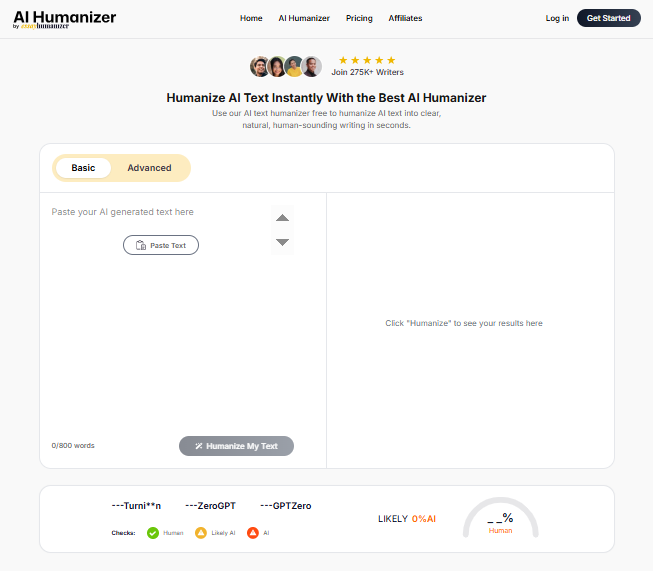
When I felt the need for a faster way of tidying up AI-generated drafts without altering their original meaning, I turned to AI Humanizer.
Most AI tools can churn out content at a fast pace, but the content often comes off as mechanical. The sentence structure becomes linear, transitions become forced, and there is an apparent lack of human sentiment in the tone. That is a problem when publishing content for editorial approval or engagement with real readers.
AI Humanizer fixes this problem by allowing you to humanize AI text naturally and in a readable manner. It rewrites content to add variety in sentence structure, identify the flow and remove certain patterns that indicate the content is produced by AI.
What I find useful is the balance of clarity and tone. The content is easier to read without changing the meaning. Therefore, the text is unlikely to become unnecessarily complicated or convey a different message, which is beneficial when reworking SEO texts.
Its use in the field is easy and trouble-free. The tool is straightforward to use; after pasting a written draft and running it through the system, one gets a finished result, which can then be published or optimized further. It can be used not only for blog posts or guest articles but any piece of writing for which authenticity and readability matter.
For any professionals who regularly deal with drafting materials with the assistance of an AI, this tool makes it much easier to humanize AI text and stick to a common thread throughout written materials so that the language used sounds natural and unforced.
Paraphrasely
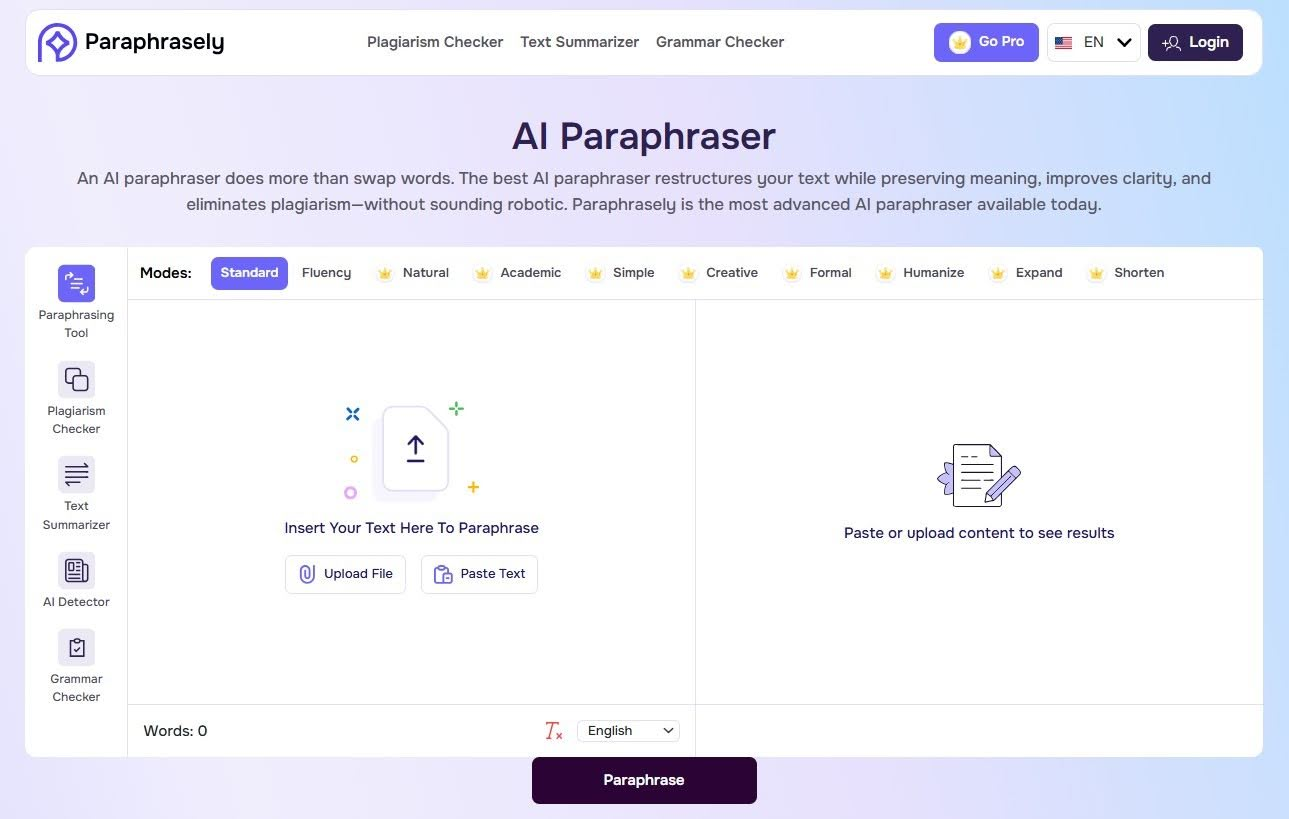
I started using Paraphrasely when I needed a quicker way to improve drafts without rephrasing entire sections manually. Most AI writing tools are good at generating ideas, but the wording often feels repetitive, stiff, or too close to existing phrasing.
That becomes a problem when you are publishing SEO content at scale or trying to make articles sound more natural and polished.
This paraphrasing tool solves the problem by restructuring text while keeping the original meaning intact. Instead of simply swapping words with synonyms, the tool rephrases sentences in a way that improves readability and flow.
The output sounds cleaner and less mechanical, which is useful when refining AI-assisted content or refreshing existing articles.
One thing I find especially useful is the variety of modes. Depending on the content, I can make text sound more natural, simpler, more fluent, or more engaging without having to manually adjust every sentence myself.
This helps a lot when working across different types of content like blog posts, landing pages, outreach emails, or product descriptions.
The tool is also practical for speeding up editing workflows. It cuts down editing time significantly while still keeping the content readable and natural.
GoHumanize
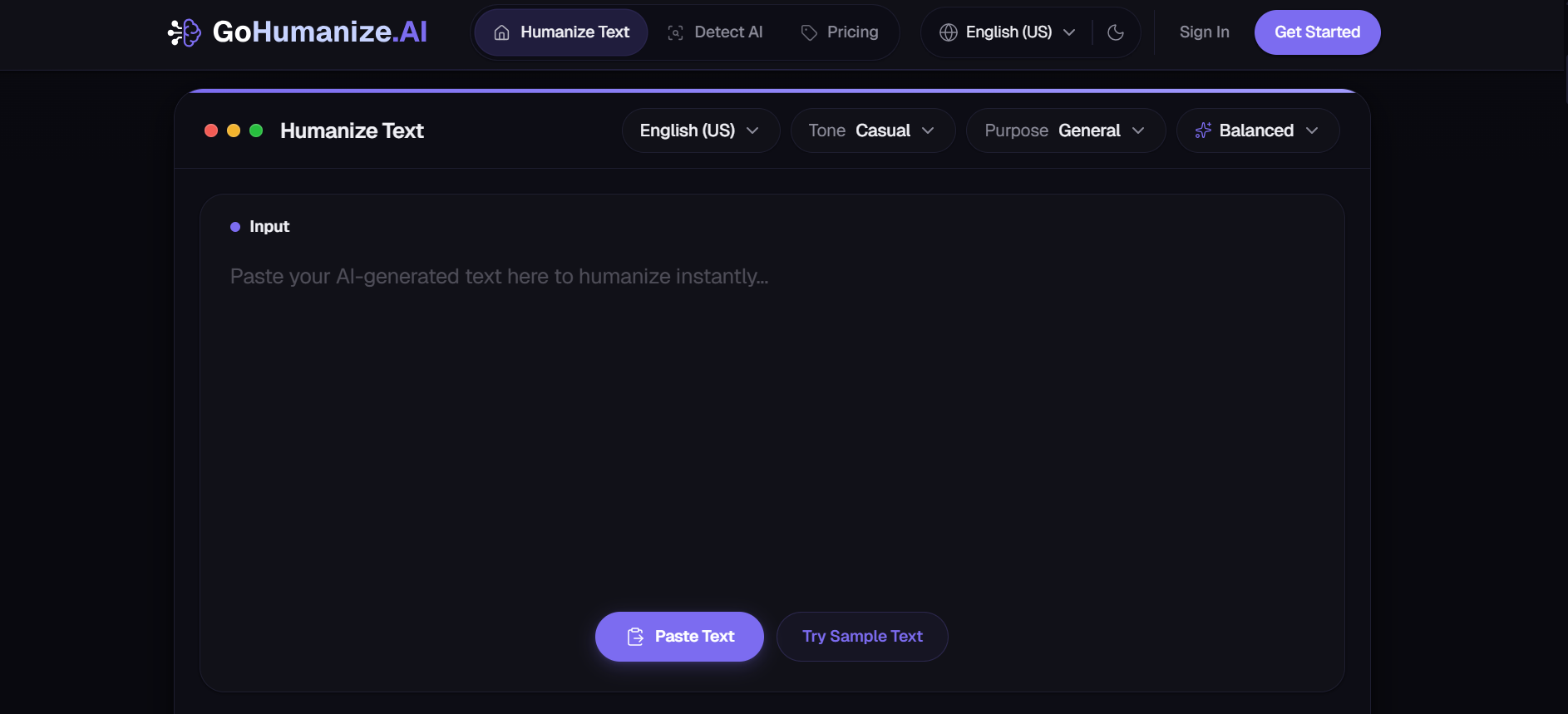
GoHumanize.ai rewrites AI-generated text so it reads like a real person wrote it. It fixes robotic phrasing, awkward transitions, and repetitive sentence patterns that AI tools keep producing.
The tool changes sentence structure, tightens wording, and smooths out the flow. It also adjusts tone based on the type of content. A cold email sounds more conversational. A blog intro feels less stiff. Product descriptions stop sounding copied from ChatGPT.
A lot of AI content gets flagged because the wording feels too predictable. GoHumanize.ai breaks those patterns. It mixes short and long sentences, rewrites generic phrases, and removes the polished “AI voice” most detection tools catch.
Writers use it for outreach emails, SEO articles, LinkedIn posts, landing pages, and affiliate content. Instead of rewriting everything manually, they run drafts through the tool and clean them faster.
The interface is simple. Paste the text, choose the writing style, and generate a rewritten version in seconds. It works well for marketers handling large batches of AI-assisted content and trying to make it publish-ready without spending an hour editing every paragraph.
Clearscope
Clearscope is the AI content optimization tool I turn to when I want to be absolutely sure a piece of content covers a topic thoroughly without turning into keyword soup.
I mainly use Clearscope as a content quality and relevance check. It grades content based on how well it aligns with what already ranks, but in a much more restrained way than some other optimization tools.
Instead of pushing dozens of terms at me, it focuses on the language that actually matters for understanding a topic.
The content grading system is simple but effective. When I am working on an important article, I want to know whether it stands up against the top results, not whether it hits an arbitrary keyword count. Clearscope’s grade gives me a quick signal that the content is competitive in terms of topical coverage.
What I appreciate most is the semantic keyword suggestions. They are clearly tied to search intent and topic depth, not just frequency. This makes it easier to naturally weave concepts into the copy instead of forcing exact-match phrases that make the content harder to read.
MarketMuse
MarketMuse is my absolute favorite content optimization tool, and it is the one I use to optimize every single article I publish.
What sets MarketMuse apart for me is that it goes beyond individual keywords and looks at topic authority as a whole.
Instead of telling me which terms to sprinkle into a page, it helps me understand what a topic actually consists of and how well my content covers it compared to what already ranks.
Before I start writing, I can see which subtopics are essential, which ones are missing from my site entirely, and where a new article fits within the bigger content picture with MarketMuse’s Content Briefs and Topic Modeling.
That makes it much easier to write with intent instead of reacting to the SERPs after the fact.
The content optimization score is another feature I use constantly. It shows how comprehensive an article is compared to competitors, but more importantly, it highlights specific gaps.
When MarketMuse tells me a page is underperforming, it is usually right. Adding depth where it recommends has consistently improved performance over time.
Super Humanizer
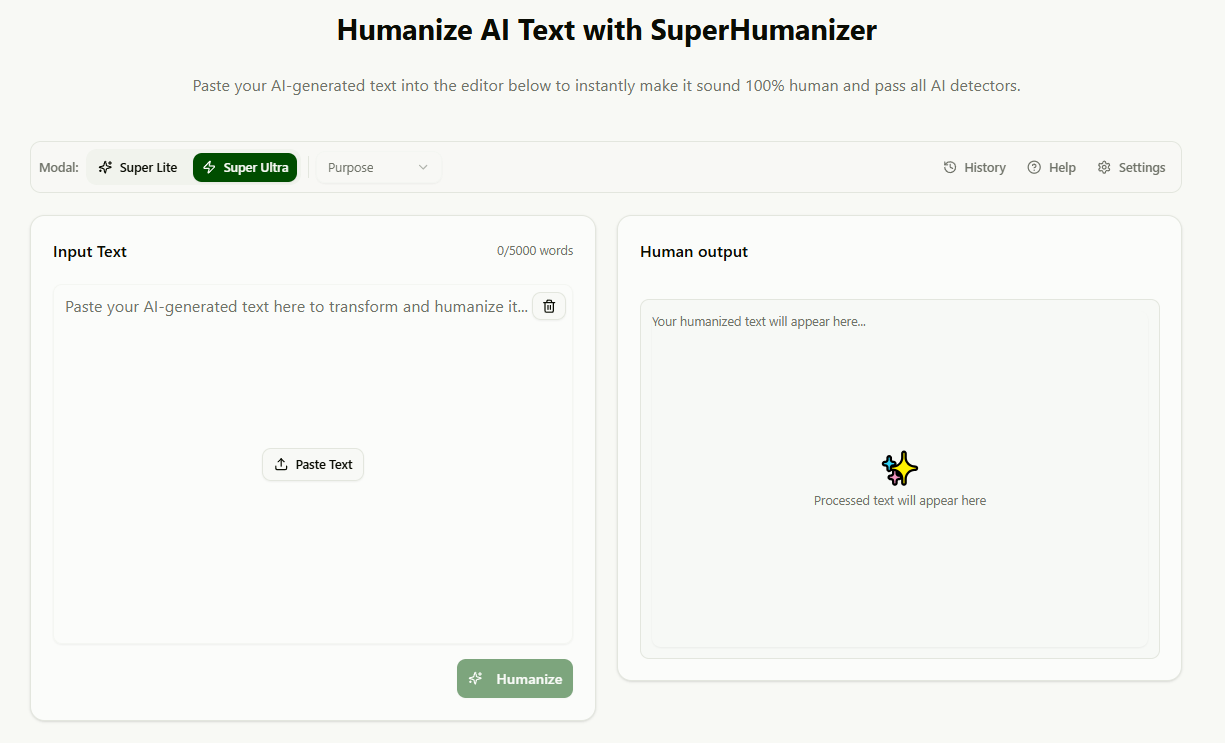
Super Humanizer helps make AI-generated content read more naturally without spending too much time on manual editing.
AI tools like ChatGPT, Jasper, and Claude can write fast, but their drafts often feel robotic. Sentences may repeat, transitions can sound stiff, and AI detectors can flag the text.
Super Humanizer fixes these problems.
It smooths the sentences, improves phrasing, and makes the content easier to read. The tone becomes more natural, while the original meaning stays intact. It also reduces the chances of AI detection tools flagging the content.
The tool is simple to use. Paste your text, run it through the tool, and get a cleaner version ready to publish or review. It works well for blog posts, guest articles, and any content where tone, clarity, and originality matter.
For fast and effective AI text humanization, this AI humanizer fits naturally into most content workflows.
Ahrefs
Ahrefs is the backbone of my SEO decision making.
I use Ahrefs primarily for keyword research, competitor analysis, and backlink analysis. Before I write or optimize anything, I want real data. Search volume, keyword difficulty, traffic potential, and backlink profiles are still the foundation for every content decision I make, and Ahrefs is where I get that information.
The Keywords Explorer is where most of my research starts. I use it to validate ideas generated by AI tools and filter out keywords that look good on paper but have no realistic ranking potential.
Long tail keywords, low difficulty opportunities, and question-based searches are especially easy to surface here.
I also rely heavily on Site Explorer for competitive analysis. Being able to see which pages drive traffic to competing sites, which keywords they rank for, and where their backlinks come from helps me avoid guesswork.
If something already works for multiple competitors, there is usually a reason.
The Content Gap tool is another staple in my workflow. It shows me keywords competitors rank for that we do not, which makes content planning far more strategic. Instead of brainstorming endlessly, I focus on opportunities that are already proven.
From an AI search standpoint, Ahrefs keeps expectations grounded. AI tools can generate ideas endlessly, but without data, those ideas are just guesses. Ahrefs tells me which pages actually have a chance to rank in the top 10, which is still a prerequisite for showing up in AI Overviews and other AI-driven results.
Semrush
Semrush is the SEO tool I open when I want to understand what is happening at a higher level, not just on a single page or keyword.
Instead of starting with individual opportunities, I use Semrush to get context.
How a site is performing overall. Which topics are gaining traction. Where visibility is slipping.
That wider perspective is something I do not get as easily elsewhere.
One feature I use constantly is domain-level organic research. It lets me see which pages drive the majority of traffic for a site and how those pages change over time.
When something suddenly drops or climbs, Semrush usually makes the reason obvious. That insight is incredibly helpful for planning updates and prioritizing fixes.
I also lean on Semrush for SERP feature visibility. Knowing whether a keyword triggers featured snippets, People Also Ask, or AI Overviews influences how I structure content before it is published.
If the SERP favors short answers or lists, I want to reflect that early instead of retrofitting the page later.
For keyword expansion, the Keyword Magic Tool is still one of the easiest ways to turn a single idea into a clean list of related queries. I often use it as a second pass to catch variations and modifiers that did not show up in my initial research.
For teams tracking AI visibility across search engines, Semrush Enterprise AIO offers advanced features that help monitor how content performs in AI-generated answers and AI search results.
ChatGPT
I use ChatGPT almost exclusively at the very beginning of keyword research.
Not to replace SEO tools, but to avoid starting from a blank page. When I am exploring a new topic, ChatGPT helps me map out how people might actually search, long before I look at any metrics.
I rely on it to generate seed topics, long tail keywords, and question-based queries.
Asking it to list how beginners, advanced users, or buyers might phrase a search often surfaces angles I would not have thought of on my own. This is especially useful for uncovering informational queries that traditional keyword tools tend to bury.
ChatGPT is also great for turning vague ideas into structured keyword groups.
I will feed it a broad topic and ask for clusters based on intent, such as educational, comparison, or problem-focused searches. That gives me a cleaner starting point before validating anything with real data.
What I do not do is trust ChatGPT with volumes or difficulty.
Everything it suggests is treated as a draft, not a decision. Once I have a list of ideas, I move them into Ahrefs or Semrush to see which ones actually make sense to pursue.
Claude

I use Claude primarily as a writing assistant, especially when tone and flow matter more than raw ideation.
What stands out about Claude is how natural its writing sounds. When given the right prompts and enough context, it produces a copy that feels far closer to something a human would write than most other AI tools.
The sentence structure is smoother, transitions feel more intentional, and the overall voice is easier to shape.
I often use Claude for rewriting and refining drafts. If an article feels stiff, repetitive, or overly optimized, Claude helps loosen it up without losing clarity. It is particularly good at improving intros, transitions, and explanations that need to sound natural while still being informative.
Prompting matters a lot with Claude.
The better and more specific the instructions, the better the output. When I clearly define tone, audience, and intent, Claude consistently delivers strong results. When prompts are vague, the output is average at best.
Link building cheat sheet
Now Over to You
AI optimization tools can help with research, writing, and on-page improvements, but none of them work in isolation.
I use ChatGPT, Claude, Surfer, Clearscope, and MarketMuse to create better content and make smarter decisions. I use Ahrefs and Semrush to ground everything in real data. But none of that matters if the content never earns authority.
With Google’s AI Overviews and other AI-driven search features, ranking in the top 10 is no longer just a goal. It is a requirement. If your page is not already performing well, AI systems will not surface it, summarize it, or cite it.
That is where link building still plays a critical role. High-quality, editorial backlinks are one of the strongest signals for authority and rankings.
If you want your content to rank higher and actually show up in AI-powered search results without spending months running outreach yourself, our done-for-you link building is the fastest way to get there.
We handle everything from prospecting and personalization to outreach, follow-ups, and link placement. You focus on creating great content. We make sure it earns the authority it deserves.
Frequently Asked Questions (FAQ)
What are AI optimization tools?
AI optimization tools help improve content, SEO performance, and workflows using machine learning and language models.
They can assist with keyword research, content optimization, writing, and analysis, but they still rely on strong fundamentals like authority and relevance. These tools range from AI content optimization platforms to specialized AI search engine tools.
Understanding how AI crawlers evaluate and surface content is becoming essential for anyone serious about search engine optimization and generative engine optimization.
AI SEO optimization is not about gaming the system. It is about creating authoritative content that AI engines and search engines can confidently reference.
Can AI optimization tools replace SEO tools?
No. AI tools are excellent for ideation and optimization, but they do not replace SEO tools that provide real data such as search volume, keyword difficulty, and backlink profiles. Tools like Ahrefs and Semrush are still essential for making informed decisions about which content to create and optimize.
Do AI optimization tools help with Google AI Overviews?
Indirectly, yes. These tools help create clearer, more comprehensive content, which is a requirement for AI Overview visibility. However, pages still need strong rankings and authority to be eligible for AI-generated visibility and AI answers.
Is content optimization enough to rank in AI search results?
No. Well-optimized content is only part of the equation. Without backlinks and domain authority, even the best content struggles to reach the top 10, which is where AI systems typically pull their sources from for AI responses.
What other tools help with AI search optimization?
Tools like SE Ranking, AI trackers, and platforms with AI mode capabilities are making it easier to monitor performance across traditional search and AI-powered search results.
An SEO toolkit that includes AI visibility tracking helps teams understand how their content performs when AI-generated answers appear in search results.
For those looking to track AI search performance specifically, tools like AI Search Grader provide insights into how content performs in AI response contexts. Combining these insights with data from Google Analytics and traditional SEO tools creates a complete picture of content performance across all search engines.
Some teams also use specialized platforms like Scrunch AI, Search Atlas, or Jasper AI for specific content workflows.
Technical SEO considerations remain important, as do tools focused on artificial intelligence optimization and generative AI applications.
An AI visibility toolkit or AI content helper can complement traditional optimization tools, but the fundamentals of content quality, relevance, and authority still matter most.
Whether you are using a GEO tool or a more comprehensive approach to engine optimization, the goal remains the same: create content that deserves to rank and earn the backlinks that signal authority.
Why is link building still important for AI search?
AI search does not bypass traditional ranking signals. It relies on them. Backlinks remain one of the strongest indicators of authority, and authority is what allows content to rank and be surfaced in AI-powered results and AI answers across different AI search engines.
If you want your content to rank higher and actually show up in AI-powered search results without spending months running outreach yourself, our done-for-you link building is the fastest way to get there.
We handle everything from prospecting and personalization to outreach, follow-ups, and link placement. You focus on creating great content. We make sure it earns the authority it deserves.