
Quick answer: high DA links still matter for ranking in Google’s top 10. But they won’t do what most teams actually want in 2026, which is showing up inside AI Overviews, ChatGPT answers, and Perplexity citations.
If your link building strategy is still organized around “highest authority placement wins,” you’re optimizing for a game with fewer and fewer players. Each ranking spot drives less click traffic every quarter as users get their answers from AI engines instead of clicking through.
This article breaks down what those link building placements actually do in 2026, where they fall short, and what’s replaced them as the highest-leverage placement type.
Key Takeaways:
- High DA still matters for traditional SEO, but it’s no longer the goal that drives the most traffic. AI Overviews and answer engines have changed the math.
- Link building remains valuable. The shift is in WHICH placements deserve your attention. Editorial mentions on listicles and roundups now drive more impact than links to obscure posts on high DA sites.
- Search rankings used to be the whole point. Today, a top-3 ranking position drives less click traffic than a single listicle mention that AI engines cite repeatedly.
- The ranking factor that’s grown most in importance: structured brand mentions inside content that AI engines parse. PageRank still matters; so does showing up in the right kind of content.
- If you’re rebuilding your backlink profile from scratch in 2026, your link building should prioritize editorial listicle placements with active traffic over generic high da websites that nobody actually reads.
Link building cheat sheet
What Are High DA Links?
DA stands for Domain Authority. It’s a metric developed by Moz that predicts how well a website will rank in search engine results based on the quality and quantity of its inbound links.
A higher da score equals stronger potential to rank. Ahrefs has its own equivalent metric called Domain Rating (DR), and most seo tool dashboards show one or both.
The DA concept goes back to Google’s original PageRank logic: pages get authority partly from the pages that link to them. Links from a high-DA site pass more link equity than links from a low-DA site. That much hasn’t changed.
The math behind the algorithm still rewards inbound links from reputable websites, and a balanced backlink profile remains a foundational signal.
What HAS changed is how much that authority signal actually matters in the real world.
Two reasons:
- Mass content production. AI tools have made it trivial to publish thousands of articles per month. Most niches now have 10x the volume of content fighting for the same top-10 search results. Even pages with strong page authority struggle to break through.
- Click traffic has cratered above the fold. Users who used to click results 1-3 now read the answer in Google’s AI Overview block. The first-page position you used to chase delivers a fraction of the clicks it did three years ago. Each ranking spot is worth less in absolute terms, even when the search results page still shows your link prominently.
So traditional DA-driven link building still works for search positioning. It just doesn’t deliver the same return on effort.
What you need on top: structured brand mentions inside content that AI engines actually parse and cite. We’ll get to how that works next.
How Do You Get Into Google AI Overviews?
AI engines work fundamentally differently from traditional search algorithms. Where Google’s classic algorithm asks “which page best matches this query?”, AI engines ask “what does the web collectively say about this topic, and which brands keep coming up?”
The mechanism is consensus.
AI engines parse content from authoritative sites across the web (review platforms, industry directories, news outlets, and most importantly, editorial blogs in your niche).
The brands that appear consistently across these reputable sources are the ones the AI cites in its answer.
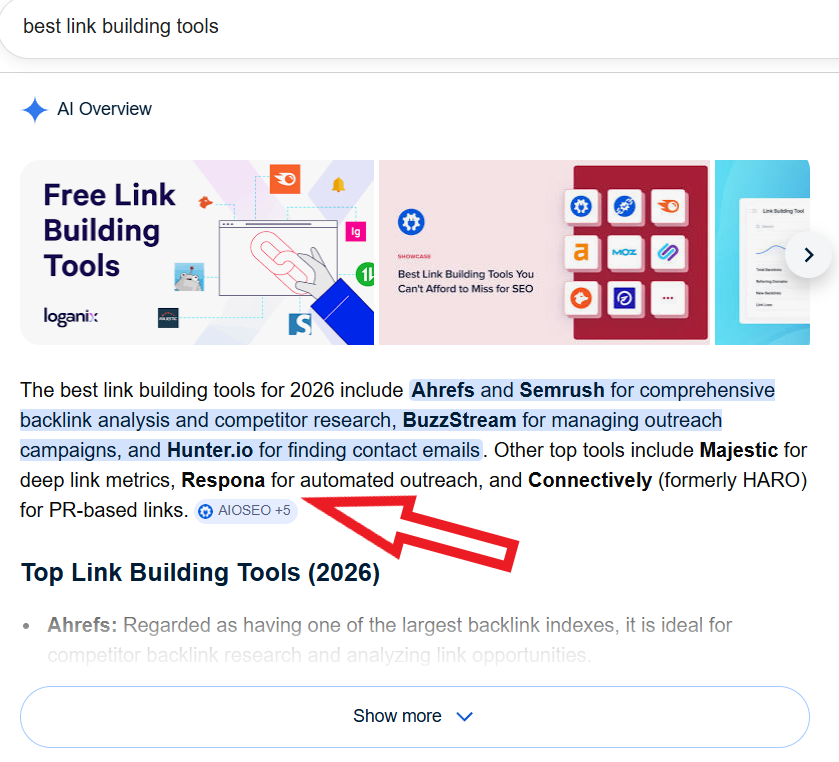
This is why a single backlink, however high in authority, often does nothing for AI visibility.
The traditional link building math doesn’t apply the same way. AI Overviews aren’t checking your backlink profile metrics one by one. They’re checking whether reputable websites across the web mention you when discussing your category.
Brand credibility matters too.
AI engines preferentially cite sources that themselves carry credibility signals: consistent publishing, expert author bios, structured data, link patterns suggesting editorial standards.
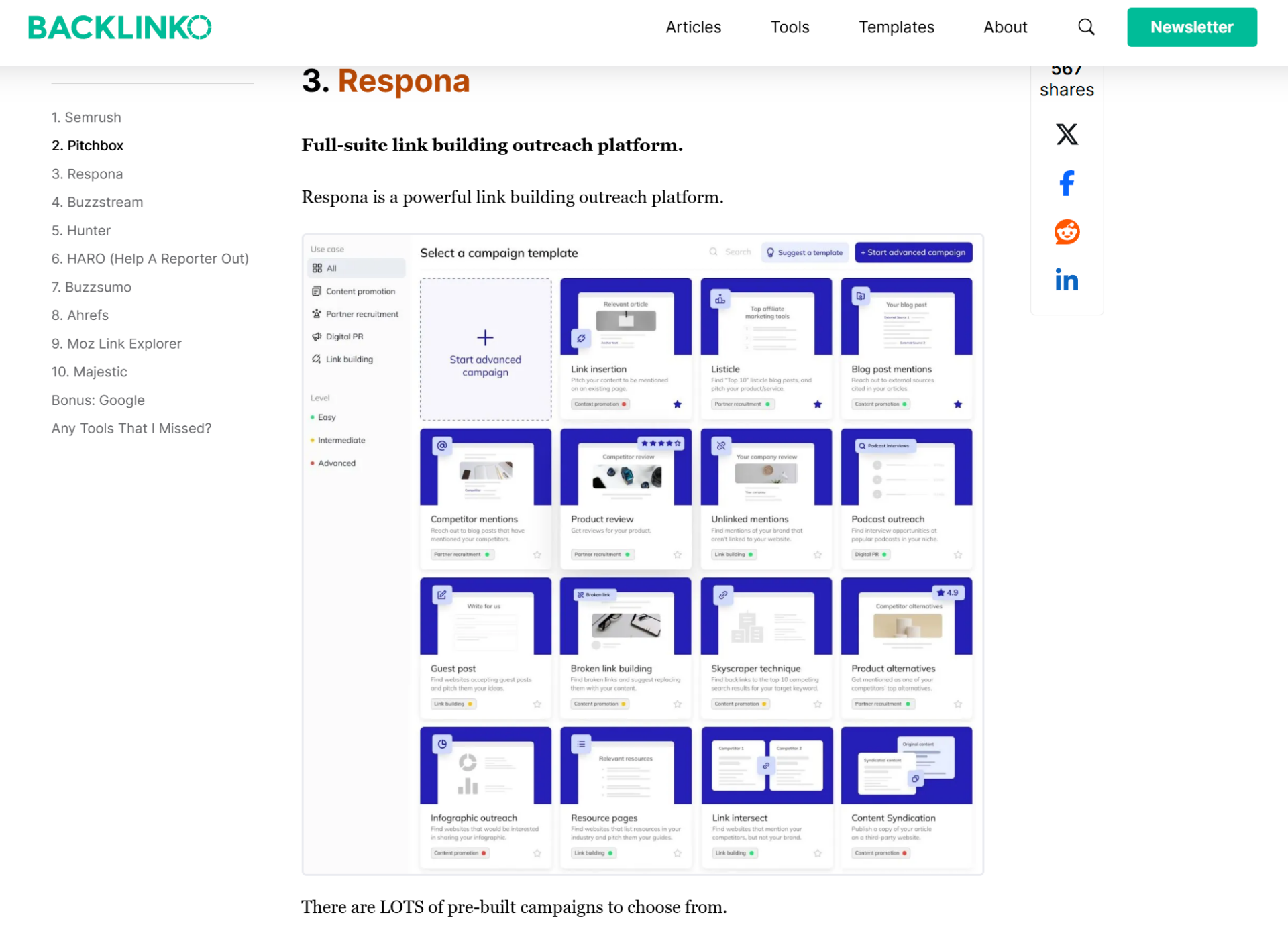
Pages like this listicle on Backlinko are a perfect example:
What moves the needle:
- Listicle mentions on industry publications. “Best [your category] tools,” “Top X for [your use case],” “10 alternatives to [competitor].” These are the highest-leverage placements because they’re structured, easy for AI engines to parse, and they tend to rank for the exact category queries AI is summarizing.
- Review platform listings. G2, Capterra, TrustRadius, and category-specific equivalents. Even without backlinks, your presence on these platforms factors into AI consensus.
- Editorial mentions in trusted content. A mention in TechCrunch, Hacker News, or a respected niche publication carries more weight than ten low-authority links.
How Do You Get These Listicle Mentions?
In broad strokes, the manual workflow looks like this:
- Find prospects. Search for listicles in your category, then filter for the ones where:
- The website already ranks in Google for your category queries
- The website already gets cited by AI engines (test by asking ChatGPT/Perplexity directly)
- The website has active traffic (real readers, not just SEO ghost towns)
- Find contact info. Free email finders handle low volume; paid tools like Hunter or Snov.io scale up. You’re looking for the right person at each website.
- Reach out with real value. Offer something specific in return: a reciprocal link from your website, an expert quote, a guest post on a topic they haven’t covered, or exclusive data. The backlink quality you offer should match the link quality you’re asking for.
- Personalize the pitch. Reference the specific article, related posts they’ve published, and clear anchor text suggestions. Generic templates get ignored.
The trade-off with running this manually: it’s a full-time job. Between prospecting websites, finding emails for each website you target, writing pitches, and managing the follow-up cycle, a serious campaign easily eats 20-30 hours of focused work per week. That’s before you’ve earned a single placement.
That’s why most teams outsource it. Here’s how Respona handles the entire pipeline as a done-for-you service.
Step 1: Register
Create a Respona account. No onboarding calls, no kickoff meetings, no sales rep dance.
Step 2: Place an order with your targets
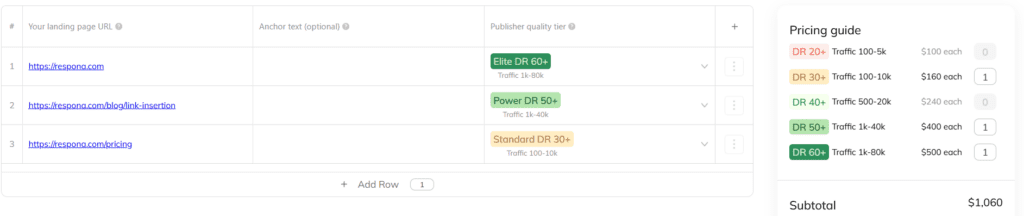
Submit your target URLs along with the anchor text variations you want for each. Optionally, add a list of AI prompts you want your brand to show up for (e.g. “best CRM for startups,” “top SaaS tools for marketing teams”).
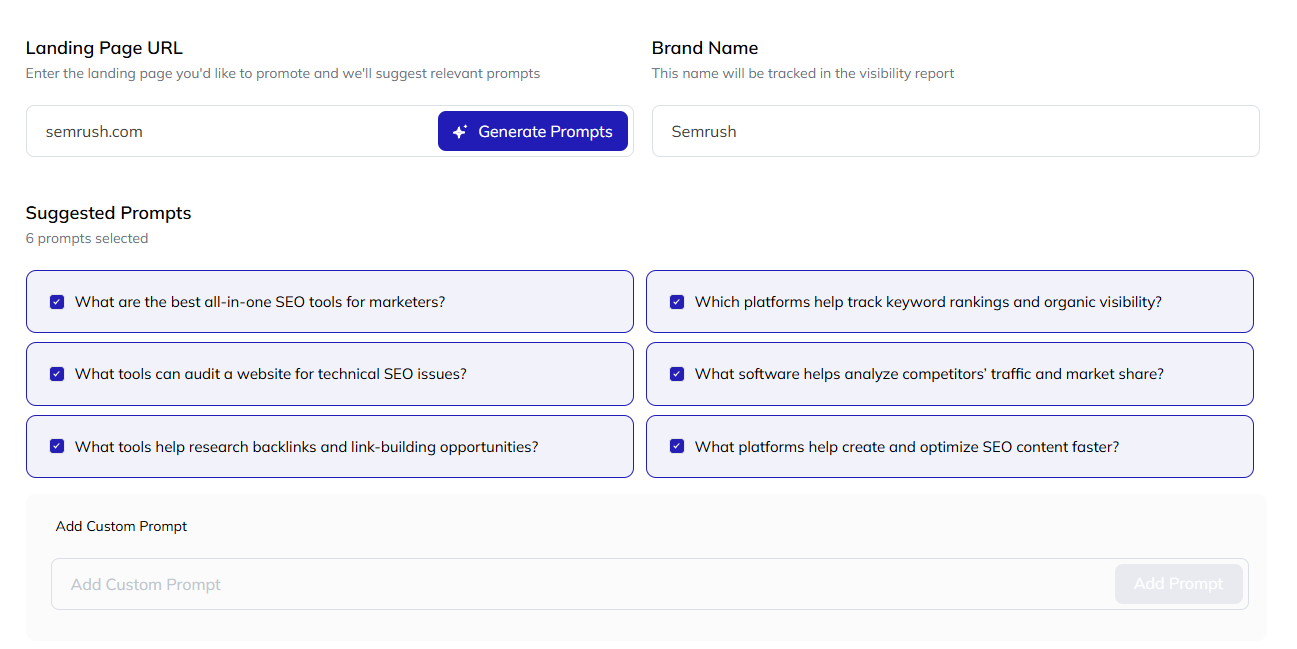
Step 3: The tool generates your action plan
The platform automatically generates a link building action plan: a ranked list of listicles, roundups, and “best of” articles that already rank in Google AND get cited by AI engines for your prompts. Every prospect is filtered for domain rating, topical relevance, and active traffic on the linking page.
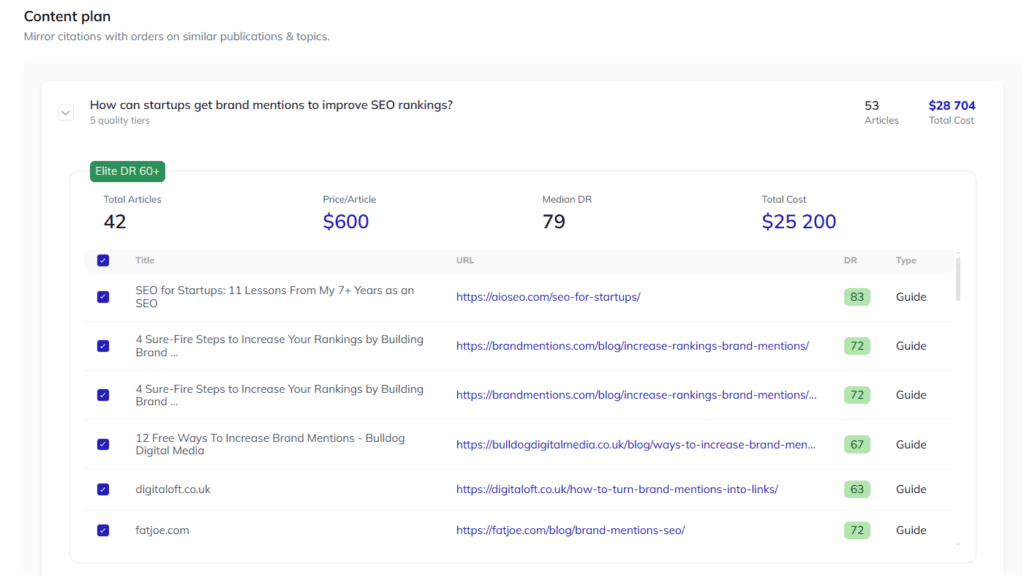
This is where Respona’s prospecting differs from doing it by hand. Instead of casting a wide net and filtering through hundreds of websites manually, you get a list pre-vetted for the placements that compound across both traditional search and AI visibility.
Step 4: Place orders on the placements you want
Browse the recommended articles, pick the ones worth pursuing, and place orders. Pricing is per-placement, tiered by the publisher’s DA tier:
- Starter (DR 20+): $100 per link
- Standard (DR 30+): $160 per link
- Authority (DR 40+): $240 per link
- Power (DR 50+): $400 per link
- Elite (DR 60+): $500 per link
No monthly retainer, no setup fees, no charge for any link that doesn’t meet your defined specs.
Step 5: Our team handles the outreach
Once an order is placed, our team takes over end-to-end. Personalized pitches, follow-ups, negotiation with editors, and back-and-forth until each link goes live and meets your guidelines. Every confirmed placement shows up as a separate line item on your invoice.
Step 6: Track results in the AI visibility tracker
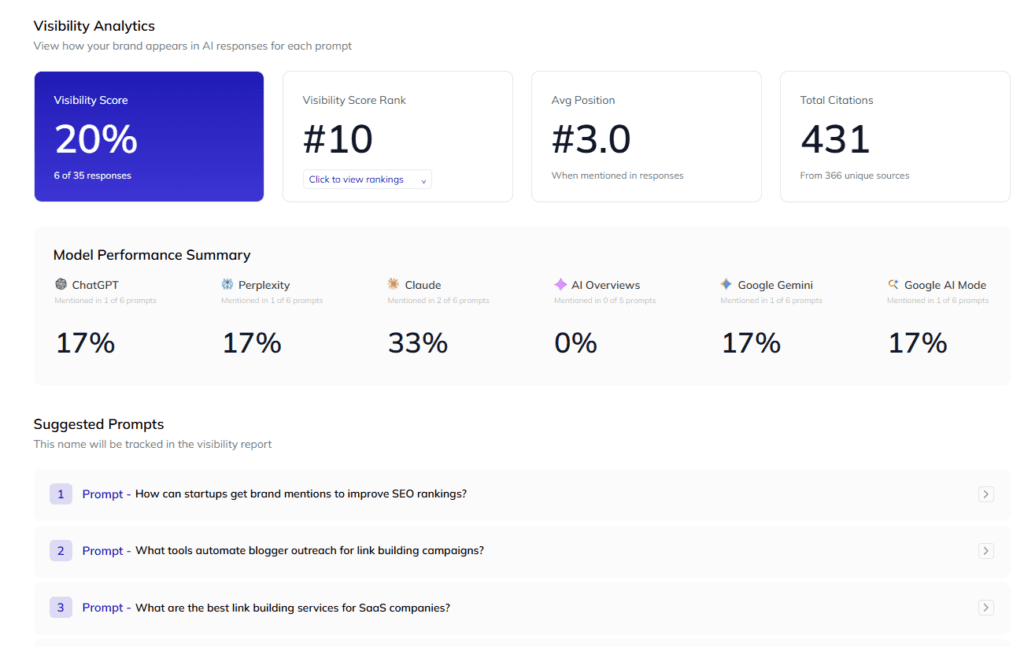
The built-in tracker monitors your brand mentions across the six major answer engines (ChatGPT, Perplexity, Google AI Overviews, Gemini, Claude, Copilot). Over time, you can see exactly how your placements influence AI citation rates and where coverage gaps remain.
Optional: Pre-approval add-on (+20%)
If you want manual sign-off on every prospect before any outreach goes out, enable the pre-approval add-on for an additional 20% on top of placement pricing. It puts every email on hold until you green-light the target.
This is the approach most teams default to once they realize that “find listicles → pitch them” is conceptually simple but operationally expensive. The seo strategy gain is consistent placements on publications AI engines actually cite, without the overhead of running a full outreach team.
Link building cheat sheet
Now Over to You
The TL;DR: high DA placements aren’t dead, but they’re not enough on their own anymore.
The teams winning AI visibility in 2026 are the ones earning structured listicle mentions on content that already ranks AND already gets cited by answer engines.
If running that pipeline in-house isn’t realistic, our done-for-you link building service handles it end-to-end. You submit your targets, our team finds prospects on every relevant website, runs outreach, and only delivers placements that meet your defined specs.
You pay per link delivered, with no monthly retainer or setup fees.
Place your first order today to get started.
Frequently Asked Questions
Are high DA placements still worth pursuing in 2026?
Yes, but with a caveat. They still help with traditional ranking. They just don’t move the needle alone for AI visibility.
If you’re choosing between a DR 80 link on an article nobody reads versus a DR 50 link on a listicle that actually gets cited by ChatGPT, take the DR 50 placement.
What’s the difference between DA and DR scores?
DA (Domain Authority) is Moz’s metric. DR (Domain Rating) is Ahrefs’s equivalent. Both predict how well a domain will perform based on its link profile, but they use different data sources and weightings, so the numbers won’t match across tools.
Any seo expert will tell you to check both, but don’t optimize for either one specifically. They’re directional indicators, not the exact ranking factors Google uses.
How do I check backlink quality if DA isn’t enough?
A few signals beyond DA: traffic to the linking page (use Ahrefs/Semrush), topical relevance to your content, the link’s position in the article (in-content links carry more weight than footer links), and whether the linking page itself gets cited elsewhere.
Seo professionals look at these signals together rather than treating any one as decisive.
Where does digital pr fit in this approach?
PR work and link building have always overlapped. The digital marketing playbook in 2026 leans more on PR-style storytelling because data-driven story angles get earned mentions, which AI engines treat as stronger consensus signals than transactional links.
A solid digital pr program is one of the cleanest paths to the kind of brand mentions AI Overviews include.
Do high authority links help with local SEO?
Yes, but local seo benefits more from geographically relevant signals (local citations, region-specific publications, locally-engaged audiences) than from raw DA.
A DR 80 link from a global publisher matters less for local rankings than a DR 30 link from a respected regional outlet.
Is a single da backlink worth more than a regular link?
Mathematically, yes. A da backlink from a high-authority source passes more PageRank than one from a lower-authority site. But in 2026, the question isn’t “how much PageRank does this link pass” but “does this link sit on content that AI engines actually cite.”
Are any inbound link metrics worth tracking?
Yes. A modern link building approach tracks more than just DA. Look at: referring domain growth rate, anchor text distribution (to avoid over-optimization), and the ratio of contextual links to footer/sidebar links.
None of these are perfect ranking factors on their own, but together they tell you whether your backlink profile is growing in a way that supports sustainable search rankings. For a related read on tactical implementation, see our broader link building guides.