

Traffic value is one of those SEO metrics people either obsess over or completely ignore.
And honestly, I get why. If you’re not running Google Ads, it can feel kind of pointless. Like, cool, this page is “worth” $12,000 a month… but I’m not paying for that traffic, so who cares?
The thing is, traffic value isn’t trying to tell you what your content literally earns. It’s basically a shortcut for understanding commercial intent and keyword competitiveness at scale.
It’s not a metric I use every day. The use cases are pretty niche.
But when you know what it’s actually measuring, it becomes surprisingly useful for things like prioritizing pages, comparing competitors, and spotting the topics that are most likely to turn into revenue later.
In this article, I’ll break down what traffic value means in SEO, what it does and doesn’t tell you, and how I actually use it in practice.

Link building cheat sheet
What is Traffic Value in SEO?
Traffic value is an SEO metric that estimates how much it would cost to buy the same traffic through paid ads.
So if a page gets organic traffic from keywords that advertisers pay a lot for, its traffic value will look high. If it gets traffic from low-CPC keywords, the traffic value will look low, even if the page gets a ton of visits.
This is where people get confused.
Organic traffic is the number of visits you actually get.
Traffic value is a dollar estimate based on what that traffic might cost in ads.
They’re related, but they’re not the same thing.
A page can have low traffic but high traffic value (because the keywords are expensive). Or it can have high traffic but low traffic value (because the keywords are informational and cheap).
You can verify your website traffic data using Google Analytics or Google Search Console to see how your organic search performance compares to the estimated traffic value shown in your SEO tool.
How is Traffic Value Calculated?
The simplified version is:
Traffic value = estimated organic traffic × CPC
SEO tools look at the keywords your page ranks for, estimate how many clicks those rankings bring in, and then multiply those clicks by the cost-per-click advertisers pay for those same keywords.
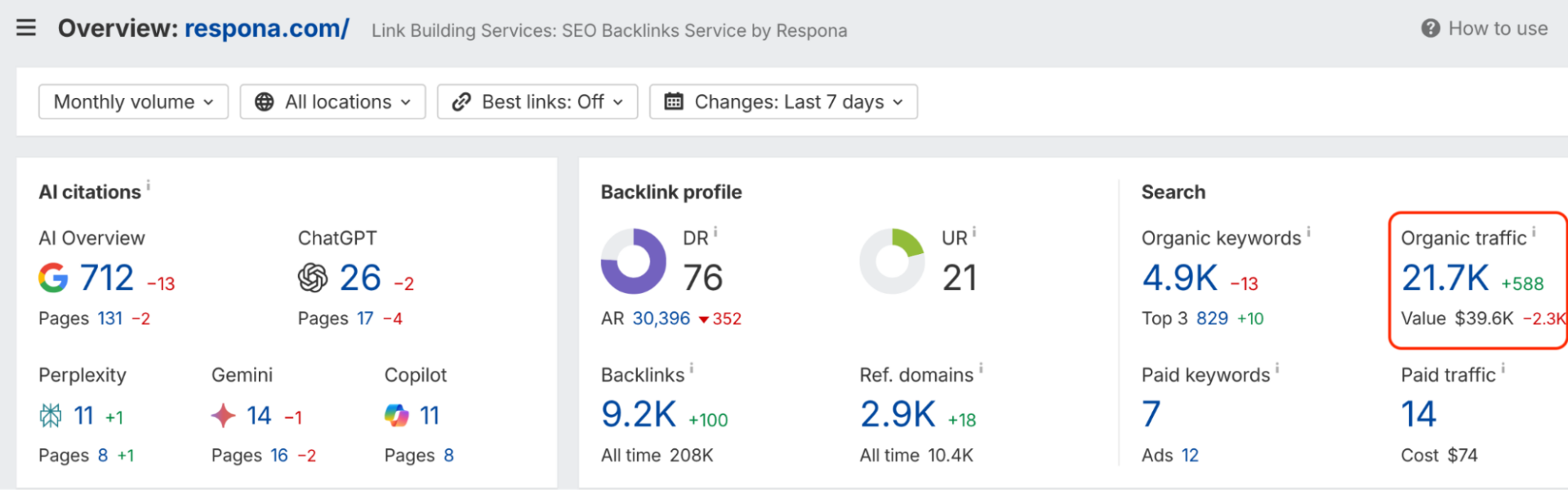
That’s why traffic value is basically a “paid search lens” applied to organic rankings.
It’s not a revenue number. It’s not profit. It’s not even what you’d actually pay in ads, because real PPC depends on quality score, conversion rate, landing page quality, and a bunch of other variables.
It’s just a proxy for commercial intent and keyword competitiveness.
What Increases Traffic Value?
Traffic value usually goes up when one of these things happens:
- You rank higher for valuable keywords.
- You start ranking for more keywords per page.
- You target keywords with stronger buying intent.
- You enter more competitive SERPs.
Just don’t confuse this with “better performance.”
A higher traffic value doesn’t automatically mean the page converts, or that it’s bringing in revenue.
It only means the keywords behind that traffic are expensive in ads.
Understanding traffic trends and how your traffic metrics shift over time helps you identify which content is gaining or losing commercial value in search results.
Does Traffic Value Translate into Revenue?
Not directly.
Traffic value doesn’t tell you how much money a page makes. It’s telling you what that traffic might cost if you bought it through ads.
Sometimes high traffic value pages do convert well, especially if they rank for “money” keywords like comparisons, alternatives, pricing, or best-of terms.
But it’s not guaranteed.
A page can have great traffic value and still bring in zero revenue if the intent is wrong or the offer doesn’t match.
So I treat traffic value as a signal, not a business metric. If it’s high, it usually means the keyword space is commercially valuable. The revenue part still depends on the page, the funnel, and what you’re selling.
What’s the Real Application of Traffic Value?
This is the part where traffic value becomes useful.
I don’t treat it like a KPI. I treat it like a shortcut for finding where the money keywords are, and where it’s worth spending time.
It’s a directional metric. Not perfect, but helpful.
Competitor research
Traffic value is great for competitor research because it shows you what kind of keywords a competitor is actually winning.
Two sites can have similar organic traffic, but one might have way higher traffic value. That usually means they rank for more commercial terms, not just high-volume informational stuff.
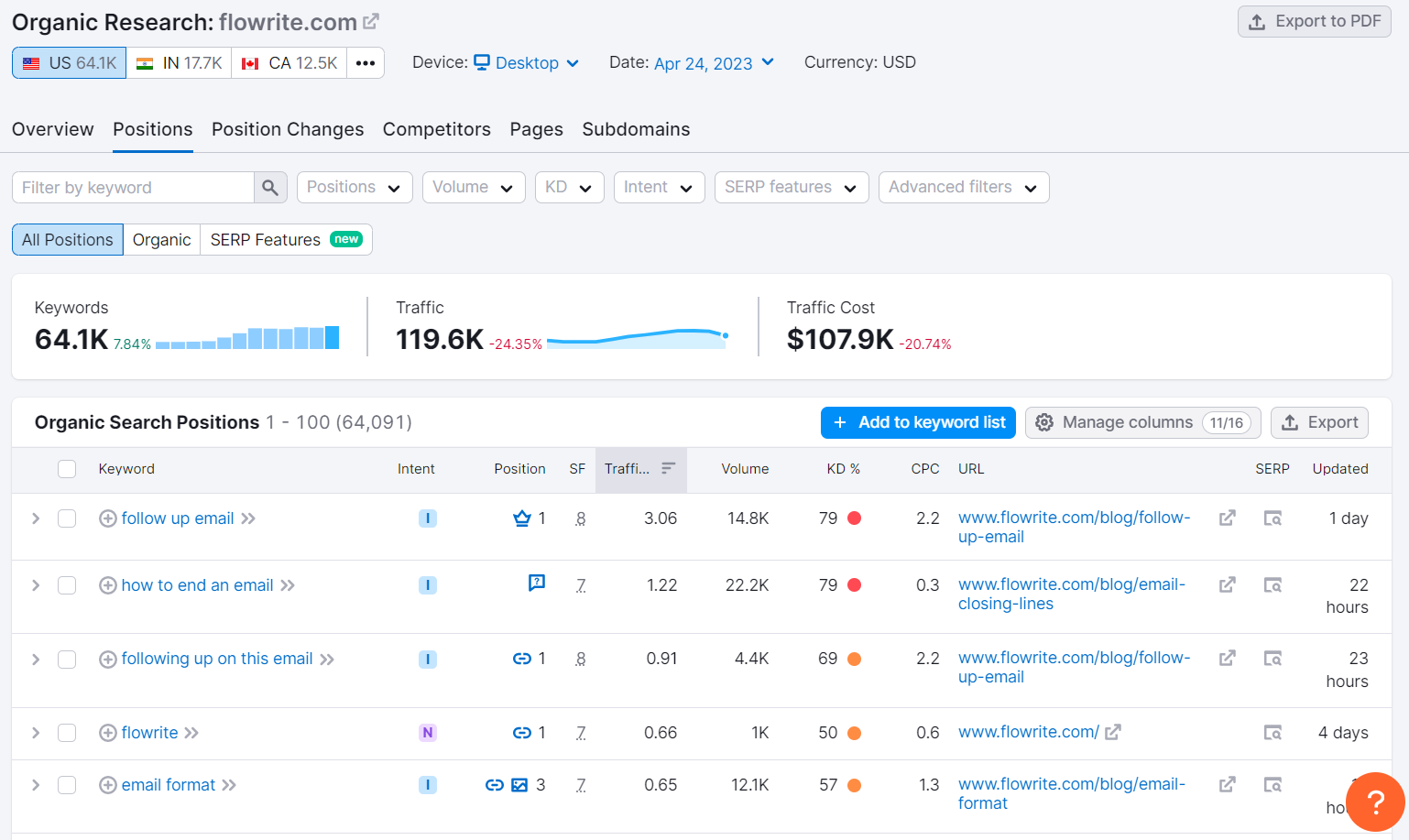
So if I’m scanning competitors, I’m looking for pages with unusually high traffic value and asking: what are they ranking for that I’m not?
Most of the time, it’s things like “best tools,” “alternatives,” “pricing,” “vs,” or “software for X.” Those are the pages I want to reverse engineer.
Content prioritization
Traffic value helps me prioritize content when I have too many ideas and not enough time.
If a page or keyword cluster has strong traffic value potential, it usually means there’s real buying intent behind it. That doesn’t guarantee conversions, but it’s a good sign the topic matters commercially.
It’s also useful for spotting quick wins.
If I already rank in the top 10 for a high traffic value keyword, I know that moving up a few positions could have a big payoff. That’s often a better use of time than writing something brand new.
When evaluating which content to improve, look at both search volume and the specific keyword intent behind your visitors. Tools like Keywords Explorer provide insight into whether your current rankings justify the optimization effort.
Link building prioritization
This is where I use traffic value the most.
When I’m deciding what pages deserve links first, I don’t start with “what’s my newest post?” I start with “what page will benefit the most if it moves up?”
Pages targeting high-CPC, high-intent keywords tend to have the most leverage. If you build links to those pages and push them from position 7 to position 3, you’re not just getting more traffic.
You’re getting traffic that’s closer to buying.
Link building cheat sheet
Now Over to You
Traffic value isn’t a perfect metric, and it’s definitely not revenue.
But it’s useful when you treat it for what it is: a quick way to spot which keywords and pages sit in high-intent, high-competition territory. The kind of pages that are worth pushing harder.
And if you want to push them, you already know what the lever is.
Links.
If you’ve got pages with real traffic value potential, our done-for-you link building helps you turn that potential into rankings by securing high-quality backlinks and listicle placements on relevant sites.
You focus on creating and improving content.
We handle getting it mentioned and linked where it counts.
If you want faster growth without guessing what to promote next, this is the move.
Frequently Asked Questions (FAQ)
What is traffic value in SEO?
Traffic value is an estimate of how much it would cost to buy the same traffic through Google Ads. It’s based on the keywords a page ranks for and their CPC, not on what the page actually earns.
Is traffic value the same as organic traffic?
No. Organic traffic is the number of visits you get, while traffic value is a dollar estimate tied to ad costs. A page can have low traffic but high value, or high traffic but low value.
Does high traffic value mean a page makes money?
Not necessarily. It usually means the page ranks for commercially valuable keywords, but revenue depends on intent match, your offer, and conversion rate. Think of it as a signal, not proof.
Why is traffic value useful if I don’t run ads?
Because it helps you identify “money keywords” and prioritize what to push. Even without PPC, it’s a quick way to see which pages have higher commercial potential compared to what you’d spend on paid ads to get the same visitors.
How can I increase my traffic value?
Rank higher for high-intent keywords and expand keyword coverage on pages that already perform well. In competitive spaces, building links to those pages is often what helps them move up and capture more valuable clicks.
Track your monthly organic traffic and traffic trends to measure progress over time.