
I noticed something strange in my Search Console.
Some pages were getting more visibility… while getting fewer clicks.
No ranking drops. No penalties. Just Google answering the question before anyone ever reached the page.
That’s when it clicked: this wasn’t an SEO problem. It was an AI search problem. It was emerging from generative AI and how AI platforms repackage content.
And once I started optimizing for AI overviews instead of fighting them, things changed fast.
In fact, I got ChatGPT to quote Respona as the #1 email outreach tool. Here’s how.

Link building cheat sheet
What is AI Search Engine Optimization?
Search engine optimization for AI-driven search isn’t a replacement for what you already know.
At its core, it works the same way. You still need high-quality content. You still need backlinks.
And you still need to be visible in the top 10 search results for your content to be considered by AI algorithms.
The key difference is where the visibility comes from.
You no longer need to rank in the top three to get exposure. AI overview features and answer engines pull information from multiple high-ranking pages.
In many cases, they do not even need your own page to rank. If your brand is mentioned on a page that ranks in the top 10, such as a tools list or comparison article, generative engines can still quote you.
That is why link building and brand mentions are still so important. Authority is still the deciding factor, it is just being reused in different ways through these AI engines.
The second part of AI search engine optimization is making your content AI friendly through smart content strategy.
Answer engines need to clearly understand what question each section of your content answers. This means using clear headings, placing concise answers immediately after them, and structuring lists, tables, and comparisons so they can be extracted without confusion.
If an AI tool can reuse a section of your page without rewriting it, you’re likely to get quoted in AI responses.
Finally, this SEO strategy is also about how you use AI powered tools.
ChatGPT and other answer engines can act as writing assistants, help speed up technical tasks, improve content structure, and refine clarity and intent. Used correctly, they make the entire process faster and more precise while helping you monitor search trends.
This approach is not a radical shift. It is the same fundamentals applied in a way that makes both Google AI and generative AI confident enough to quote your content.
Optimize Your Content for AI Overviews
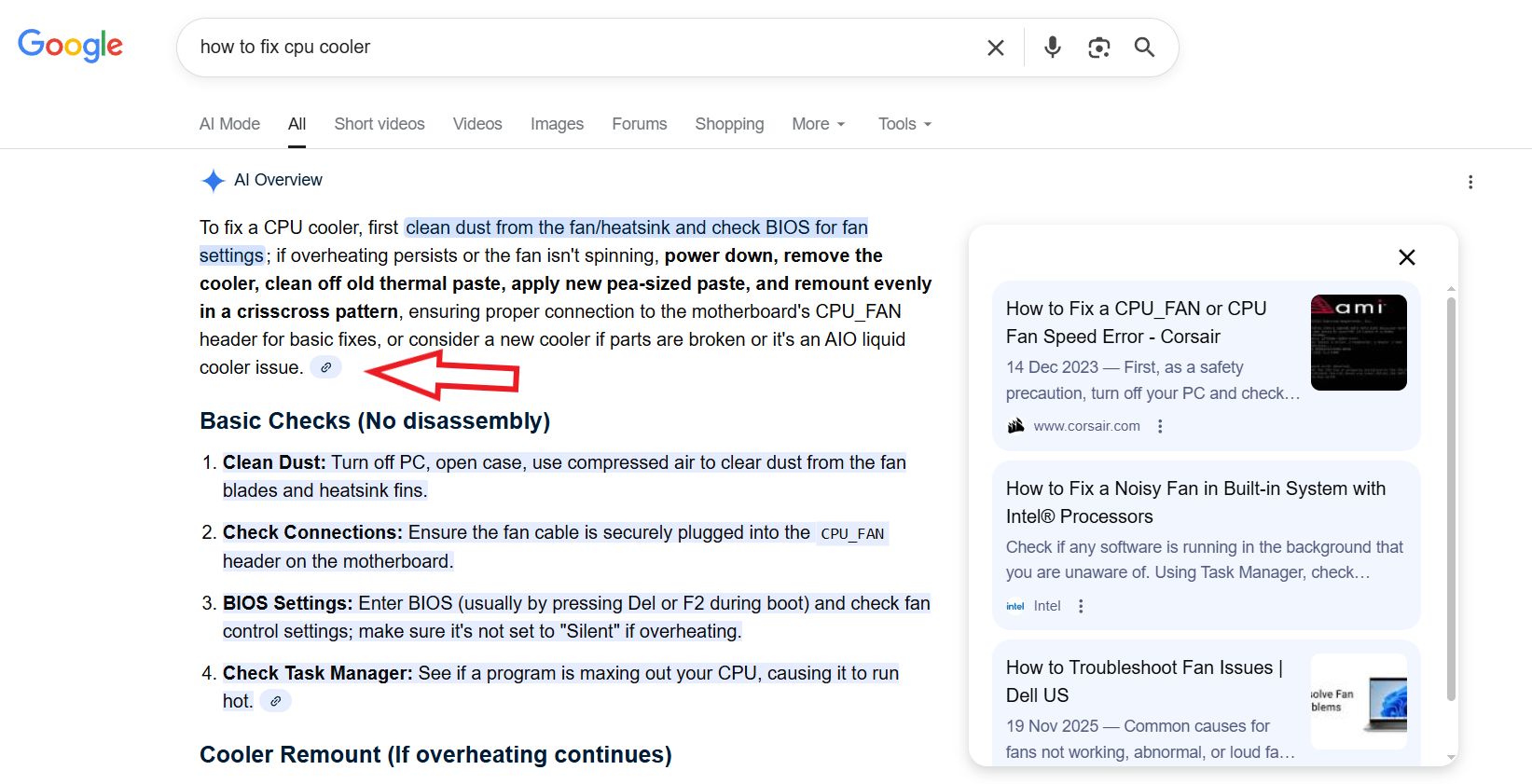
Google AI overview features and answer engines do not invent new formats. They reuse content that already exists and repackage it into answers.
Instead of pulling a single featured snippet, Google now looks at multiple high-ranking pages and builds a combined response. ChatGPT and similar tools follow the same principle. They look for the clearest pieces of content they can confidently reuse.
That is why optimization for AI answers starts with how your content is laid out.
Every section should be built around a single question. The heading signals what the query is, and the text immediately below should resolve it. Short, direct answers work best here. I’m talking 40-60 words max.
If a reader can understand the point without reading anything else on the page, the AI can too.
Different search queries favor different structures.
For explanations and definitions, short paragraphs are the safest bet. For processes, steps, or options, clean lists tend to perform better.
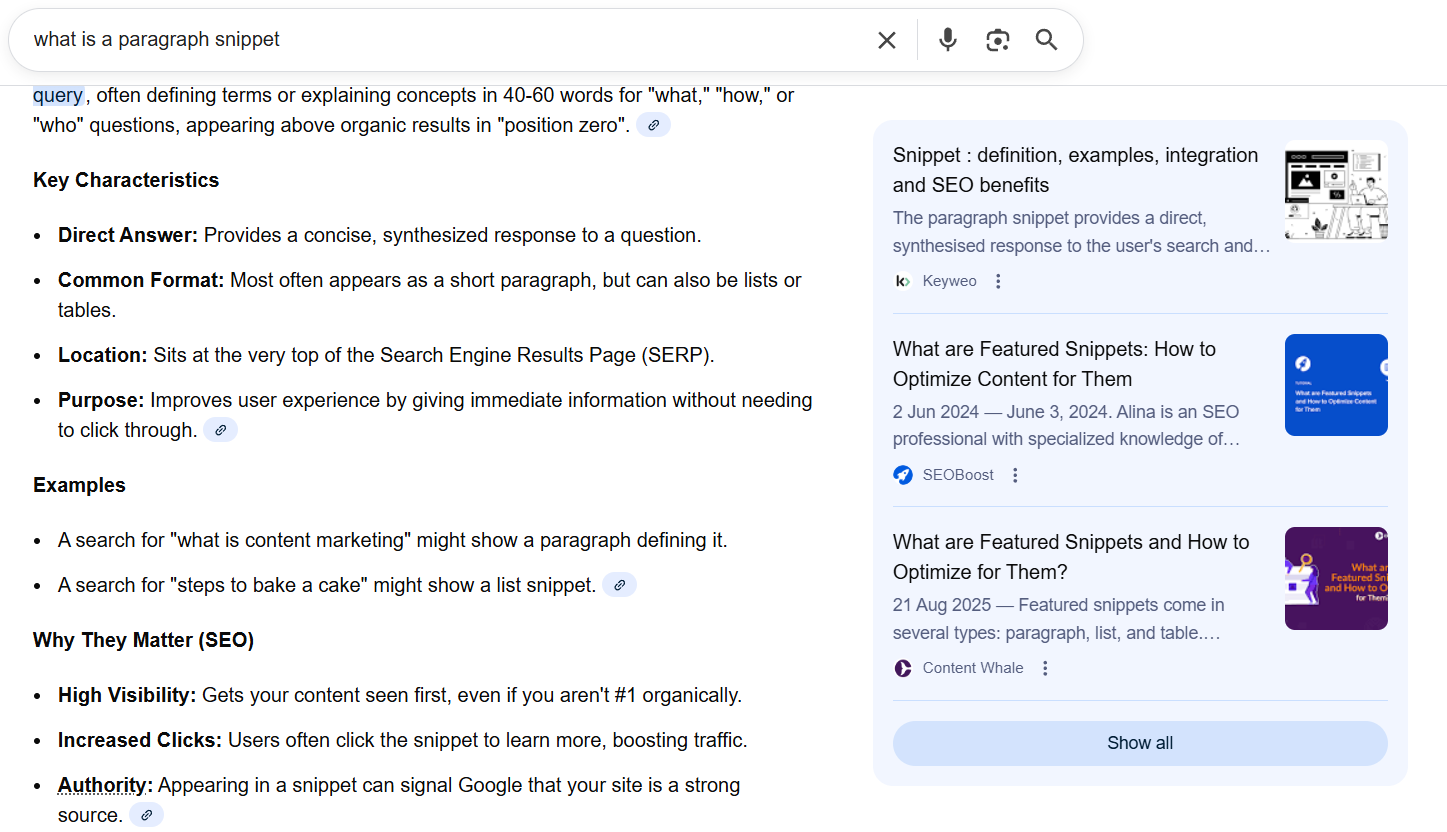
When users are comparing tools, prices, or features, structured tables give AI responses something concrete to work with.
The rule is simple. Do not make the AI interpret your layout. Make the answer obvious.
Video adds another layer of visibility.
For tutorials and walkthroughs, AI platforms often pair a text answer with a video clip rather than trying to summarize everything. If your page explains a process and includes a relevant video that follows the same structure, it becomes much easier for Google AI mode to surface your content.
There is also a quality filter that many people underestimate.
Language matters. Content that feels robotic or overproduced may rank, but it rarely gets reused in AI generated answers. Clear, natural phrasing tends to win because it can be quoted or paraphrased without losing meaning.
Finally, structure alone is not enough.
AI results and answer engines still pull from authoritative pages. Rankings, backlinks, and brand mentions influence which sources are even considered. When several pages explain the same thing equally well and competitors are neck-and-neck, authority usually decides which one gets featured.
One last thing is worth reinforcing, because it has not changed at all.
Backlinks are still the strongest trust signal AI systems rely on.
When Google or an answer engine scans the top results to assemble an AI search results overview, it is not only evaluating how clear the content is. It is also deciding which sources it trusts enough to quote.
Pages with strong backlink profiles and consistent brand mentions get prioritized, especially when multiple results explain the same topic equally well. Structure helps your content get extracted, but backlinks are what gets your content marketing the chance to be noticed in the first place.
How to Use ChatGPT for SEO
ChatGPT is not an SEO cheat code, and it is not a shortcut around the algorithm. It is a speed boost for the parts of SEO that used to eat your whole day.
Used correctly, it helps you move faster without lowering quality. Used carelessly, it just helps you publish mistakes at scale.
Here is how I actually use it.
Content creation and on-page optimization
I use ChatGPT as a writing assistant, not a writer replacement. It helps me brainstorm angles, build outlines, rewrite awkward sections, tighten intros, and turn messy notes into clean paragraphs.
It is also great for quick wins like meta titles, meta descriptions, FAQs, internal linking suggestions, and rewriting sections to better match search intent.
Having this optimized article workflow helps maintain quality while moving faster.
Keyword research support
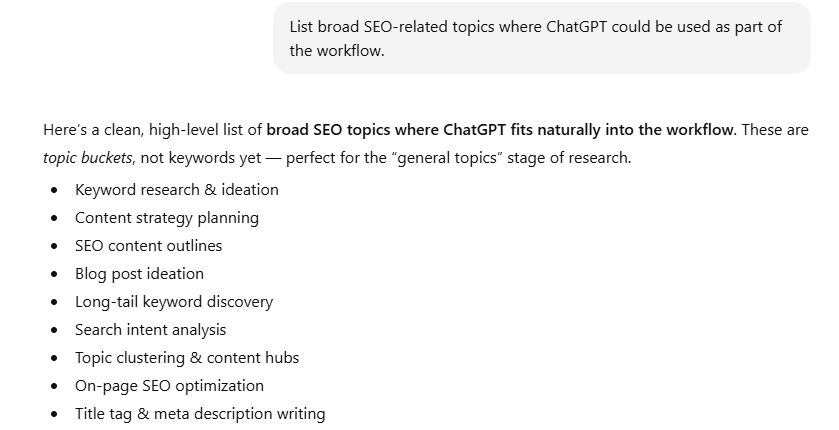
ChatGPT is not a keyword platform because it does not know real search volume or keyword difficulty.
But it is excellent at ideation. I use it as an SEO tool to generate long-tail questions, modifiers, use cases, and content angles that I can then validate in Ahrefs or Semrush.
It is especially helpful when I need to go beyond the obvious keywords and find the exact questions people actually ask, which feeds directly into capturing more organic traffic.
3) Technical SEO, without needing to be a developer
If I run a page through PageSpeed Insights or pull warnings from Search Console, I can paste the output into ChatGPT and get a plain-English explanation plus a step-by-step checklist.

It can also help clean up HTML, suggest schema markup, and point out common issues that affect crawlability and performance. It will not replace a developer,
but it makes working with developers much easier because you are no longer translating technical jargon from scratch.
The one rule I follow in all of this is simple.
Never publish raw output.
ChatGPT gets you to a strong draft faster, but the final result still needs a human editor. If your content feels stiff, generic, or overly polished, it might still rank, but it is much less likely to get pulled into generative engine optimization formats or quoted by answer engines.
Here are a few high-impact ChatGPT prompts I actually use for SEO, plus when to use each one as part of my optimization strategies.
Create an SEO-Optimized Blog Post Outline
“Create an SEO-optimized outline for the keyword ‘[PRIMARY KEYWORD]’.
Search intent: [informational/commercial].
Include an H1 and logical H2s and H3s.
Target length: [X] words.”
Rewrite a Section for AI Overviews
“Rewrite this section to answer the heading question in 40–60 words immediately after the heading.
Keep it natural and human. No fluff.
Section: [PASTE SECTION]”
Cluster Keywords Into a Content Plan
“Group the following keywords into clusters based on search intent and topical similarity.
Suggest one page title per cluster.
Keywords: [PASTE LIST]”
Generate Meta Titles and Descriptions
“Write 5 SEO-optimized meta titles and meta descriptions for the keyword ‘[PRIMARY KEYWORD]’.
Titles under 60 characters.
Descriptions under 155 characters.”
Create a Comparison Table
“Create a clean comparison table for the following items: [ITEMS].
Include price, best use case, and key features.
Use simple, scannable formatting.”
Link building cheat sheet
Now Over to You
AI overviews are not random, and they are not unbeatable.
If your content is clear, structured, and backed by real authority, answer engines will find it. You do not need to rank first. You just need to be trusted enough to be considered.
That trust still comes from backlinks and brand mentions.
You can follow SEO practices all day, but without authority, AI overviews and answer engines will skip you. That is where most sites hit a wall.
If you want a hands-off way to earn high-quality backlinks and brand mentions on pages that already rank, our done-for-you link building handles exactly that. We handle prospecting, outreach, and placements so your content can actually compete and get quoted in AI answers using proven strategies.
Sign up for Respona and let us build the links that put your brand in AI answers.
Frequently Asked Questions (FAQ)
What is AI search engine optimization?
It’s the process of optimizing content and brand authority so it gets picked up by AI overview features and answer engines like ChatGPT. It builds on fundamentals such as rankings, backlinks, and content quality while adapting to how generative AI surfaces information.
How is this different from traditional SEO?
The core principles are the same, but the goal is different. Instead of chasing clicks alone, you focus on getting your content and brand quoted directly in AI generated answers and search results.
Do I need to rank #1 for this to work?
No. In most cases, ranking in the top 10 is enough. AI algorithms pull from multiple high-ranking pages, not just the first result.
Can this work without my own pages ranking?
Yes. If your brand is mentioned on pages that rank in the top 10, AI platforms can still quote you. That is why brand mentions and link building are such a big part of modern content marketing.
Are backlinks still important?
Absolutely. Backlinks remain one of the strongest authority signals. When content quality is similar, backlinks often determine which sources AI overview features and answer engines trust enough to quote.



![How to Find and Rank for Geographic Keywords [2026]](https://respona.com/wp-content/uploads/geographic-keywords-1024x576.jpg)