
Google search results are dominated by featured snippets and AI overviews for user convenience.
At the same time, they “steal” your clicks since there’s no point in clicking through to your website if the answer is right there.
Unless you’re looking to buy something, of course.
However, getting your content pulled into a featured snippet or an AI overview is the “golden ticket” to position 0, above everyone else.
In this article, I’ll’ll talk about:
- What are featured snippets and AI overviews
- How they differ from each other
- How to rank in AI overviews and optimize your content for both
- Our favorite way to get featured in AI overviews
Let’s get started.
Link building cheat sheet
What Are AI Overviews (AIOs) and Featured Snippets?
Featured snippets are bits of your content that are pulled directly from your page into search results.
You’ve seen them before:
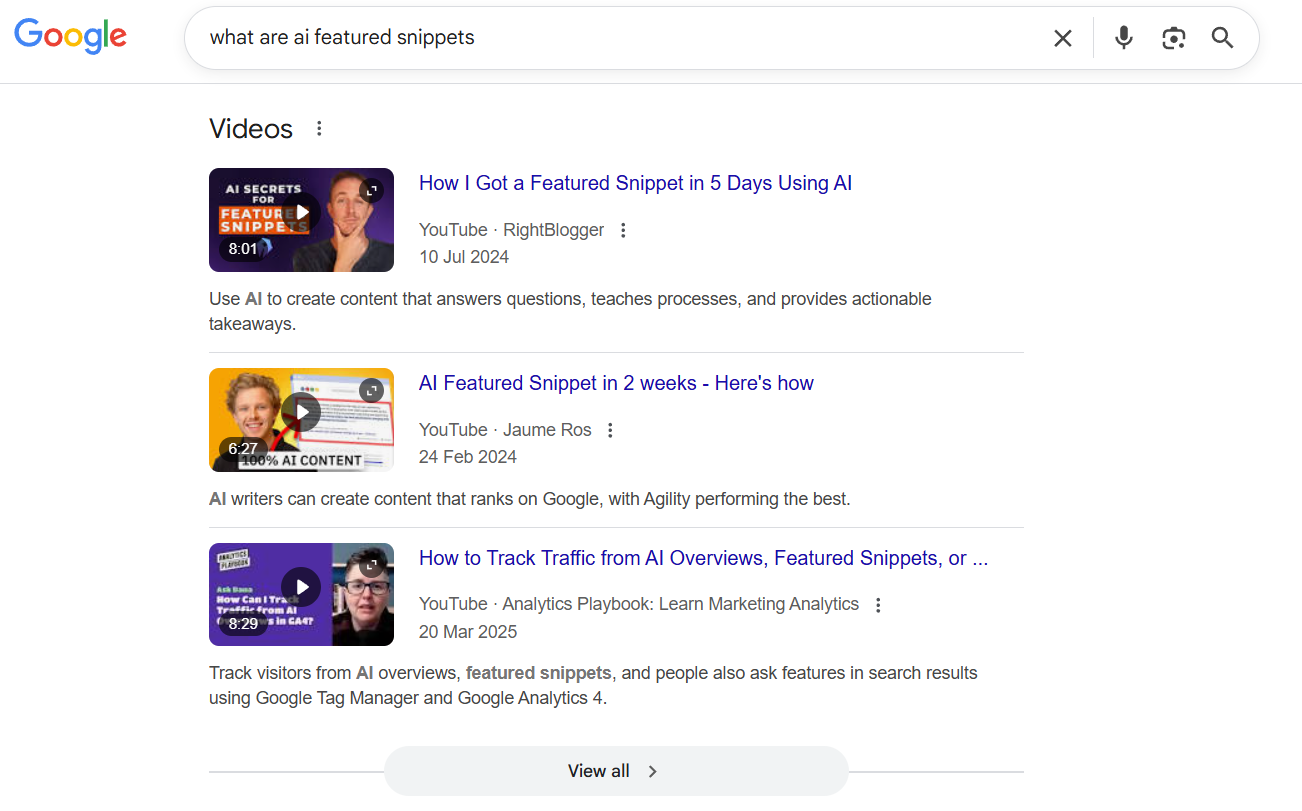
They can be in the form of videos, paragraphs taken straight from your article, lists, tables, and even carousels.
Before the introduction of AI overviews (AIOs), featured snippets were THE way to get ranked at position zero in Google search.
This isn’t quite the case anymore. At least not for every keyword.
Almost every search result page now pulls an overview above (or instead of) featured snippets where possible:
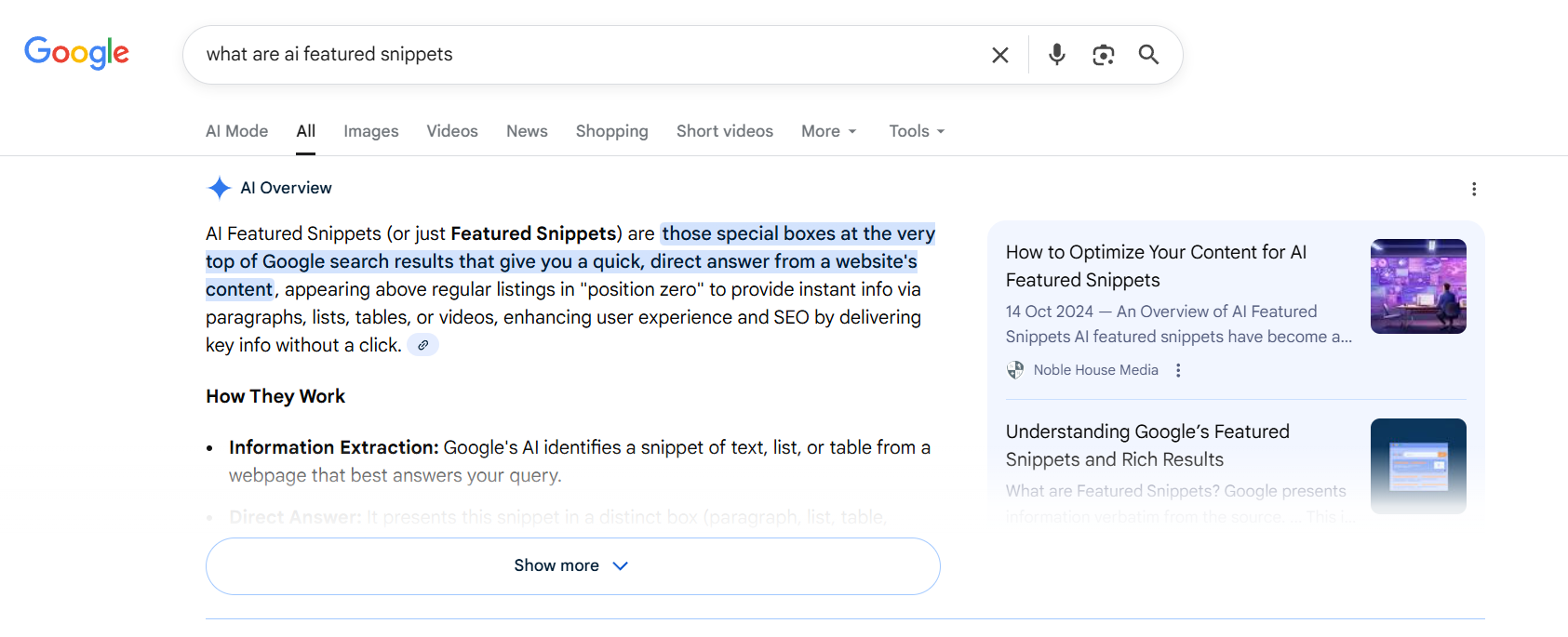
Let’s put it this way: featured snippets have become the building blocks for AI overviews.
For most queries, Google’s AI now tries to create its own AI-generated summary that consists of:
- A paragraph/definition
- Comparisons
- Lists or step-by-step instructions
- Tables
- Videos
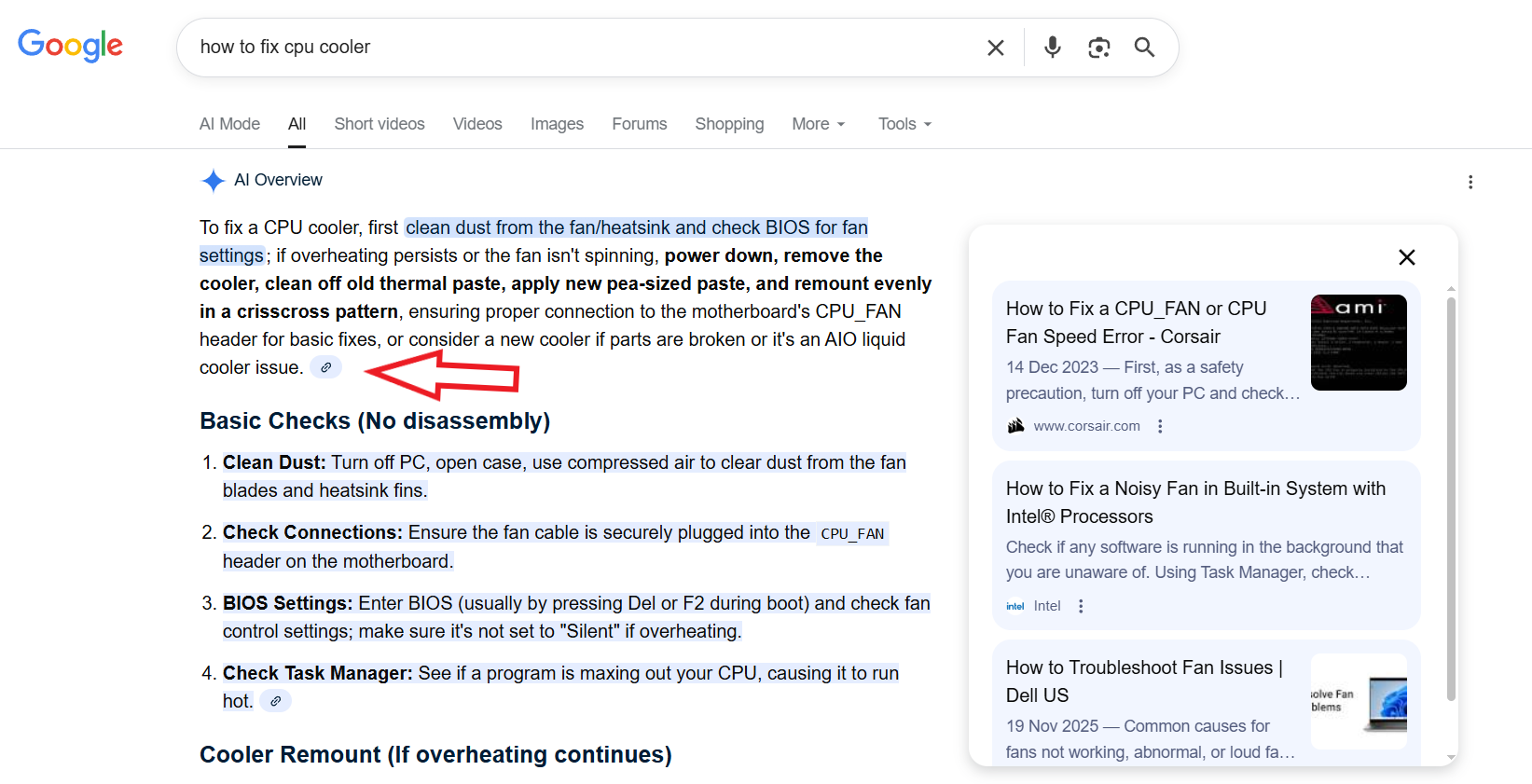
Even super-technical answers that used to only be pulled as featured snippets like “how to fix rtx 4090 power connector” are mostly absorbed into AI overviews now.
The only type of snippet that will reliably bring clicks (even if it’s wrapped into an overview) is video.
Which brings the question: are featured snippets even worth optimizing for anymore?
Yes, they are.
Because overviews “read” the top 10 search results for any given keyword and pull answers from multiple sources into the overview.
If your content is optimized for a specific type like the paragraph snippet, it’s very likely that the overview will pull your bit of the article.
If you have clear and accurate step-by-step instructions for a technical query, the AI system will display that.
Sometimes it even comes with a link to your page:
Is There Any Difference Between Featured Snippets and AI Overviews?
Technically, yes. Featured snippets quote your content exactly and bring your page to the top of Google search results.
While AI overviews are synthesized from multiple sources, Google’s AI can cite your content in its own words and sometimes make mistakes, especially with technical queries.
However, in application, overviews are built from a variety of featured snippets from multiple sources to create a comprehensive AI-generated answer to any informational query.
So they have essentially become one thing as Google refined its generative AI search experience through various AI search platforms.
How to Optimize for AI Overviews and Featured Snippets
It sounds simple: your content must answer the search query accurately and concisely.
Google’s goal is to provide the best user experience possible, which is to get the best, most detailed answer to any question in an easy to read and follow way.
You’ve heard this countless times before, but the best way to ensure AI visibility is to actually pay attention to what you’re publishing.
It’s no secret that everyone is using AI tools for content production.
And, honestly, there’s nothing wrong with that. AI agents are awesome for keyword research, paraphrasing, and optimization.
But you need to really edit it to make it sound human. Everyone knows what a fully AI-generated article looks like.
Yes, it might rank in Google search, even in the top 10.
Will it be captured by an AI overview?
Probably not because of the weird language AI agents can use. It’s stiff and wordy. Sometimes even self-contradictional.
Which is exactly the opposite of what Google’s AI is looking for in AI search results.
Now let’s look at some specific snippet types and how to optimize for them – the foundation of AI overview optimization.
Paragraph
Paragraph snippet is the first little block of text (no longer than 40-60 words) that shows up in overviews.
It usually answers questions like “what”, “why”, “who”, “when”, and so on.
It is pulled from a single paragraph on a page (usually one that follows a header with a question).
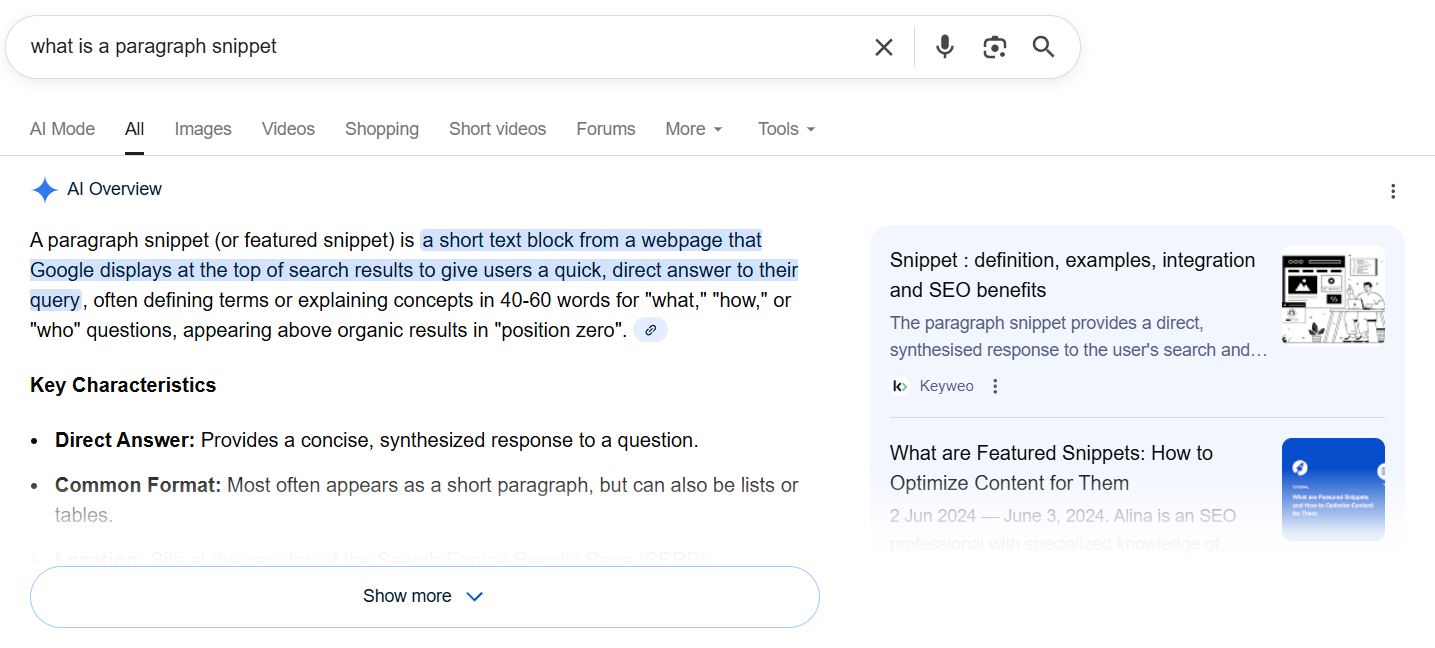
To optimize for paragraph snippets, your content must provide clear and concise definitions/answers immediately after a heading with the question from the search query.
This is crucial for featured snippet optimization and improving your AI visibility in search engines.
Using structured data and schema markup can also help Google’s AI algorithm better understand your content structure.
List
The list snippet is usually the next SERP feature in AI overviews and features steps, characteristics, options/alternatives, rankings, etc.
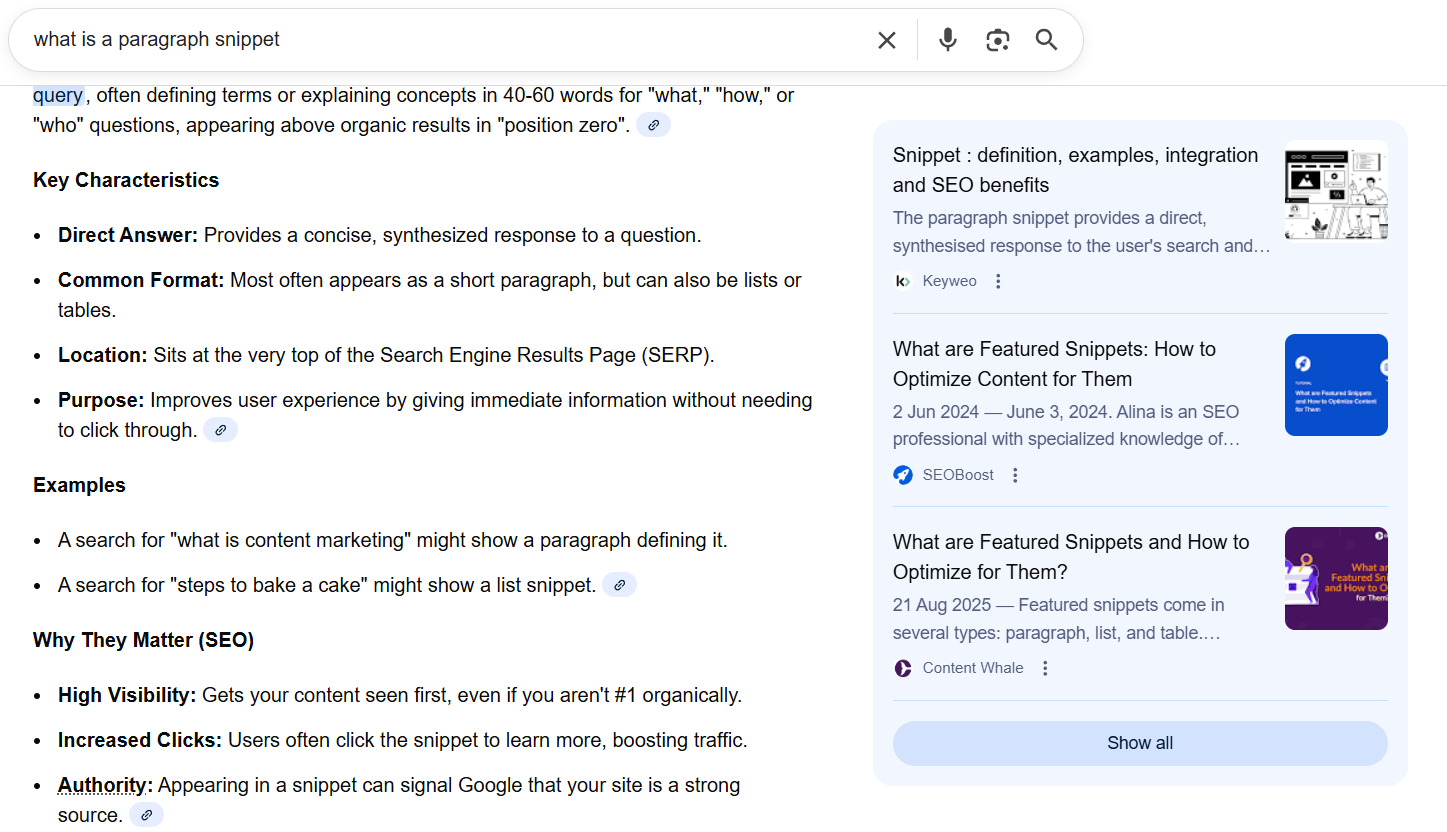
Below you will find not only an explanation of how to optimize for list snippets, but also an optimized chunk of snippet content in and of itself.
Note the transition sentence (can be a heading):
To optimize for list snippets:
- Optimize the title & URL for list intent
- Put the list immediately after a clear heading
- Keep list items short (3-8 words/item)
- Limit list length (5-8 items max)
- Add a one-sentence context line
- Use clean HTML (<ul>/<ol>/<li>)
Table
Tables are used for comparisons: either regarding price or other characteristics.
If the query involves numbers, comparisons, prices, specs, or attributes, Google doesn’t want to explain the answer, it wants to show it.
A great example is comparing calories in different food items:
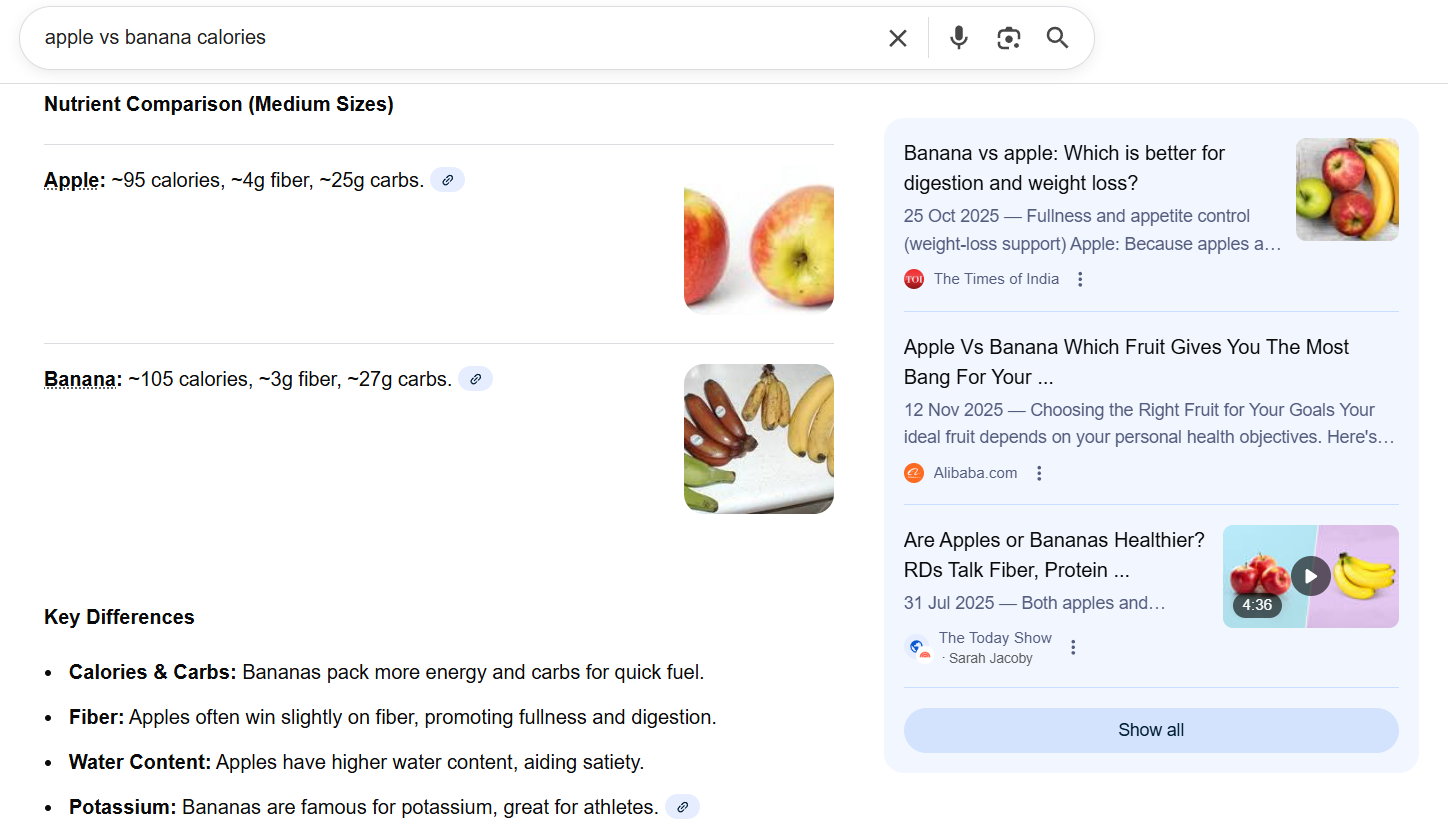
Here’s the important part:
Tables are one of the most AI overview-resistant snippet types.
Why?
Because AI overviews are great at summarizing ideas, but not so good at preserving exact data without distortion.
To optimize for table snippets, all the rules for list snippets apply.
Meaning keep it concise, put it right after a header with the question from the search query, avoid extra formatting, and have a context sentence.
But there’s also another trick that’s unique to tables.
You have to use the actual <table> HTML for proper snippet eligibility.
If you use divs, CSS grids or JavaScript layouts, Google might not be able to extract your table, which is bad for technical SEO and impacts whether AI overviews appear with your content.
Video
Video snippets are the most reliable way to still earn clicks, even when a Google AI overview is present.
Unlike text snippets, Google can’t fully “summarize away” a video. Instead, it highlights a specific clip or timestamp and sends users to YouTube (or occasionally your page) to actually watch it.
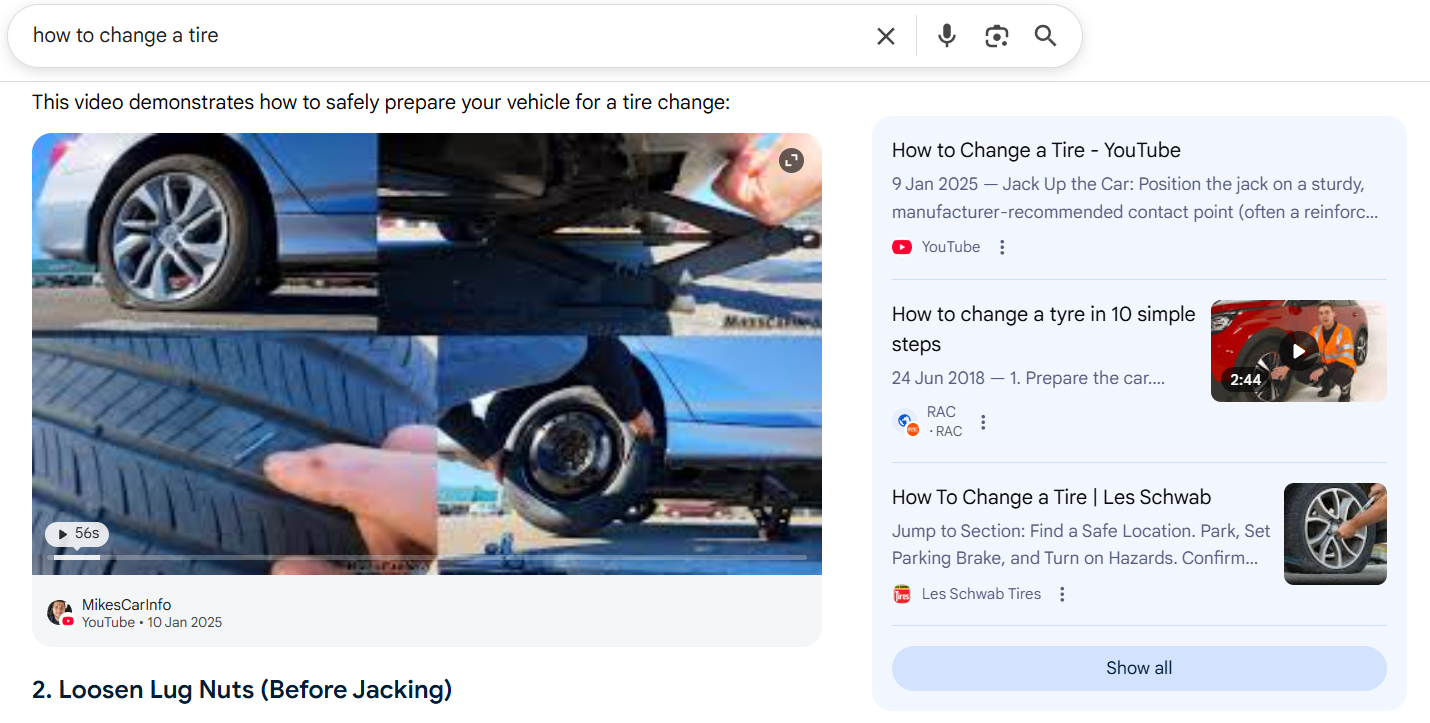
Video snippets usually appear for:
- How-to queries
- Tutorials
- Fixes and walkthroughs
- Visual demonstrations
That’s why video is the least affected snippet type by AI overviews and why AI overviews matter even moore for video content.
To optimize for video snippets, your content needs to clearly demonstrate the answer visually, follow a step-by-step structure, and match the keyword intent closely.
Use clear titles, concise descriptions (including an optimized meta description), and timestamps or chapters so Google knows exactly which part of the video provides AI answers to the question.
Does Link Building Help Get Featured in AI Overviews?
Link building helps with everything.
Seriously.
We keep preaching about it for years – for a good reason.
Sure, with the recent shift to AI search, it’s not necessarily as important to rank your pages at number one anymore.
BUT, you still have to get to the top 10 to have a chance of your content getting pulled into overviews and featured snippets, and that’s where visibility in search engines matters most.
Links are still a core part of Google’s AI algorithm, and with AI overviews, their importance has only increased, not diminished.
This is a fundamental AI overview SEO and generative engine optimization strategy.
Here’s why this matters for AI overviews specifically:
When Google’s AI scans the top 10 results to build an AI summary, it doesn’t just look at content quality. It evaluates authority signals, and backlinks are the strongest authority signal there is.
Pages with strong backlink profiles get prioritized by AI engines and AI platforms. They’re more likely to be:
- Cited in AI overview citations
- Featured in snippets
- Recommended to users
There’s no better way to get overviews to feature your business than getting brand mentions on other pages. For local businesses, optimizing your Google Business Profile also helps with AI-driven search visibility, especially for queries that trigger the Google Shopping Graph.
You can monitor these snippet opportunities using Google Search Console and Google Analytics, but building the links that get you there?
That’s the real work.
Want your brand recommended to potential customers by Google’s AI?
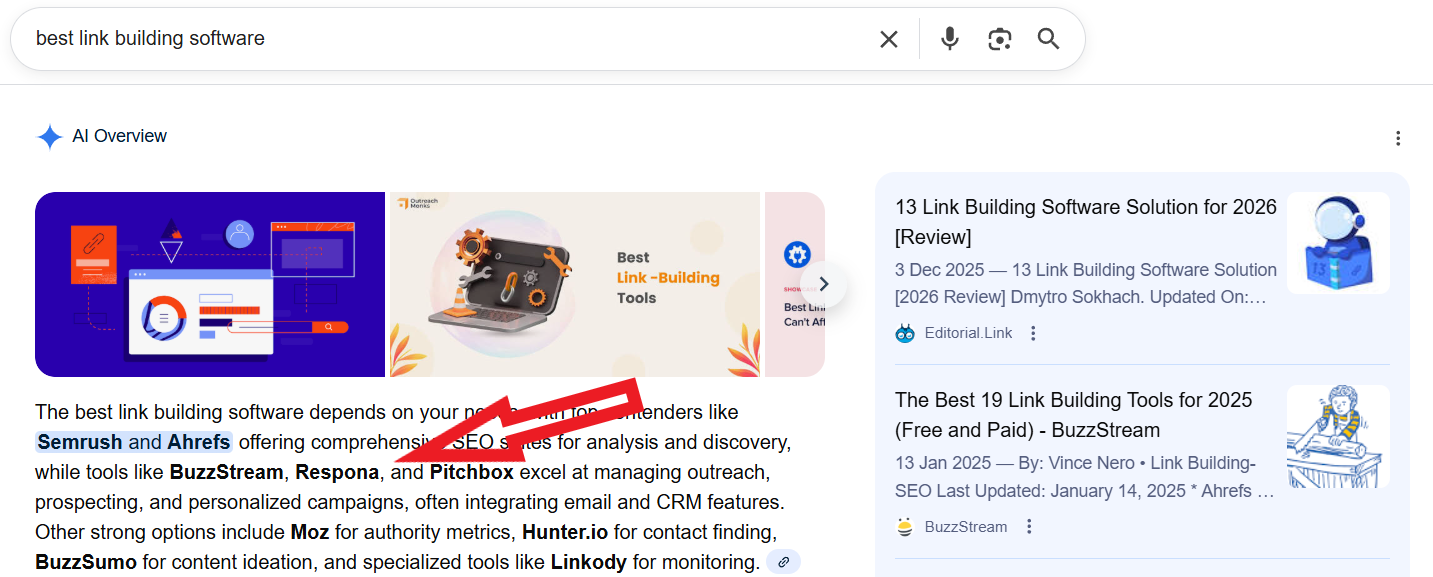
Building high-quality backlinks manually takes time: months of outreach, relationship building, and content promotion. Most businesses don’t have that bandwidth.
That’s where we come in.
Place your first order with us and we’ll get right on getting high-quality brand mentions, just for you. You don’t even have to do anything – we’ll build them for you.
Now Over to You
In conclusion, despite AI overviews taking away clicks from the Google SERP, they can be an amazing way to put your business directly in front of potential customers through improved search engine visibility.
Getting there isn’t easy, but it’s also not particularly hard.
You just need some time, some good content, and a few high-quality brand mentions.
This opportunity shouldn’t be ignored, especially as Google Assistant and other AI mode options continue to evolve through Search Labs and the search generative experience.
Understanding when AI overviews appear and optimizing for AI overview results is now essential to any SEO strategy.
Don’t hesitate to start your 14-day free trial with Respona if you’d like to dip your toes into manual link building, or place an order for our done-for-you link building if you prefer a more hands-off-approach.
Link building cheat sheet
Frequently Asked Questions (FAQ)
Do featured snippets still matter with AI overviews dominating SERPs?
Yes. Google’s featured snippets are now the primary source material overviews pull from.
If your snippet content is optimized with proper structured data and follows Google Search Essentials, it significantly increases your chances of being cited or referenced inside an AI overview result.
This is why AI overviews are important to your overall SEO strategy.
Can my page appear in both a featured snippet and an AI overview?
Absolutely. In fact, this is becoming the most common scenario. Google often uses featured snippets as building blocks for overviews, sometimes quoting them directly and sometimes paraphrasing them into an AI-generated answer.
Which featured snippet type is least affected by AI overviews?
Video snippets are by far the most resilient. Google can’t fully summarize a video, so it still sends users to watch it, making video the most click-friendly snippet type in an AI-heavy SERP.
Do I need to rank #1 to be included in an AI overview?
No. You typically need to rank in the top 10, not necessarily first. Generative AI systems analyze multiple high-ranking pages and pull the clearest, best-structured answers from them for snippet optimization and AI overview appearance.
Does using AI-generated content hurt my chances of getting featured?
Not inherently, but unedited AI content does. Google favors clear, concise, human-sounding answers, and raw AI text is often stiff, repetitive, or vague, which makes it less likely to be pulled into snippets or overviews.