
When the AI chatbot ChatGPT first exploded, I honestly thought the internet was about to get worse.
Almost overnight, search results filled up with AI generated content and mass-produced articles that looked polished but said nothing.
Every post had the same rhythm, the same structure, and the same empty confidence. You could spot them instantly.
No real opinions. No lived experience. Just words arranged to rank.
At the time, a lot of us assumed Google would shut this down fast. The common belief was simple. AI content generated by language models would not rank, and if it did, it would not last.
That belief was wrong.
Ahrefs did one of the most comprehensive studies on this question by analysing 600,000 pages pulled from Google’s top rankings.
What they found was clear: there is no meaningful correlation between how much AI content a page has and where it ranks in Google.
The pros massively outweigh the cons. And if you are not using it at all, you are not preserving quality. You are just wasting time.
In this article, I’ll explain the exact pros and cons of using ChatGPT for SEO, covering everything from content generation and keyword research to the disadvantages you need to watch out for.

Link building cheat sheet
Pros
Speed Up Content Production
Content creation is one of the leading use cases for ChatGPT, not only in SEO but in general.
Just a couple of years ago, this statement would cause every reader to frown. Everyone knows what a fully AI-generated article looks like.
The vague statements, the unnecessary metaphors, the constant em dashes, and the “in today’s digital world…”.
You know what I’m talking about.
But today, in 2026, not only did the large language models get better, the people got better at using them as well. Whether you use ChatGPT free or upgrade to ChatGPT Plus for more features, the AI technology has improved dramatically.
In fact, I use ChatGPT for almost every blog post I write, especially when the topic is something I’ve talked about a million times before.
It’s a great writing assistant powered by natural language processing. It won’t make a masterpiece on its own, but it will definitely automate the most tedious parts of the content creation process.
Drafting, optimizing for keywords, paraphrasing sections – all complex tasks that can take ages when you do them manually.
So long as you edit the generated content and don’t publish articles straight out of the conversational AI, you’re good.
Keyword Research
This is how I actually use this AI language model for keyword research.
I do not ask it for “best keywords” or anything like that. I use it to spit out long, specific searches people would realistically type in natural language when they are trying to solve something. Beginner questions. Awkward phrasing. Stuff that looks too messy for most SEO tools to surface on their own.
At the same time, I use Ahrefs search suggestions off a single seed keyword. I let Ahrefs expand the obvious paths, and I let ChatGPT fill in the human ones.
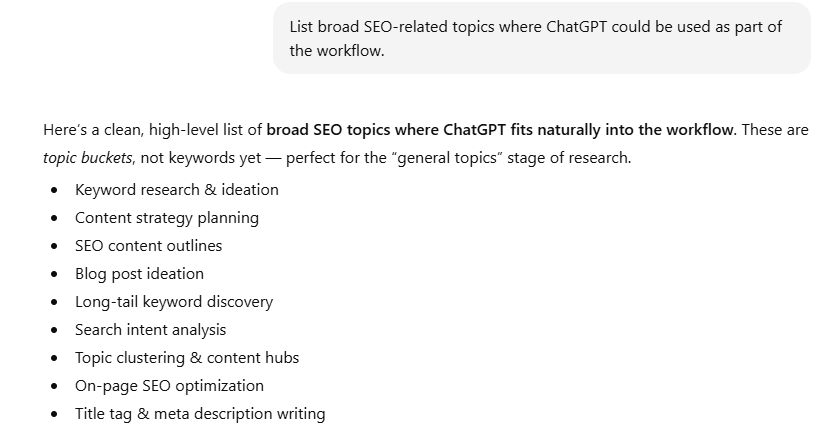
I throw both into the same list.
Between those two sources, I can build a pretty big pile of keywords fast. Not ten ideas. More like weeks of content. Sometimes months if the topic is deep enough.
Then I stop guessing.
I run the whole list through Ahrefs bulk keyword analysis and start deleting. Anything too competitive goes. Anything with no demand goes. What’s left is usually a clean set of low difficulty keywords that actually make sense to write about.
If I want to move faster, I use the Ahrefs integration inside ChatGPT and pull real data as I go. The chatbot can even handle tasks like language translation if you’re working across multiple languages.
That’s rare though – API credit cost stacks up really quickly.
Meta Descriptions in Seconds
This one is simple, but it saves a ridiculous amount of time.
Writing meta descriptions by hand is boring. Not hard. Just boring. And when you have dozens or hundreds of pages, it is one of those tasks that keeps getting pushed back.
I use ChatGPT to knock them out in batches.
I feed it the page topic, the target keyword, and the angle of the article, then ask for a few variations under the character limit using a simple prompt. Most of them are fine. One is usually good. I pick it, tweak a word or two so it sounds like me, and move on.

The important part is that I still review everything with human oversight. Meta descriptions affect click-through rate, and generic ones stand out in a bad way. ChatGPT gets me 80 percent of the way there in seconds. I handle the last 20 percent.
It is not glamorous, but it turns an annoying task into a one-minute job.
Make Sense of In-Depth Reports
I can read an SEO report just fine. I just do not enjoy spending an hour doing it when I do not have to, especially when deep research is involved.
Most audits and reports are thorough by design. They cover everything, which means they also bury the important stuff under a lot of edge cases and low-impact recommendations. The problem is not understanding them. It is prioritizing them quickly.
That is where I use generative AI.
I feed it the report and ask it to summarize the key issues and group them by impact. What actually affects rankings. What is nice to have. What can wait. It helps me make an informed decision and sanity-check my own conclusions to get to an action plan faster.
Suggest Relevant Internal Links
Internal linking is easy to understand and annoying to execute.
You know it matters. You know which pages you want to push. The slow part is figuring out where links actually make sense without clicking through half your site.
This is another place where I use ChatGPT as a helper.
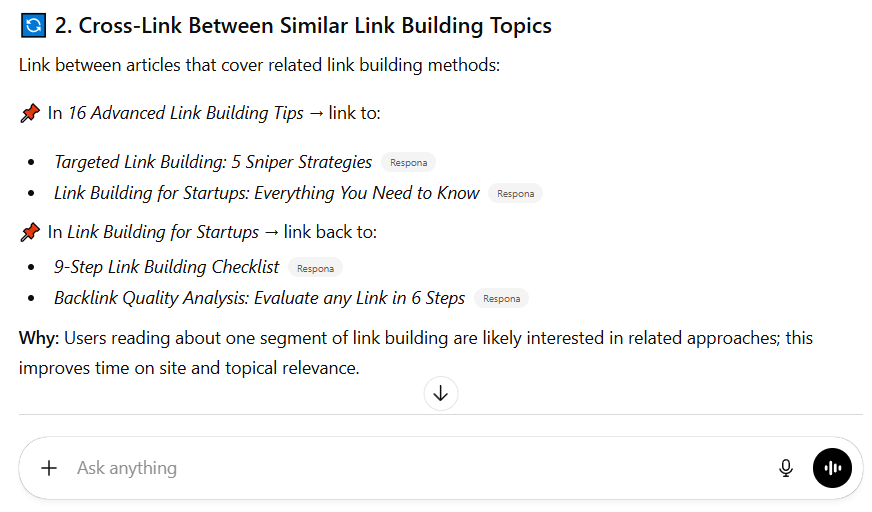
I give it the URL or content of a page and a list of related articles, and ask it where internal links would feel natural. Not forced anchor text. Just places where a real reader would actually benefit from going deeper.
I still add the links myself, but ChatGPT helps me spot opportunities I would otherwise miss, especially on older content.
Optimize for AI Overviews
AI Overviews changed what “winning” a search result looks like.
You do not need to rank number one anymore, but you do need to sit comfortably in the top ten. That is where Google’s AI pulls from when it builds an overview. If your page never gets there, it simply does not exist to the system.
This is where I use ChatGPT to help shape content, not write it. The AI technology helps me improve the user experience and overall content quality.
I use it to spot questions worth answering clearly, tighten definitions, and clean up sections that should be short and direct.
AI Overviews favor content that gets to the point fast. Clear headings. Straight answers. Lists and steps that actually help someone do the thing they searched for.
This way you have a chance of Google’s AI not only quoting your content, but even linking to it – despite the common idea that AI Overviews “steal” clicks.
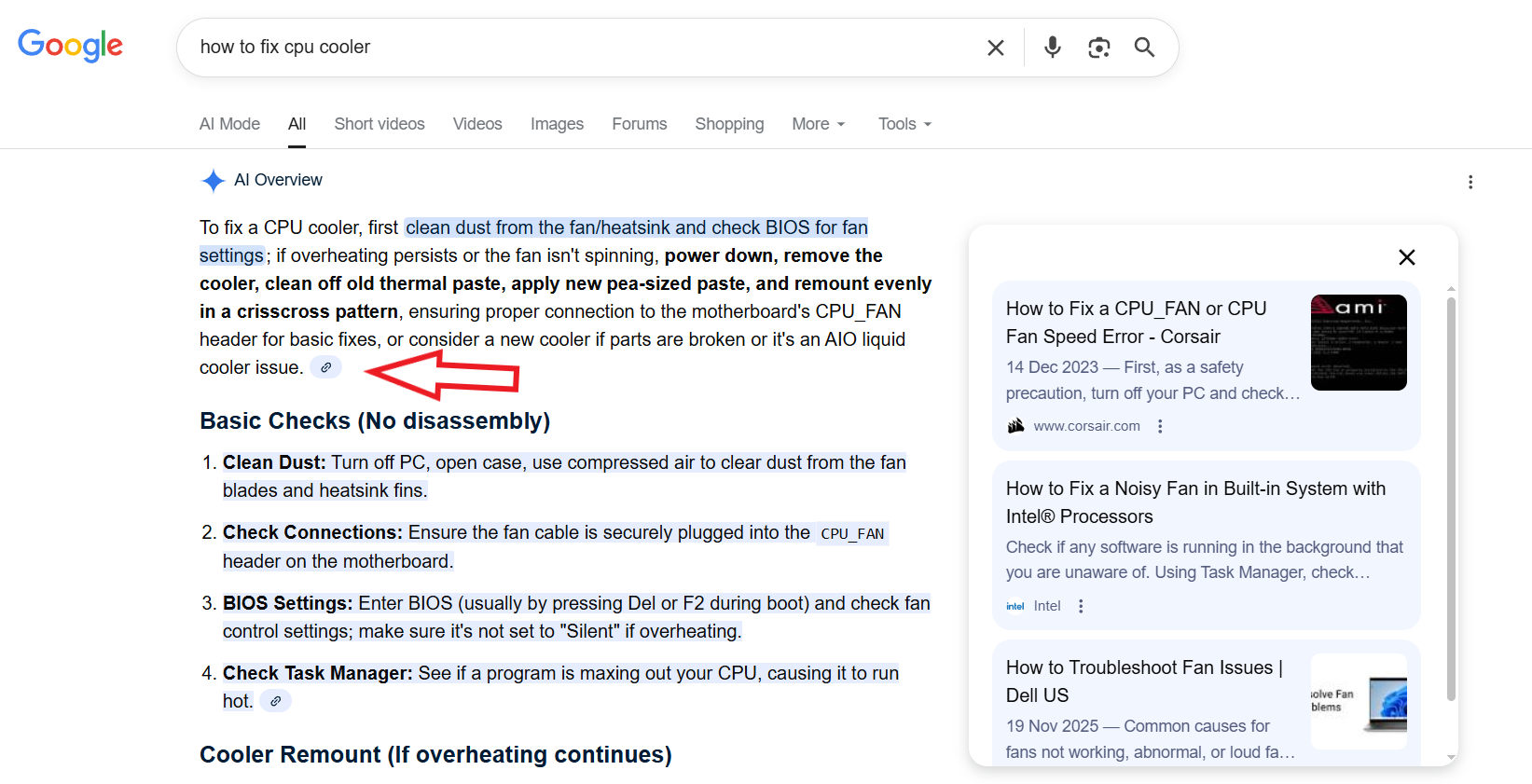
The key part is still human intelligence and critical thinking applied through editing.
Sloppy AI-written paragraphs rarely get pulled into overviews. Clean, well-structured content sections written for real people do. ChatGPT helps me refine those sections faster so the content is easier for Google’s AI to understand and reuse.
Low Cost, High Output
This is the part people tend to ignore when they argue against using ChatGPT. Even free users can access powerful features.
For the cost of a single tool subscription, I get help with drafting, rewriting, keyword expansion, meta descriptions, internal links, and report summaries. Tasks that used to eat up hours now take minutes.
Not because quality dropped, but because I stopped doing repetitive work manually.
That does not mean fewer people or less thinking. It means the same person produces more useful output in the same amount of time.
One article becomes three. One keyword list turns into a full content plan. The bottleneck moves from execution to ideas and strategy, which is exactly where it should be.
Cons
Hallucinations and Misinformation
This is the part that trips most people up and represents one of the biggest disadvantages of using AI.
ChatGPT sounds confident even when it is wrong, which can lead to misinformation if you’re not careful.
It will invent stats, misquote sources, and casually describe tools or features that do not exist. If you trust it blindly without applying critical thinking, those mistakes slip straight into your content, and that is where problems start.
I treat everything it says as a draft, not a fact. For example, I asked what our pricing is and it quoted the price for a deprecated service that we no longer provide.
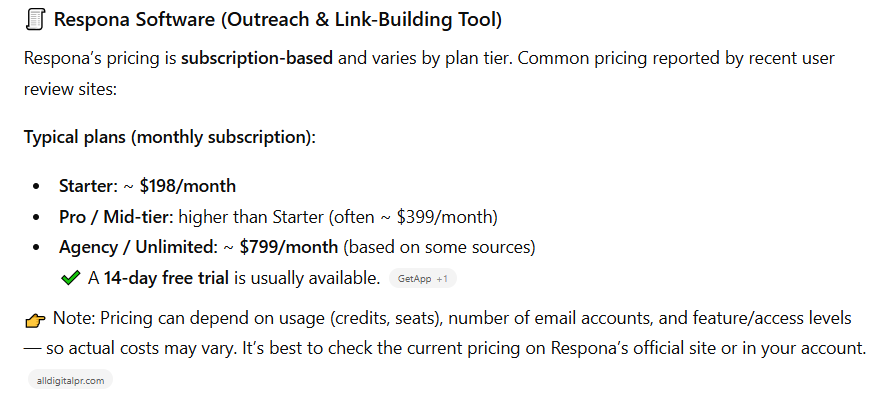
While this isn’t a true hallucination (the numbers are right, just the service no longer exists), you have to be constantly on the lookout for mistakes that could spread misinformation.
Any numbers need to get checked. Any claims verified. If something feels off, it usually is.
That small layer of human review turns hallucinations from a real risk into a minor inconvenience. You catch them the same way you would catch a mistake from a junior writer or an outdated source.
The moment you stop copy-pasting and start editing, this issue largely disappears.
AI Doesn’t Create Anything New
This connects directly to the hallucination problem.
ChatGPT does not discover ideas or demonstrate true creativity. It reshuffles existing ones based on its training data. It cannot test things, form opinions, or learn from firsthand experience.
This is the main issue with using ChatGPT for any task, not just SEO. It lacks the human intelligence needed for true innovation.
The fix is simple. Bring your own thinking.
Use ChatGPT to speed up the boring parts, then layer in your experience, examples, decisions, and perspective. The moment a real human shapes the output, the content becomes both safer and better.
These are real flaws and genuine cons, but they are not deal-breakers. With even a small amount of human judgment, they stop being problems and turn into reminders of what AI is actually good at and what it should never replace.
Link building cheat sheet
Now Over To You
ChatGPT did not ruin SEO. It sped it up. Both good and bad.
Used carelessly, it produces forgettable content that blends into everything else on the internet. One of the cons is losing your unique voice if you rely on it too heavily.
Used properly, it saves time, sharpens execution, and frees you up to focus on the parts of SEO that actually matter – the tasks that require genuine human intelligence.
And that is the real takeaway when weighing the pros and cons of ChatGPT.
Content is no longer the bottleneck. Keyword ideas are not the bottleneck. Even technical fixes are rarely the bottleneck AI-powered content tools..
Authority is.
You can publish well-structured, well-researched content all day long, but without backlinks, Google has no reason to rank it it. If you are not earning links, you are not breaking into the top results.
And if you are not in the top results, AI Overviews will never surface your content.
That is where we come in.
Our done-for-you link building handles the hardest, most time-consuming part of SEO for you.
Strategy, prospecting, outreach, follow-ups, and placements. All focused on earning real, relevant backlinks that move rankings and increase visibility.
If you are already using tools like ChatGPT to move faster, pairing that with consistent, high-quality link building is how you turn efficiency into actual results.
Frequently Asked Questions (FAQ)
Does Google penalize AI-generated content?
No. Google does not care whether content was written by a human or assisted by AI. It evaluates quality, usefulness, and trust. As long as AI generated content follows EEAT principles and satisfies search intent, AI assistance is not an issue.
What are the biggest pros of using ChatGPT for SEO?
Speed and leverage. ChatGPT helps automate repetitive tasks like drafting, keyword expansion, internal linking ideas, and summarization. The pros include faster content creation, better efficiency, and the ability for experienced SEO professionals to produce more high-quality work in less time.
What are the biggest cons of using ChatGPT?
Hallucinations and lack of originality. The main cons are that ChatGPT can confidently present incorrect information and cannot create new insights on its own. Both disadvantages disappear quickly with basic human review and real experience layered on top.
Can ChatGPT replace SEO tools like Ahrefs?
No. ChatGPT does not have access to live search data by default. It works best alongside tools like Ahrefs or Semrush, where it helps generate ideas and interpret data rather than replace it.
Is ChatGPT enough to rank without backlinks?
Is ChatGPT enough to rank without backlinks?
No. Content alone is rarely enough. Backlinks remain one of the strongest ranking signals, and they are critical for breaking into the top 10 and getting surfaced in AI Overviews. ChatGPT can help you move faster, but links are still what earn trust.