
When ChatGPT first showed up, the SEO world split in two.
One side thought it would break Google Search.
The other thought it would break their search engine rankings.
Both were wrong.
Chat GPT is not an SEO cheat code, and it is definitely not a ranking penalty waiting to happen. Used correctly, it does not replace search engine optimization. It makes the parts that used to be slow, tedious, and manual much faster.
In this article, I will break down how ChatGPT actually affects SEO, where it helps, where it hurts, and how to use it without shooting yourself in the foot.

Link building cheat sheet
No, it Won’t Break Your Site (So Long as You Don’t Abuse It)
Let’s get this out of the way first.
Using ChatGPT will not get your site penalized.
Google does not have a hidden “AI detector” that flags pages and pushes them down the search result just because a tool was involved in the writing process. What search engines care about is outcomes and user experience..
Problems only start when people abuse it.
When ChatGPT launched, a lot of sites treated it like a content generation factory. Thousands of thin, generic articles published in bulk, often on brand-new domains, with no links, no structure, and no real value.
That was never going to work long-term.
Not because the generated content was AI-generated, but because it was bad.
If you use ChatGPT to help you think, outline, rewrite, or speed up drafting helpful content, you are fine. That is no different from using Grammarly, spell check, or a content brief template.
If you use it to blindly publish low-effort pages at scale, you will run into the same issues you always would have with poor quality content: issues that affect both traditional SEO and modern search engine ranking.
Scale Up Your Content Creation & Optimization
One of the biggest ways ChatGPT affects SEO is simple.
It removes bottlenecks from your content strategy.
It helps you go from idea to draft quickly, without staring at a blank page. It can generate multiple outline variations, rewrite sections for clarity, and adapt tone without starting over.
This AI chatbot has become essential for SEO professionals looking to scale their content creation without sacrificing quality content.
ChatGPT makes all of that faster.
It helps you go from idea to draft quickly, without staring at a blank page. It can generate multiple outline variations, rewrite sections for clarity, and adapt tone without starting over.
That does not mean you stop editing.
The real value is in scaling what already works within your digital marketing efforts.
Instead of publishing one well-researched blog post a week, you can publish three pieces of engaging content. Instead of updating a handful of old posts each quarter, you can refresh dozens. Meta titles, descriptions, headers, FAQs, schema markup, and internal links can all be optimized faster with AI assistance.
ChatGPT content works best when it complements human creativity rather than replaces it. SEO professionals who understand this balance create high quality content that performs well in both Google Search and ChatGPT Search results.
The same principles apply across content marketing and social media.
ChatGPT generated text can help you adapt SEO content for different platforms, create variations for Google Ads campaigns, and maintain consistency across your digital marketing services, all while preserving the authentic voice that makes engaging content truly valuable.
ChatGPT For Keyword Research
ChatGPT is not a keyword research tool.
But it is one of the best keyword research assistants you can have for your SEO strategy.
On its own, it does not know search volume, keyword difficulty, or how competitive a SERP is. It will sometimes hallucinate keywords that sound realistic but have zero demand.
If you treat its output as final, you will miss the mark.
If you use it the right way, it speeds up the most time-consuming part of keyword research by a lot.
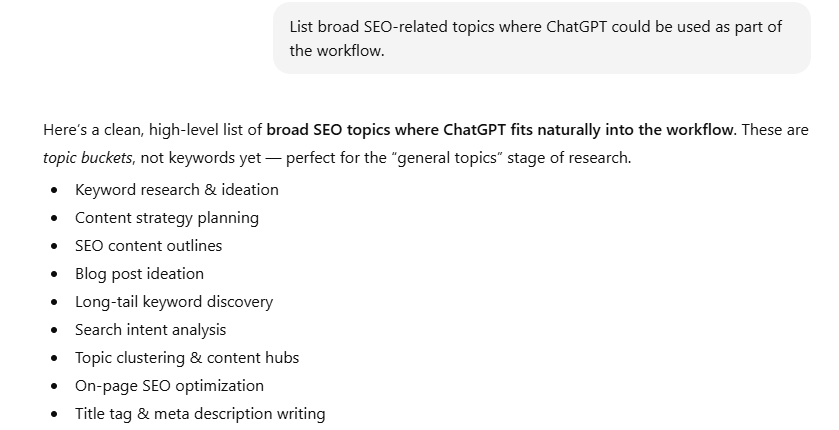
The biggest advantage is ideation for your SEO content.
Instead of staring at a blank spreadsheet, you can use ChatGPT to surface seed topics, angles, and natural language queries that real people might use when searching. It is especially strong at generating long-tail keywords and full questions, which are often lower competition and clearer in user intent.
For example, instead of targeting something broad like “SEO tools,” ChatGPT helps you uncover queries like:
- how to use chatgpt for seo keyword research
- can chatgpt replace keyword research tools
- best chatgpt prompts for keyword research
These are the kinds of searches people actually type into Google Search, and they are usually much easier to rank for.
ChatGPT is also useful for expanding and organizing lists for content creation.
You can feed it a raw export from Ahrefs or another tool and ask it to group keywords by search intent, identify topic clusters, or highlight overlaps. That turns a messy list into a usable content plan much faster than doing it manually.
This approach helps digital marketers understand user intent better and create content that matches what people are actually searching for in both traditional search engines and ChatGPT Search.
Used this way, ChatGPT fits perfectly at the start of keyword research for any SEO optimization workflow.
HTML & JavaScript Code Optimization
ChatGPT is also useful beyond content marketing.
t can help you clean up HTML and JavaScript issues that quietly hurt technical SEO and performance.
If a page is bloated with unnecessary markup or heavy scripts, Google has a harder time crawling it, and users feel it through slower load times. That directly affects search engine ranking, especially on mobile where user experience is critical.
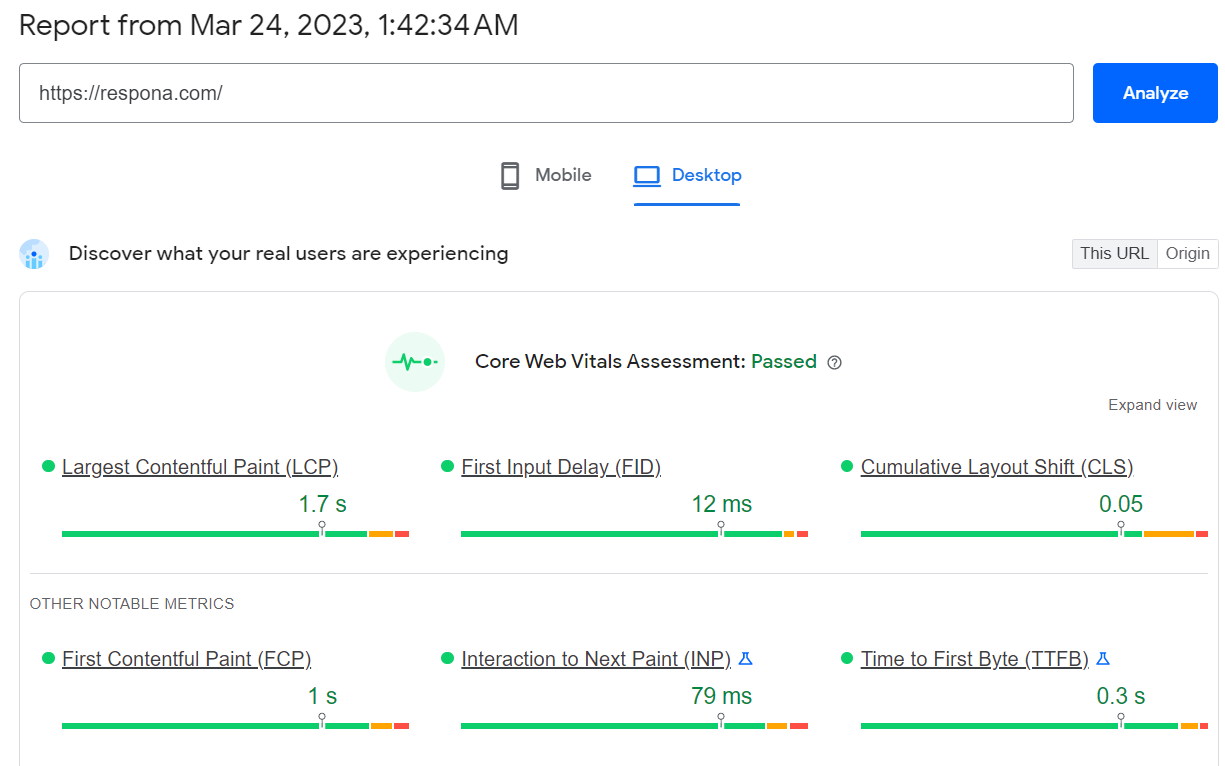
A simple use case is pairing ChatGPT with Google PageSpeed Insights or Google Search Console.
Run a page through PageSpeed Insights, copy the recommendations, and ask ChatGPT to explain what they mean and how to fix them. It turns technical jargon into a clear, actionable checklist for SEO optimization.
You can also use ChatGPT to help implement schema markup, which helps search engines understand your content structure better and can improve how your pages appear in search results.
ChatGPT will not replace a developer, but it can help you identify problems faster and make smarter decisions that improve both SEO rankings and overall user experience.
The ChatGPT response will break down complex technical issues into steps that even non-technical content creators can understand and implement, making technical SEO more accessible across your team.
Link building cheat sheet
Now Over To You
ChatGPT is not a threat to SEO. It is a force multiplier.
It helps teams move faster, scale content creation, speed up SEO optimization, and remove busywork from the SEO process. Used correctly, it makes good strategies more effective for digital marketing. Used carelessly, it just accelerates mistakes.
But here is the part where AI does not change.
SEO rankings still depend on authority.
You can publish better quality content faster. You can create more engaging content efficiently. But without strong backlinks, that content will struggle to break into the top results. And if you are not ranking, ChatGPT Search, AI generated content features, and search engines will ignore you.
That is why link building remains one of the highest-impact SEO activities—whether you are doing traditional SEO or adapting to ChatGPT SEO and other AI developments.
If you want your SEO content to rank, get cited, and stay visible as search evolves, you need high-quality, relevant backlinks pointing to your site. This is true regardless of whether your generated content comes from ChatGPT or human writers.
That is exactly what we do.
Our fully managed link building handles the SEO strategy, outreach, and placements for you, so you earn links that actually move search engine rankings and support everything else you are doing with AI and SEO efforts.
Frequently Asked Questions (FAQ)
Can using ChatGPT hurt my SEO?
No, as long as you do not abuse it. Google does not penalize content for being AI-assisted. Problems only arise when low-quality content is published at scale without value or search intent alignment.
Does Google detect AI-generated content?
Google focuses on helpful content quality, not how it was created. If ChatGPT generated content satisfies search intent and follows EEAT principles, AI assistance is not an issue.
Is ChatGPT good for keyword research?
Yes, for ideation. ChatGPT is excellent at generating topic ideas, long-tail keywords, and natural language queries. You still need a keyword research tool like Ahrefs or Semrush to validate them with real data.
Can ChatGPT replace SEO tools?
No. It complements them. ChatGPT helps with thinking and organization in your content strategy, while SEO tools provide the metrics and competitive data needed for decision-making in content marketing.
What still matters most for SEO when using ChatGPT?
Authority. Backlinks remain one of the strongest ranking signals. AI can help you move faster with content generation, but links are what help your content rank and stay visible in Google Search results.