
ChatGPT has become my go-to tool for the first step of keyword research.
Before, I had to juggle at least 3 spreadsheets – now it’s down to one.
And instead of staring at the keywords for hours comparing metrics, I have an AI assistant to do it for me.
Yes, it’s not really a keyword research tool by itself.
But it’s awesome at generating keyword ideas that you can later build upon with Ahrefs or another software.
And at interpreting raw data into actionable insights.
In this article, I’ll be sharing our exact keyword research process with ChatGPT.

Link building cheat sheet
Is ChatGPT a Reliable Keyword Research Tool?
First things first, I want to make it clear that ChatGPT on its own is NOT a keyword research tool.
It is a language model. Yes, it will “read” Google and maybe even put together a list of somewhat sensible keyword suggestions.
But half of the time it hallucinates. Meaning, it just makes stuff up.
If you just take them at face value, are you’re never going to rank.
BUT, what it can do is help you generate some ideas, which you can then further research in proper SEO tools like Ahrefs or Semrush.
There are three ways in which you can use ChatGPT for keyword research:
- Have it generate keyword ideas to build upon
- Import a list of keywords you have found through a proper keyword research tool like Ahrefs to help you organize and pick the most lucrative ones
- Connect ChatGPT to Ahrefs through their MCP server and have it pull live, verified SEO data.
Learn more about it here: https://ahrefs.com/blog/new-features-oct-2025/
However, most people use ChatGPT as a standalone tool, so, for the purpose of this article, I will be talking about that, no external integrations.
Back it Up With an real Keyword Research Tool
I use Ahrefs, but you can go with Semrush, Moz, or any other keyword research tool.
ChatGPT’s role in our keyword research process is to help find ideas, and then refine them with Ahrefs.
Before writing SEO content on any keyword, you need to be aware of these crucial keyword metrics that ChatGPT on its own simply does not provide:
- Keyword Difficulty (KD): how competitive a keyword is, measured in the relative backlink profile strength of competing content
- Traffic volume
- Cost Per Click (CPC)
For easy, consistent traffic gains, you should pick low-difficulty keywords with decent traffic volume.
This may vary from niche to niche, but in general, you would be looking at a keyword with a couple of hundred traffic globally.
It may not seem like much, but if it has a really low difficulty score, it essentially means free traffic.
Write an article each day and those seemingly low numbers really stack up.
Let’s look at an example of an “easy” keyword to rank for and a hard one.
This one is virtually impossible to rank for:

With a KD of 96, nobody but the absolute industry giants can even dare try to get a spot on search results for it.
Note: A neat trick I learned from Farzad (our main man) when picking keywords is to only go for KWs that have a difficulty score that is lower than your Domain Rating (DR). For example, our DR is 76 so I theoretically could go for higher-KD topics. However, to rank for these topics, you’ll need a LOT of backlinks pointing to your pages. So our real targets usually don’t exceed a KD score of 35 for quick, easy traffic gains.
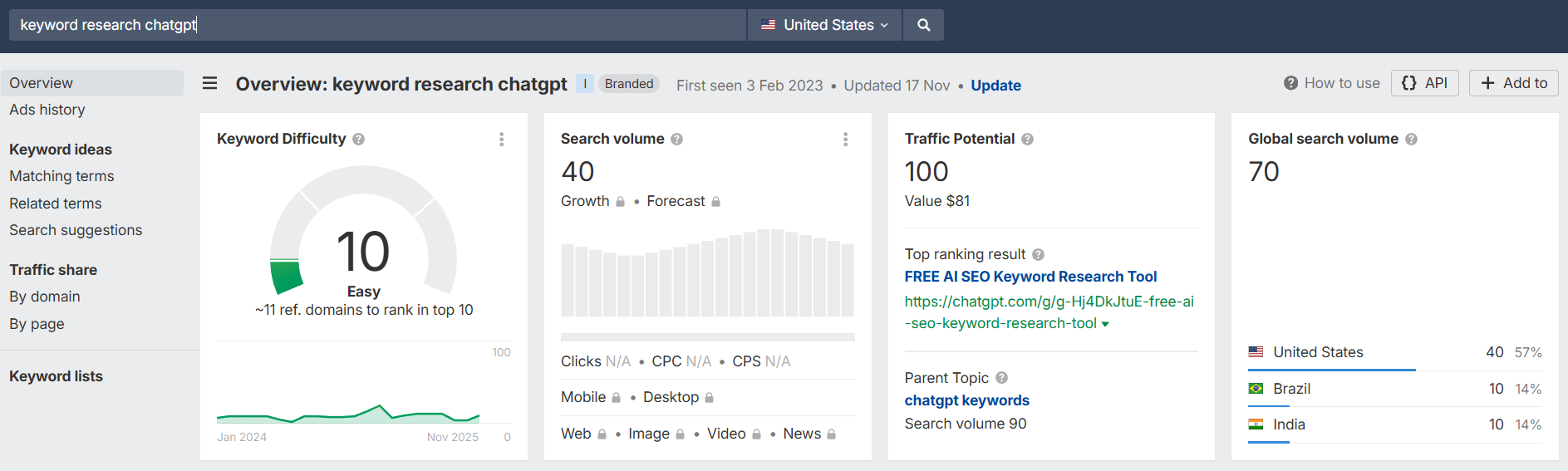
And this is the keyword that this very article is targeting, “keyword research chatgpt”.
Yes, it only has a global search volume of 70. But, with a KD of only 10, it is very easy for us to slip in the top 10 results for this query.
Cost Per Click (CPC) relates to how expensive it is to buy ads for any given keyword. More competitive keywords generally are more expensive.
I don’t currently use paid ads, but I use CPC as part of an “opportunity score” formula to quickly sort through large keyword lists.
More on that later.
Let’s find these keywords first.
Research General Topics
The first step in keyword research with ChatGPT is identifying general topic areas, also called seed keywords or main keywords. These are the broad themes your content (and product) revolves around.
Think of them as the foundation everything else is built on.
Ask yourself a simple question:
What would someone type into Google if they were looking for content like mine?
Since this article is about ChatGPT keyword research, some obvious general topics might be:
- ChatGPT SEO
- Keyword research
- AI for SEO
- Content ideation
- SEO tools
- Blogging with ChatGPT
These are not keywords you’ll necessarily target directly. Most of them are way too broad and competitive. Their job is to act as starting points for your content strategy.
Just like with traditional keyword research tools, these topics should be tightly aligned with:
- Your niche
- Your audience
- Your product or service (if you have one)
Instead of staring at a blank page and brainstorming manually, you can have ChatGPT do the heavy lifting and quickly generate topic clusters you might not think of yourself.
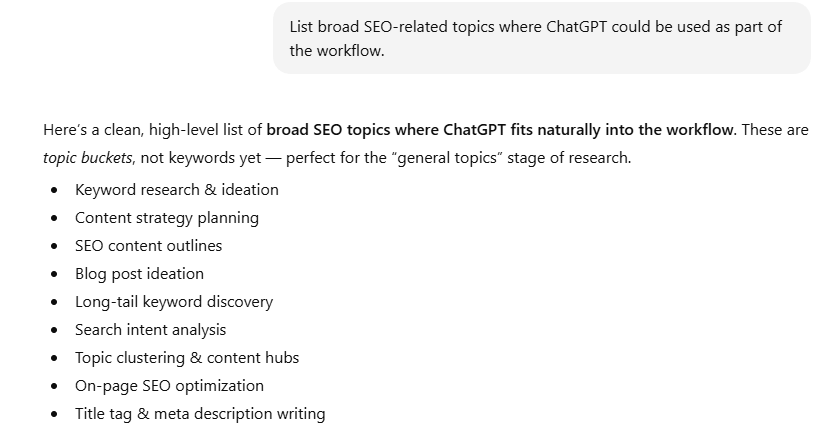
Here are a few prompts I regularly use.
- “List broad SEO-related topics where ChatGPT could be used as part of the workflow.”
- “I’m writing content about keyword research with ChatGPT. Give me 10 high-level topic areas related to this.”
- “What general SEO topics would beginners search for when learning how to use ChatGPT for content and keyword research?”
You’ll get a mixed bag. Some good, some bad, and some surprisingly good.
Remember: for now, you’re just getting content ideas. You’ll sift through them using proper metrics later.
Move on To Long-Tail Keywords
Once you have your general topics, it’s time to get specific.
This is where long-tail keywords come in, and this is where ChatGPT becomes genuinely useful for SEO.
Long-tail keywords are longer, more descriptive search queries. They usually:
- Have lower search volume
- Are far less competitive
- Show very clear search intent
In other words: they’re much easier to rank for.
Instead of trying to rank for something vague like “ChatGPT SEO”, you want keywords like:
- how to do keyword research with chatgpt
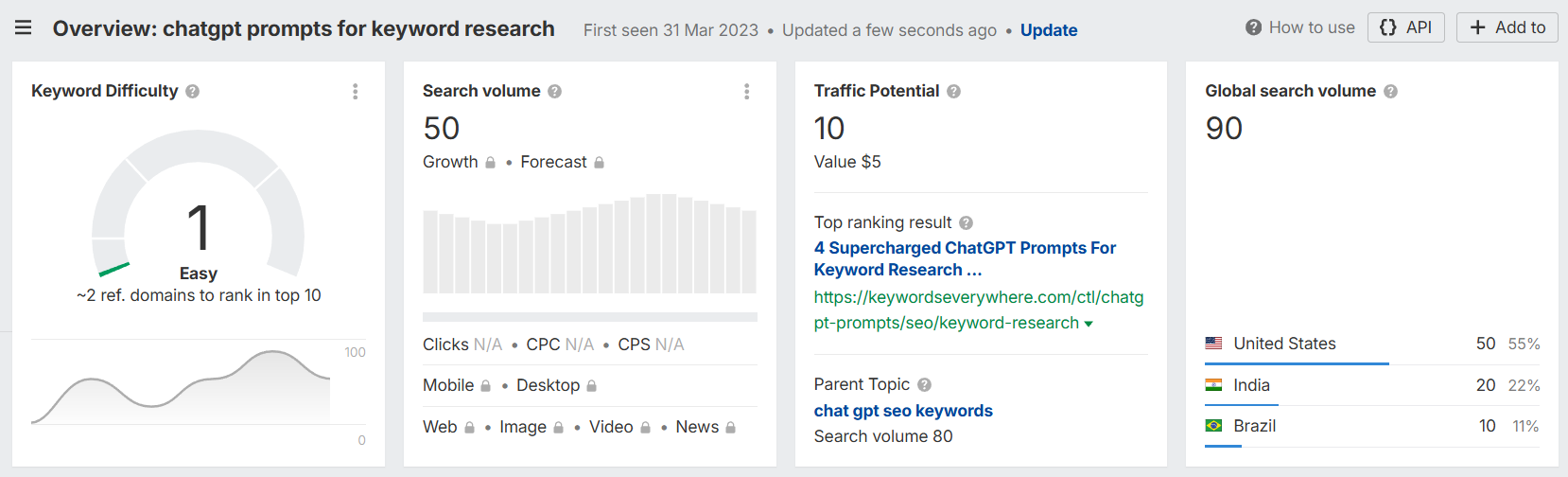
- chatgpt prompts for keyword research
- can chatgpt replace keyword research tools
See for yourself: only 1 KD but almost 100 global search volume:
You’re basically asking ChatGPT:
“If someone is searching around this topic, what exactly would they type into Google?”
Here are a few prompts to do that:
- Give me a list of long-tail keyword ideas related to keyword research with ChatGPT.
- List long-tail keywords people might search for when trying to use ChatGPT for SEO keyword research.
- Generate long-tail keywords for beginners learning keyword research with ChatGPT.
Check Full Questions
Now, when people look stuff up on Google, they don’t robotically type keywords.
They talk to search engines like they do to people: by asking questions.
Which is why I like to take a look at these questions as part of our keyword research process.
Because a huge portion of searches (especially low-competition ones) are phrased as questions.
And Google loves ranking clear, well-structured answers for them.
Think about how people actually search:
- can you do keyword research with chatgpt
- is chatgpt good for seo
- how accurate is chatgpt keyword research
These are incredibly specific, intent-driven queries, and they’re often much easier to rank for than generic keyword phrases.
Whole questions can also contain new and sometimes unexpected keyword ideas: both short-tail and long-tail.
The People Also Ask section in Google is also a great source of question ideas:
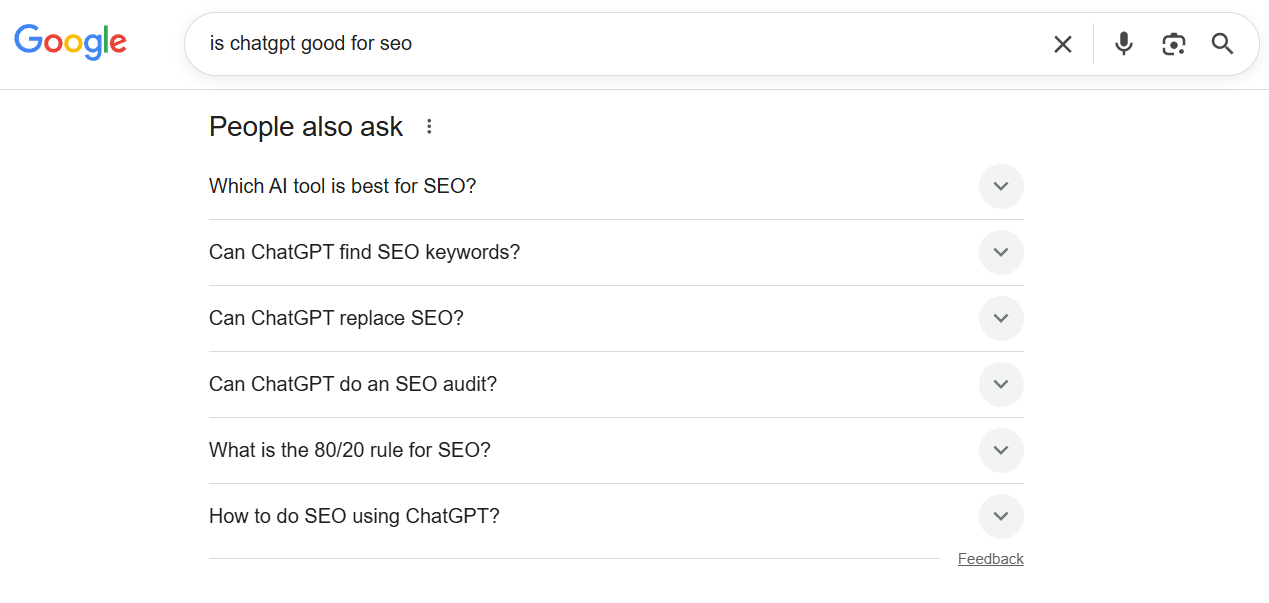
Here are a few prompts I use.
- Turn these keywords into common Google search questions: [keyword list]
- What questions do people ask about doing keyword research with ChatGPT?
- List beginner questions about using ChatGPT for SEO keyword research.
Can You Check Competitor Keywords with ChatGPT?
Another important step of keyword research is competitive analysis.
This means finding related keywords that your competitors are ranking for, but you aren’t.
It’s actually our favorite keyword research strategy, since all the research has already been done for us, all I need to do is take a peek.
Can ChatGPT help with that?
Somewhat. Yes, it can find and cite your competitors’ articles.
It might even extract the correct keywords out of their titles. But you have to remember, it’s just a language model, and what it’s doing is synthesizing an answer out of Google search results.
So it’s just guessing.
If you want to run actual competitor keyword analysis, you’ll need a proper keyword tool like Ahrefs.
Here’s how to do it.
Step 1: Choose the Right Competitors
Before opening any tools, you need to be clear on who your real competitors actually are.
This isn’t just about similar features. Audience overlap matters far more.
For example, two tools might both do email outreach, but if one is built for enterprise teams and the other is aimed at freelancers, their keyword strategies will look completely different.
For keyword research purposes, you want competitors that:
- Target the same type of customer
- Publish content consistently
- Rank for topics you’d realistically want to own
Pick a small list. Usually 3 to 5 domains is more than enough.
Step 2: Use Ahrefs’ Content Gap
Once you’re in Ahrefs, open the Content Gap tool.
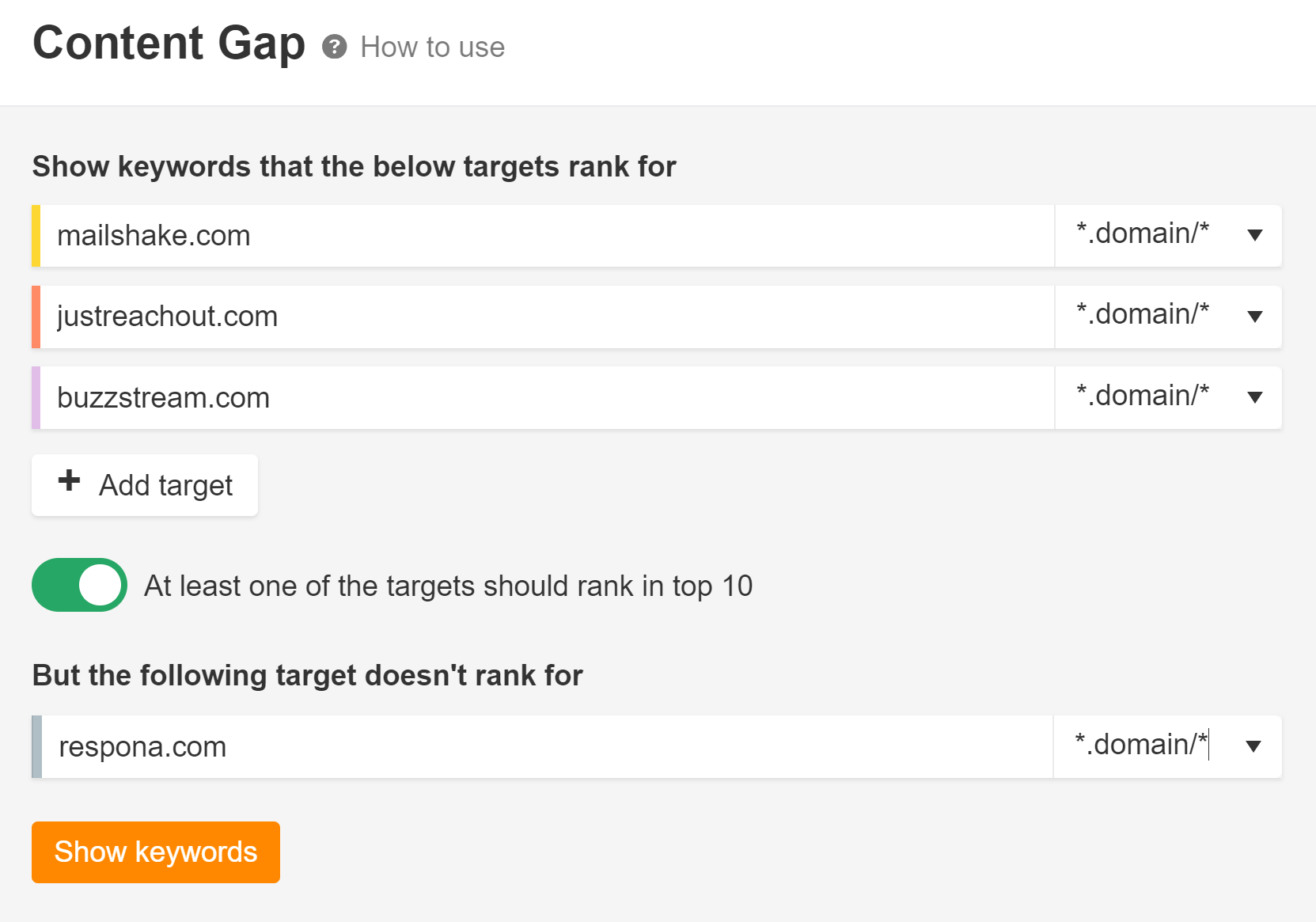
This lets you compare your site directly against multiple competitors and highlights keywords where they have rankings, but you don’t.
Add your competitors’ domains to the top fields, your own domain to the bottom field, and run the report.
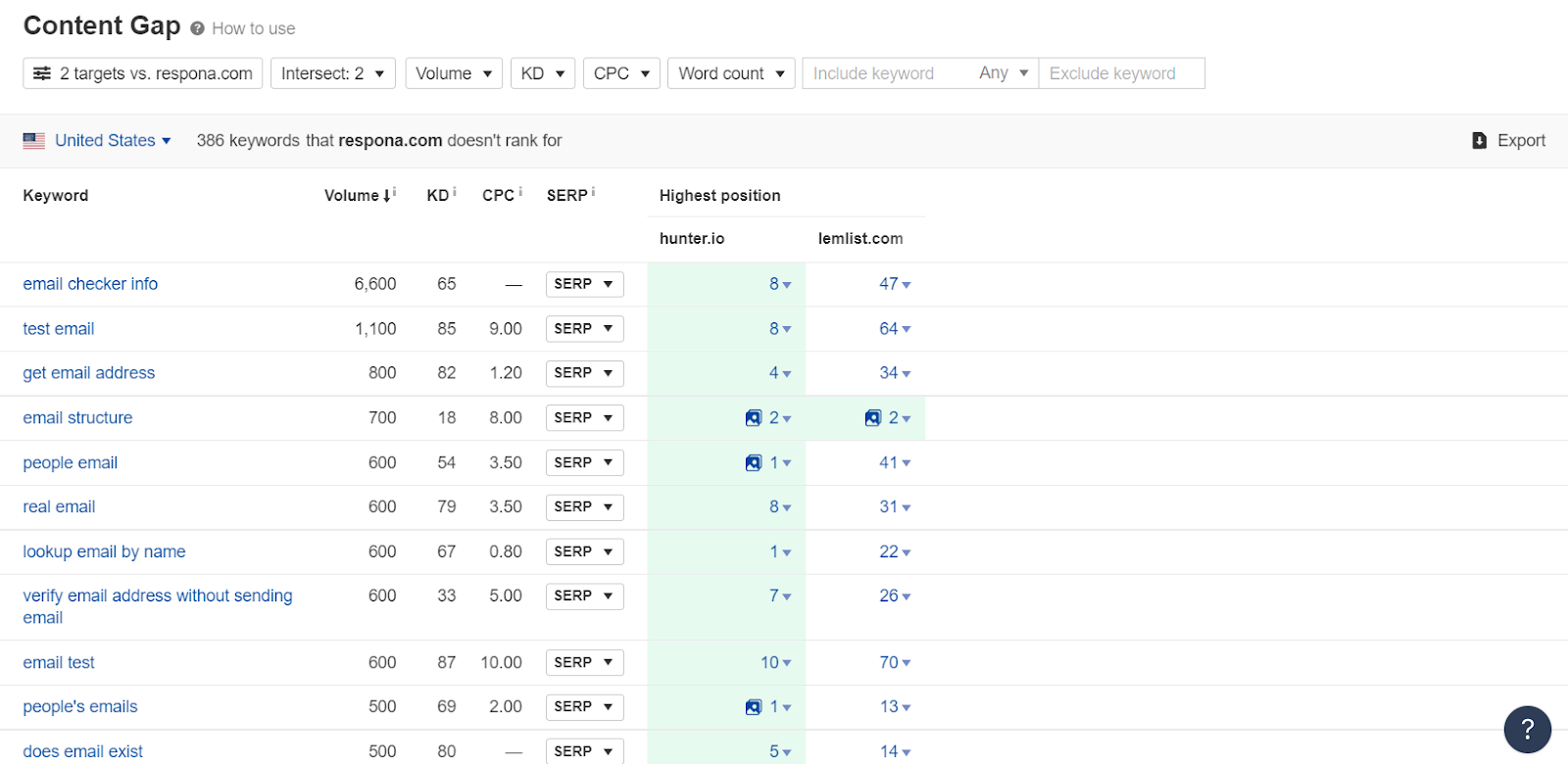
Here is also where you’ll find the three most important keyword metrics:
- Search Volume
- Keyword Difficulty
- Cost Per Click (CPC)
I recommend filtering these by Keyword Difficulty and remove everything that’s too competitive.
Remember: there’s no point in trying to compete with industry giants.
It’s much easier (and more consistent) to pick quick wins.
Export the list and move on to the next step.
Organize, Check with Ahrefs, Take Your Picks!
Now the real research starts. Yep, at the very end.
If you’ve followed the process so far, you probably have a long, messy list pulled from ChatGPT (and maybe some from your competitor research).
Check every single one of them in Ahrefs. Luckily, it offers a bulk keywords explorer:
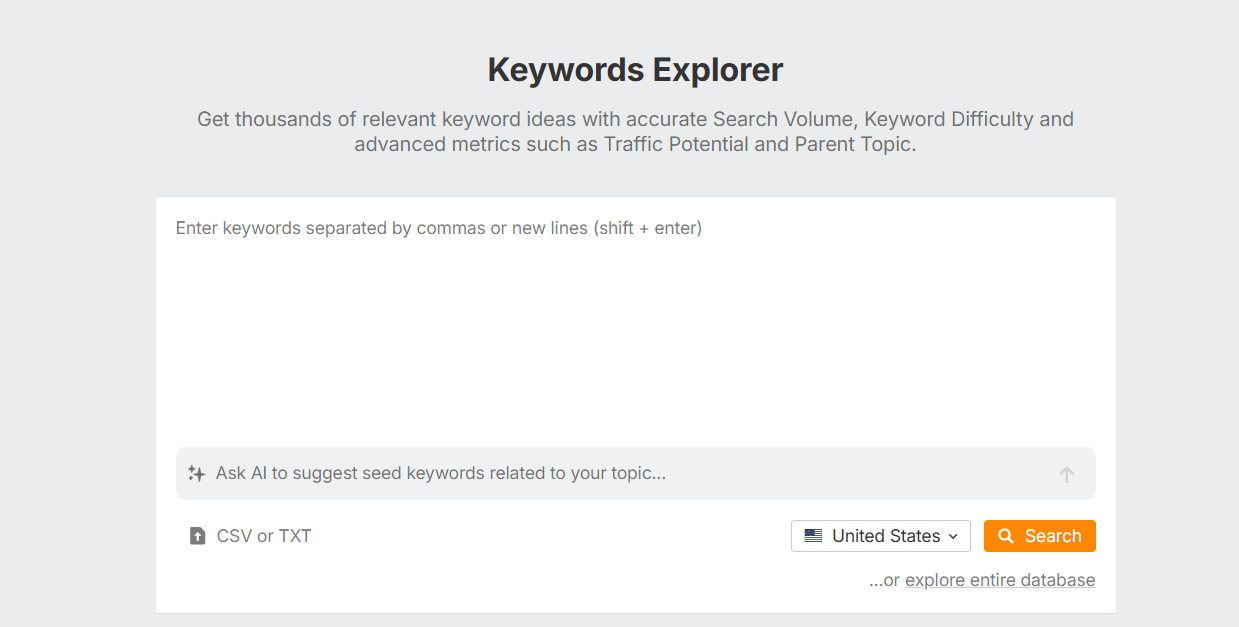
Keywords on their own are useless without any real metrics.
Once you’ve enriched your list, you’ll need to group keywords into topic clusters through keyword clustering. Instead of treating every keyword as its own content idea, I look for shared search intent.
Keywords that essentially answer the same question or solve the same problem belong together in a keyword cluster.
This makes it much easier to plan content creation and prevents you from publishing multiple blog posts that end up cannibalizing each other.
Once everything is grouped, the list usually shrinks on its own. Remove duplicates and focus on the potential keywords with the lowest difficulty score and highest traffic potential.
For this, I recommend using a simple opportunity score.
Rather than eyeballing difficulty, traffic, and CPC, I roll them into a single number using this formula:
(1 / keyword difficulty) × traffic potential × (CPC + 1)
Note: This isn’t some universal SEO rule or magic equation. It’s just a quick way to sort large lists of keywords with low competition, reasonable traffic, and at least some commercial intent. Adding 1 to CPC ensures purely informational keywords don’t get wiped out. Those are actually where most of our traffic comes from.
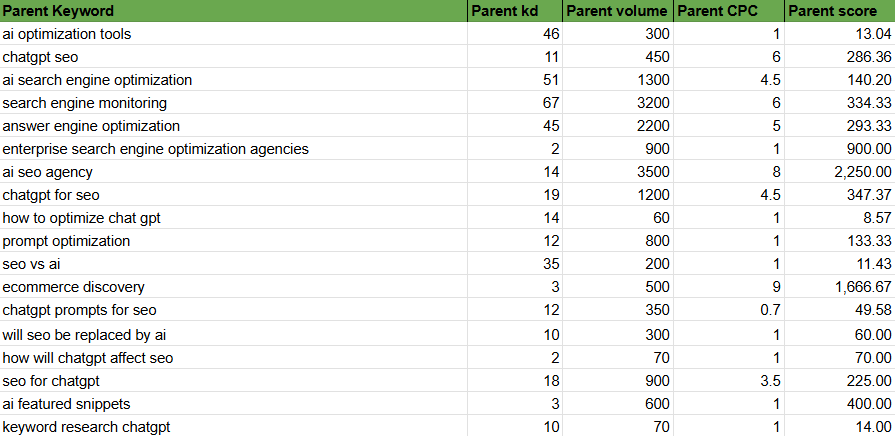
Sort your Google Sheet by this score and you’ll see a pattern.
The best opportunities usually aren’t flashy, high-volume keywords.
They’re some random question about an obscure topic.
And who makes searches like these? That’s right: people who actually engage with that topic.
Those are the keywords I pick.
At this point, you’re no longer guessing or going off gut feeling. You have clustered topics, real SEO data, and valuable insights for a clear prioritization method.
That’s more than enough to confidently decide what to write next.
Link building cheat sheet
Now Over to You
In conclusion, ChatGPT is great for keyword research, but on its own, it lacks real SEO data.
This is why if you’re serious about publishing content, you’ll also need the help of a keyword tool like Ahrefs or Semrush.
But here’s the thing: great content with perfect keywords isn’t enough.
You can have the best-researched SEO keywords and the most perfectly optimized articles, but if Google doesn’t see your site as authoritative, you won’t crack the top 10.
And if you’re not in the top 10? You won’t get captured by Google’s AI Overviews.
You won’t show up in featured snippets.
You won’t get traffic.
The missing piece? High-quality backlinks.
Backlinks signal to Google that your content is trustworthy and worth ranking. They’re the difference between sitting on page 3 and getting featured at position zero.
Building them manually takes months of outreach, relationship building, and follow-ups. Most businesses simply don’t have that time.
That’s where we come in.
Our fully-managed link building does all the heavy lifting for you. You focus on creating great content with your newly researched keywords – we’ll make sure Google actually sees it.
Ready to turn your keyword research into actual rankings? Sign up for our done-for-you link building and let’s get you to position zero.
Frequently Asked Questions (FAQ)
Can ChatGPT replace traditional keyword research tools?
No. ChatGPT is great for generating ideas and uncovering angles you might not think of, but it doesn’t have access to live SEO data like search volume, keyword difficulty, or traffic estimates.
For real decision-making, you still need a keyword research tool like Ahrefs or Semrush. SEO professionals and SEO experts rely on these tools for accurate keyword data.
Is ChatGPT good for finding low-competition keywords?
Yes, but indirectly. ChatGPT can surface long-tail keywords, questions, and niche phrasing that often end up being low-competition.
You still need to validate those potential keywords in an SEO tool to confirm difficulty and traffic based on search intent.
How accurate are ChatGPT’s keyword suggestions?
They’re directionally useful, not data-accurate. ChatGPT bases suggestions on language patterns, not ranking data, so it can suggest keywords that sound realistic but have no search demand.
Think of it as a brainstorming assistant for content ideas, not a measurement tool. For accurate keyword metrics, use Google Keyword Planner or other keyword research tools alongside your SEO strategy.
What kind of keywords work best with ChatGPT?
Long-tail keywords and informational keywords work best. Using the right ChatGPT prompt around “how,” “can you,” “best way to,” and beginner-style questions tend to produce realistic search queries that are easier to rank for once validated.
Focus on relevant keywords that match your search intent and content strategy.
Should I use ChatGPT at the start or end of keyword research?
At the start. ChatGPT is most valuable during ideation: generating topics, angles, and questions for your SEO efforts.
Once you have those ideas, keyword research tools should take over for validation, prioritization, and final keyword selection. You can also use Google Search Console and technical SEO analysis to identify specific keywords already driving traffic to your site.