
Relationship-based link building can sound like a buzzword with not a whole lot of meaning behind it.
But it’s actually the ultimate way to scale your link building.
It goes like this: you have your cold email link building – and then you have a separate process of building quality backlinks with your partners.
In this ultimate guide, we’ll be breaking down exactly how relationship-based link building works, how to find and recruit new partners, and of course, how to KEEP them.
Let’s begin.
Key Takeaways:
- Relationship building is what scales link building past the cold email plateau. Cold outreach has a ceiling. Once you’ve built genuine relationships with 20-30 link builders in your space, you’re getting links on autopilot instead of pitching from scratch every campaign. The compounding effect is what makes this approach the most sustainable long-term play.
- Pitch the partnership, not the favour. Most pitches treat the first interaction as a one-off ask. Frame it as the start of an ongoing exchange. You’re trying to build relationships, not just secure one valuable backlink and disappear.
- Tracker sheets are non-negotiable once you scale. A casual partnership becomes a serious link source when you remember to send the partner a new draft every two weeks. Without a tracker, your best partners get forgotten while you chase new ones. That’s how good relationships go cold.
- Quality matters more than volume. Twenty active relationships with credible publishers in your space will produce more high quality links than 200 dormant contacts. Focus on building relationships with link builders who consistently produce content in your category, not on collecting names.
- AI search is changing what counts as a valuable backlink in 2026. Editorial mentions inside listicles and roundups that AI engines like ChatGPT and Perplexity pull citations from are worth more than they were even a year ago. Prioritise relationship building with publishers whose content shows up in AI answers, not just in Google.
- A pay-per-result service can compress months of relationship building into weeks. If you don’t have time to build your own partner network from scratch, an outsourced provider that already has those publisher relationships can fast-forward you straight to the results. We’ll cover that in the next section.
Link building cheat sheet
What is Relationship Based Link Building?
Relationship-based link building is a loose term used to describe an agreement between two or more link builders.
This agreement involves regularly providing each other with links – either from the same domains or new ones.
The most common setup looks like this:
- Both link builders regularly write guest posts for new sites
- They send each other their drafts to include each other’s links
- Profit! Both sides get links
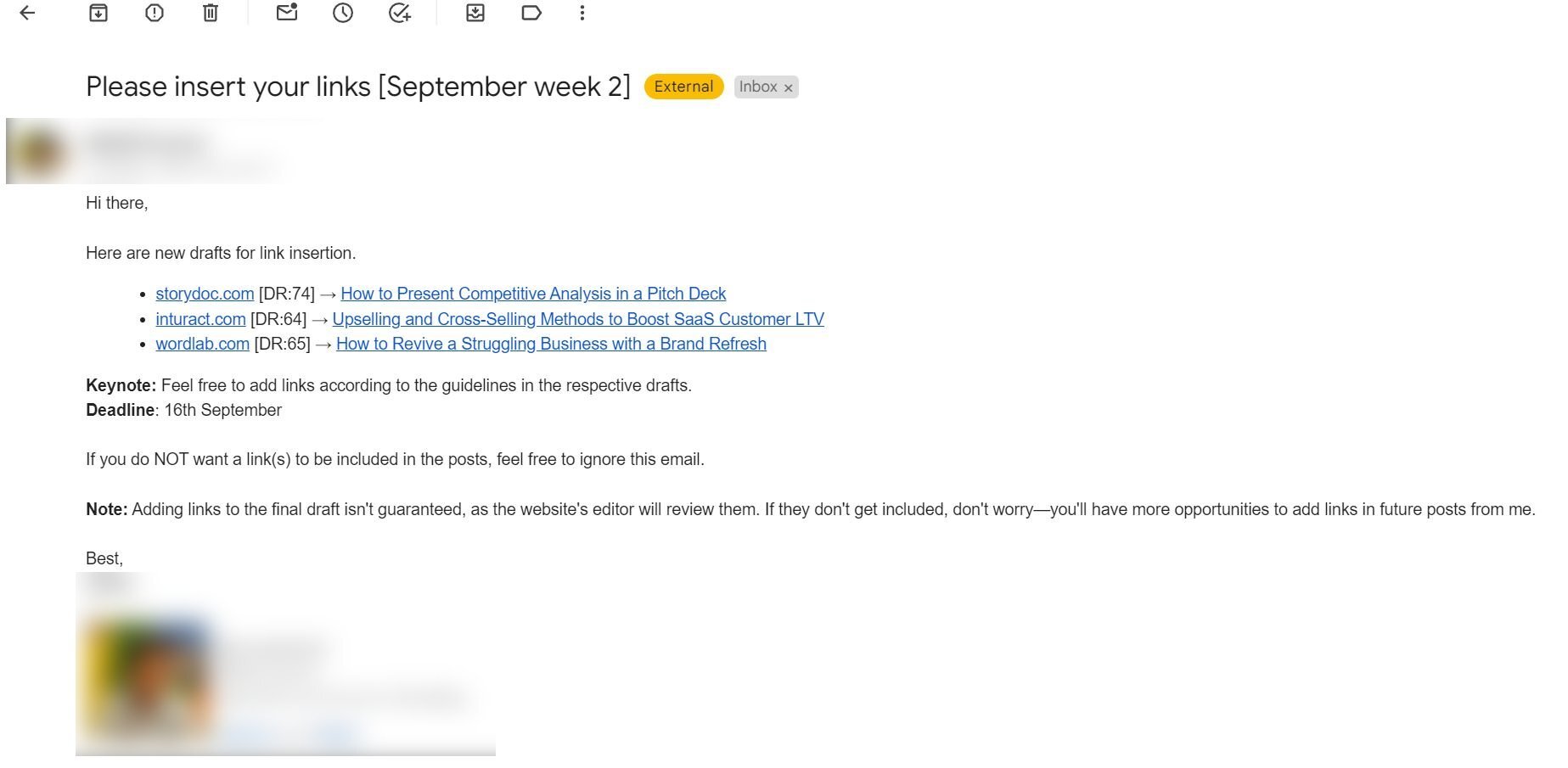
Now, imagine you have a network of 30 partners you do this with.
Building links is a game of numbers – and the more partners you have to support your link building efforts, the more links you’ll build in the end.
Additionally, your partners may have insider access on some really good sites you wouldn’t normally be able to reach with a cold email – like Backlinko.
How to Find New Partners?
In this section, we won’t be focusing on every individual link building strategy like link insertion, broken link building, resource page link building, guest posting, etc.
Instead, we will focus on the top four (in our opinion) tips on how to get the most out of your relationship-based link building.
Each one is applied internally in our link building team on a daily basis.
If you’d like to learn more about specific link building campaign types, feel free to start our fere video link building course.
It covers:
- Technical setup
- How to write a good pitch
- Step-by-step tutorials on 15 different strategies
Pitch Long Term Relationships to Every Prospect
Let’s imagine a situation: you were running some blogger outreach campaigns in the background and have already secured some links from your target sites.
Why not try and recruit these people as regular partners?
After all, you’ve already got your foot in the door.
A solid starting point for a long-term collaboration is to pitch a guest post.
Even if they don’t have a “Write for us” page.
Here’s the catch – we call it the Content Gap strategy.
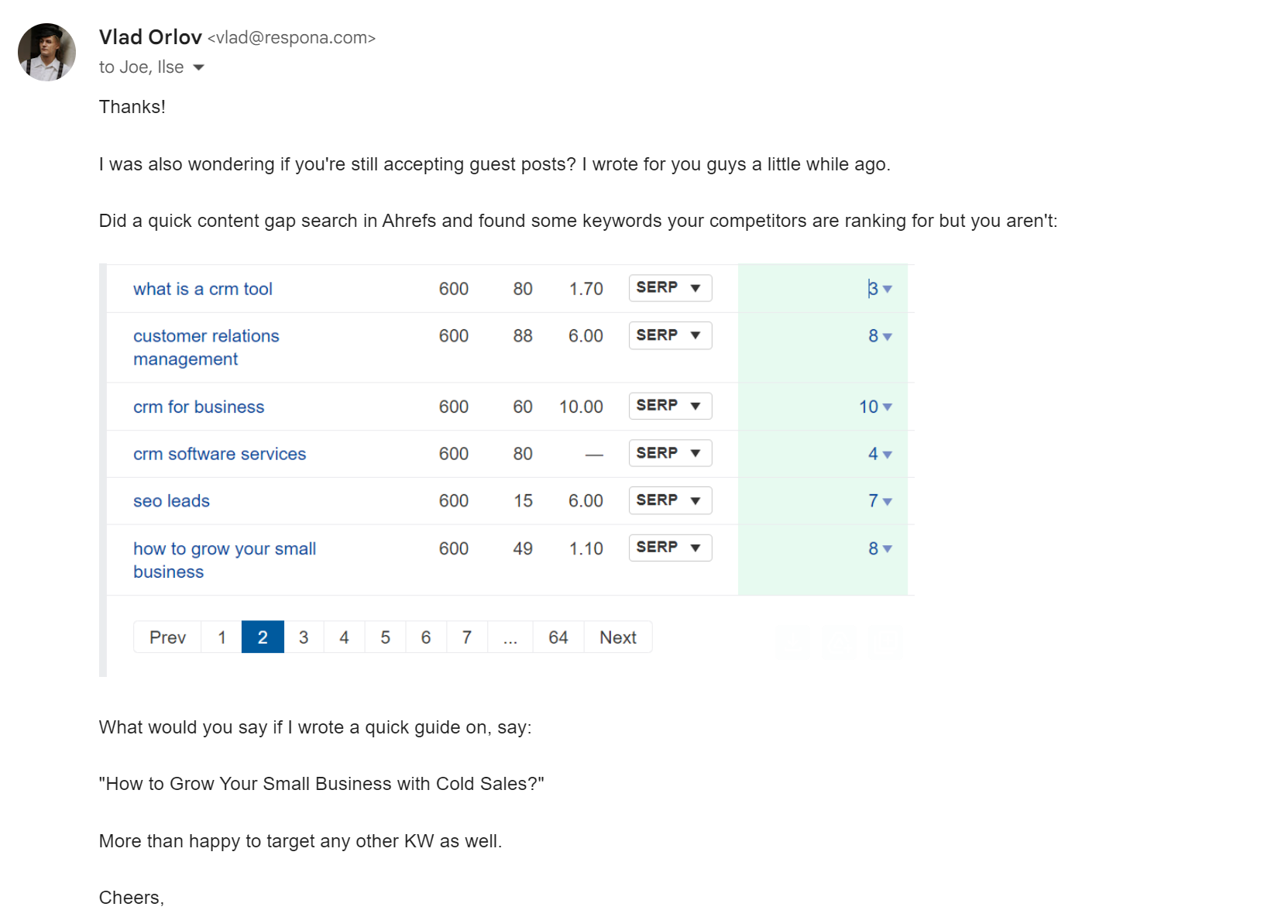
In it, you’ll be figuring out which keywords your prospect does not have a search engine ranking for but their competitors do.
Then, you’ll be taking a screenshot of the missing keywords report and offering to write an article to cover their content gap.
Pro tip: Don’t call it a “guest post”. Everyone is tired of link exchanges, “partnership opportunities”, and guest posts – but the careful choice of words may land you an article on a site that doesn’t typically accept guest posts at all.
You’ll need a keyword tracking tool such as Ahrefs or Semrush.
We’ll be using Semrush in our example.
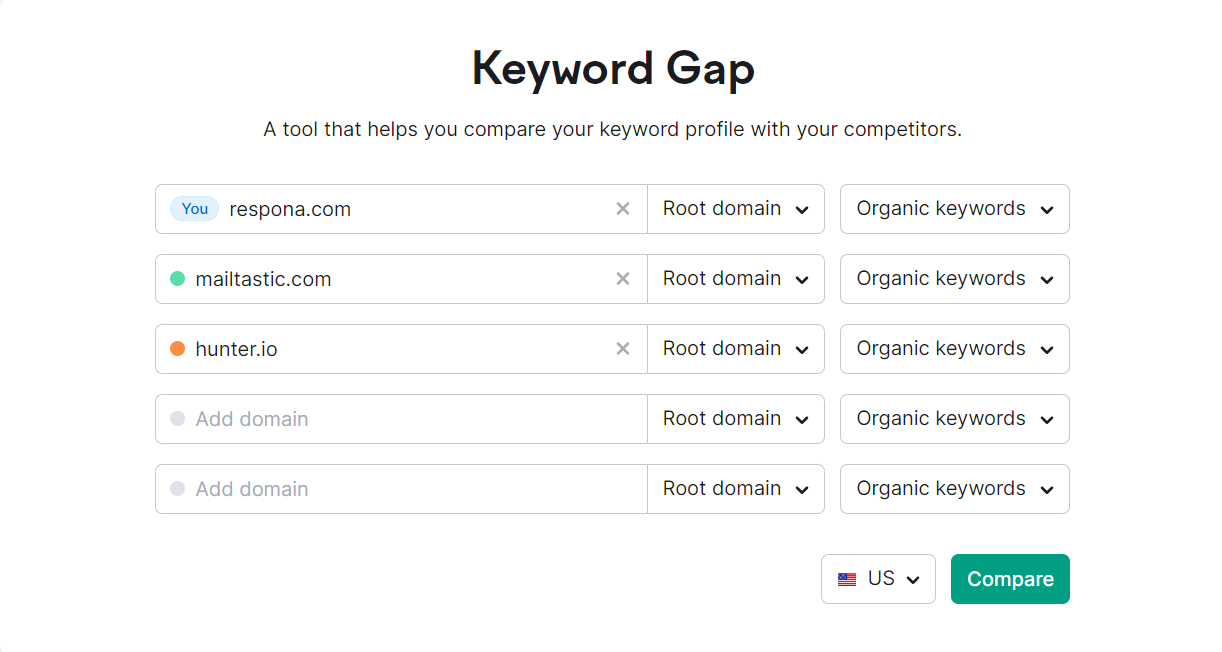
Go to the Keyword Gap report and paste your prospects’ website along with 1-2 competitors.
Then, hit “Compare” and navigate to the “Missing” tab.
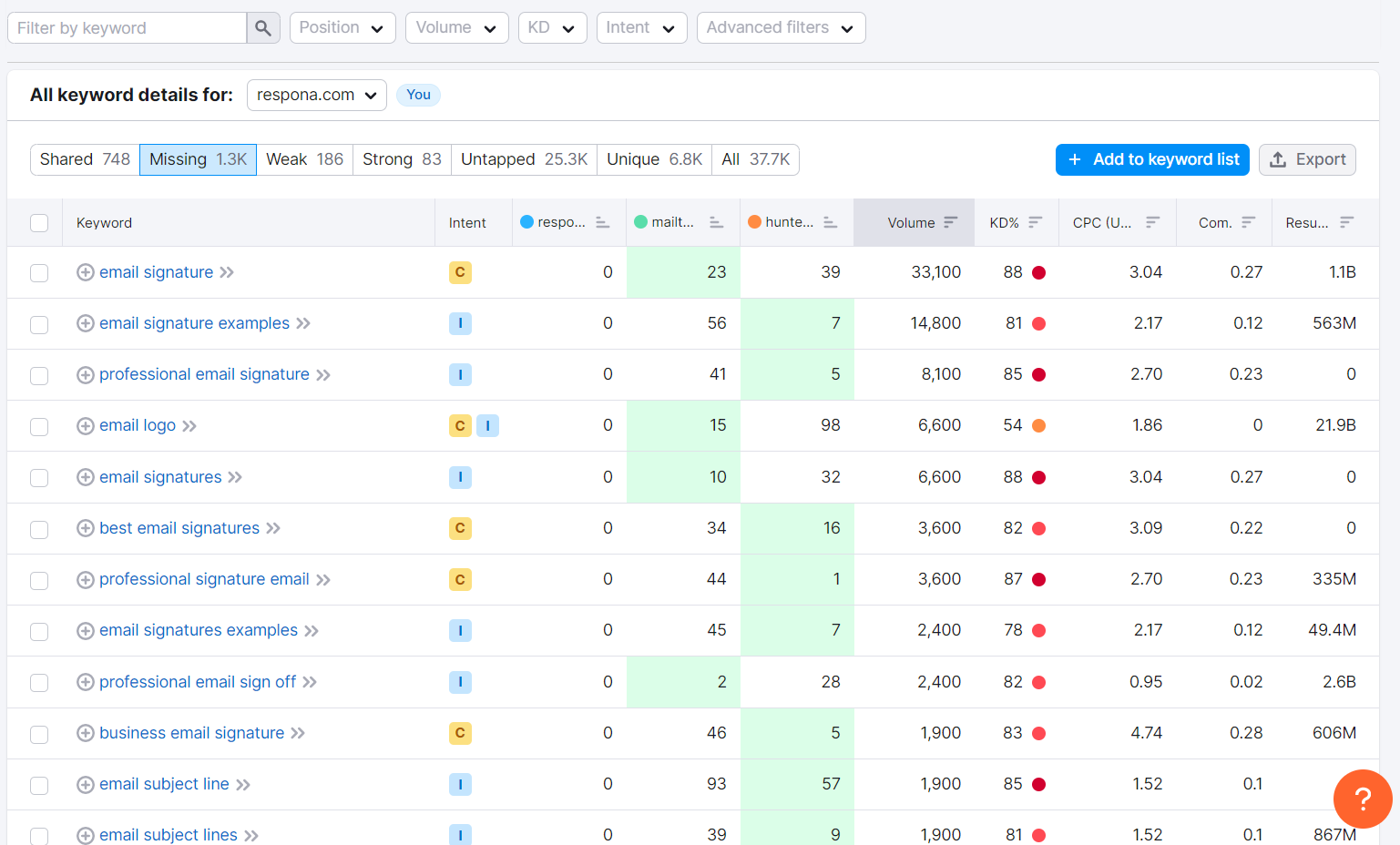
From here on, just pick a keyword or two that you like and offer to write a piece to cover the gap!
This strategy is great for building relationships because you’re:
- Providing an immense amount of value to your prospect by covering a real content gap they have
- Showing your expertise and proactivity by researching their website vs their competitors beyond what’s available with just a search engine query
Now, on to the next strategy.
Join SEO Link Building Communities
Link builders are a crowd that likes to stick together – because it’s easier to get their work done.
So, if you’re looking to quickly find some long-term partners, the first place you should look would be the dozens of online link builder communities.
These are present on every major social media platform – and even on Slack.
Take for example Link Building HQ ran by uSERP:
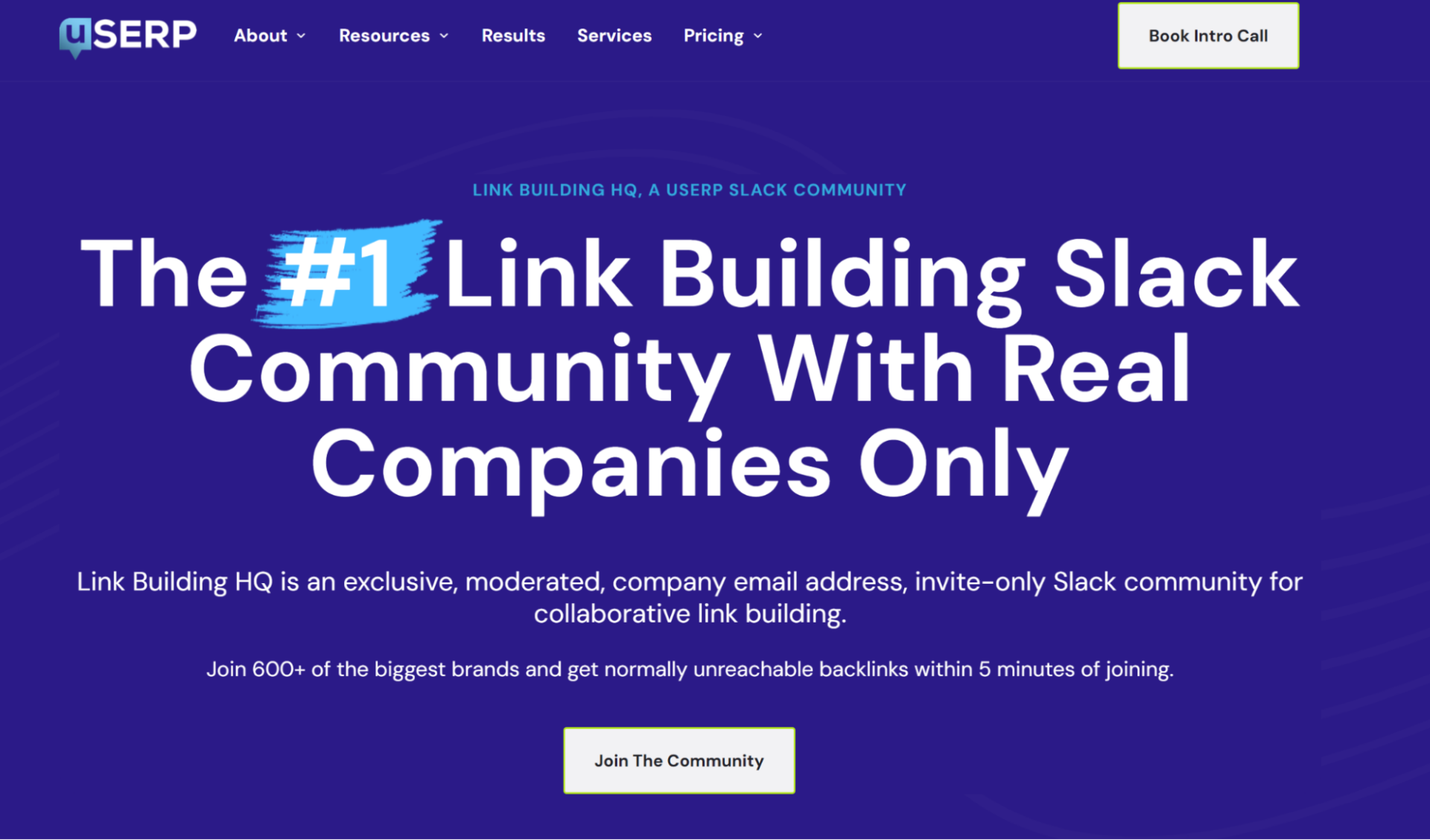
Fun fact: our link builder (who is coincidentally the writer of this article) built 38 links on the week that they joined 5 or so link building communities.
The downside to them is that they tend to attract the same few people – but are an awesome way to quickly grow your partner list.
Provide Value Upfront
One of the biggest things that makes you a great partner is not being a pain to work with.
By this, I mean that you should always be quick about giving partners their links.
Or, at least, sending them resources where they can get them.
This ties in into our Content Gap strategy – it works because it’s one huge value proposition.
So, in your pitches, instead of asking “Hey, can I get a link here?”, say:
- Your link is live here
- Here’s a new guest post draft, feel free to insert your link here
- I have sites x, y, and z right now, interested?
Even though you can be on friendly terms with your link partners, this is business we’re talking about.
If you want something, you’ll have to give something in return – and the quicker you do it, the faster you’ll get your link in return.
Use Tracker Sheets
This may seem like an inconsequential tip, but tracker sheets are important.
I can’t tell you how many times I’ve forgotten to send my best partners a new draft simply because I relied on memory alone.
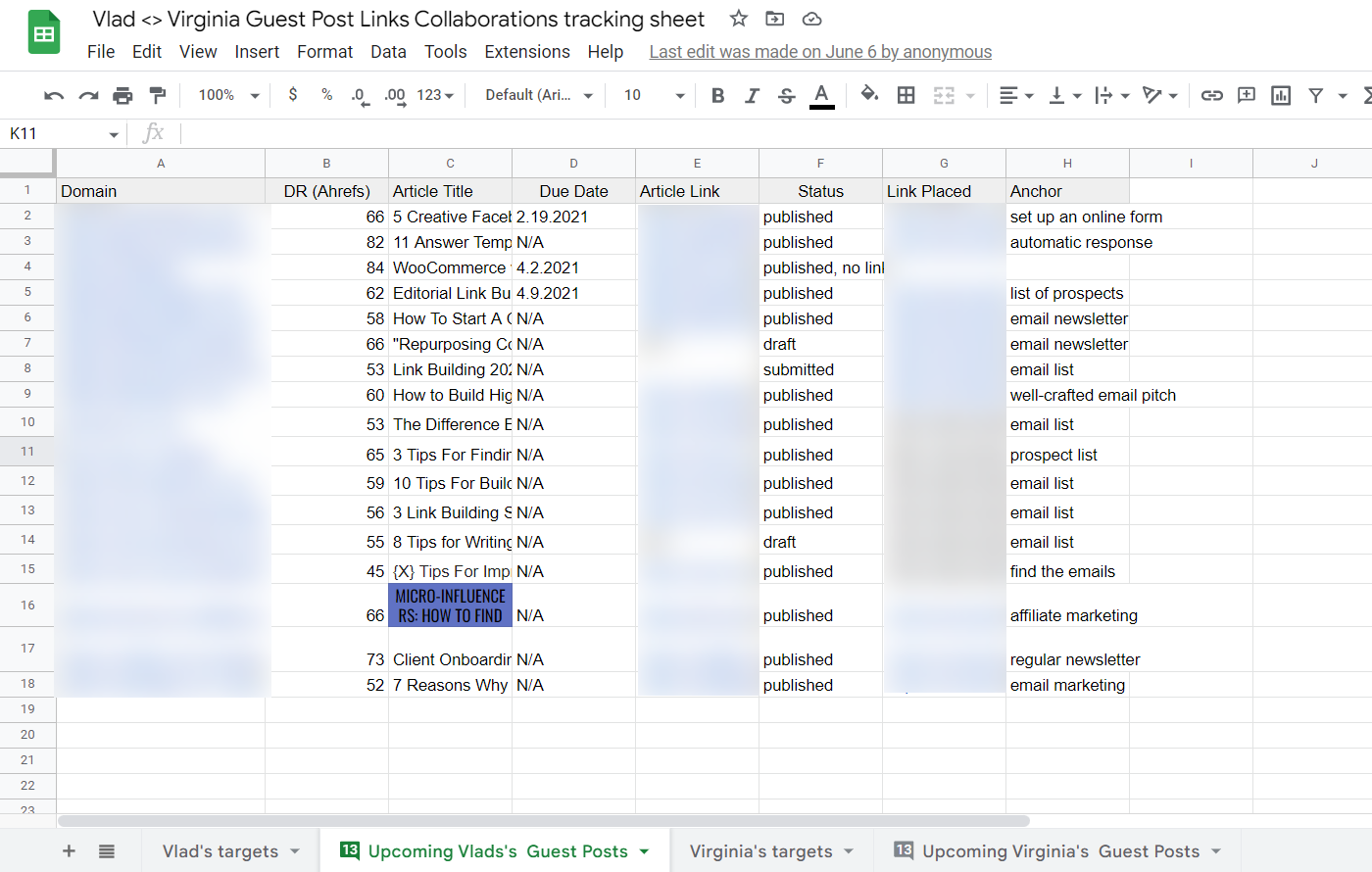
You can have one master sheet with tabs for each individual partner, or have a dozen different sheets.
We recommend going for the former – link building and content marketing in general can get VERY messy if you keep multiple sheets.
Leverage a Pay-Per-Result Service
All of this takes time. The communities, the cold drafts, the tracker sheets, the slow building of partnerships. You’re looking at months of work to start seeing any kind of tangible result.
If you don’t have that kind of runway, there’s a faster way.
It’s called pay-per-result link building, and it goes like this:
You send us your target pages, target keywords, and any anchor text preferences.
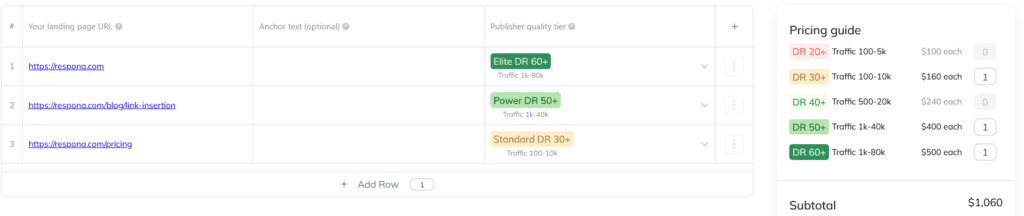
We tap our existing partner network (editors and publishers we’ve been working with for years) to find the ones in your niche.
We pitch them on your behalf. We send each prospect to you for approval before any email goes out.
The team prioritizes listicles for their dual benefit: AI citations on top of improved organic rankings.
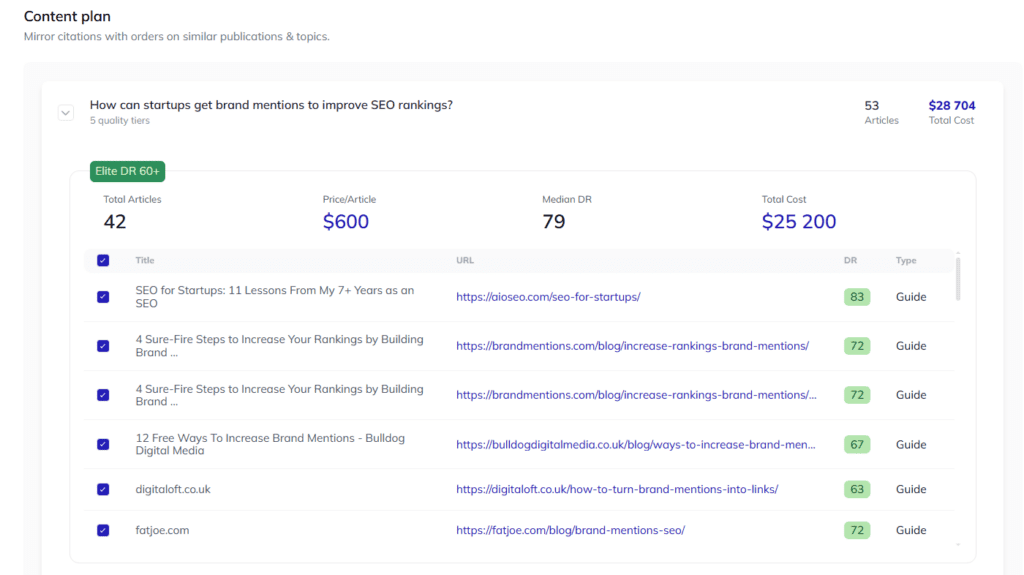
Pricing is tiered by DR. Starts at $100 per placement for DR 20+ sites, goes up to $500 for the DR 60+ stuff. No retainer, no minimum commitment.
You pay for each link that lands. That’s it.
When you have real relationships with publishers, getting links is easy. When you don’t, it’s a grind.
Building relationships from scratch takes a year. Borrowing ours takes a kickoff call.
Link building cheat sheet
Now Over to You
So, in conclusion, this approach is the most sustainable way to scale your link building program once you’ve done the work to find and keep the right partners. It compounds in a way cold outreach never quite matches.
The shortcut is letting someone else’s existing partner network do the heavy lifting for you.
If you’d rather skip the year of relationship building and go straight to the results, hand it off to Respona.
Share your target pages and target keywords, and we’ll handle the prospecting, pitching, and securing live placements with publishers we’ve worked with for years.
Frequently Asked Questions (FAQ)
What is Relationship-Based Link Building?
Relationship-based link building involves creating mutually beneficial partnerships with other link builders.
This strategy focuses on regularly exchanging links through guest posts or other collaborations rather than relying solely on cold email outreach.
How Do I Find Potential Link Building Partners?
Potential partners can be found in white label link building communities, social media groups, and industry forums.
These platforms are full of other link builders looking for similar opportunities, making it easier to establish long-term collaborations.
What Should I Include in My Pitch to a New Partner?
A successful pitch should emphasize mutual benefits and provide value upfront.
Consider offering a guest post idea based on keyword gaps in their content or delivering immediate, high quality link placements to demonstrate your commitment to the partnership.
How Do I Keep Track of Links and Partnerships?
Use tracking sheets to manage your partnerships and links systematically.
This ensures you never miss an opportunity to share new content with partners and helps maintain a smooth workflow in your link-building efforts.
Why Choose Relationship-Based Link Building Over Traditional Methods?
Genuine relationship based link building is more sustainable and scalable, providing ongoing link opportunities with trusted partners.
It also helps you access relevant websites that might be difficult to reach through traditional cold email outreach methods.
What’s the difference between relationship-based link building and traditional cold outreach?
Cold outreach treats every email as a fresh ask. Partner-based outreach treats the first email as the start of an ongoing exchange.
The mechanics are similar (you’re still pitching content and asking for links), but the underlying goal is fundamentally different. Cold outreach optimises for one-time conversions; relationship building optimises for repeat opportunities over years.
How long does it take to build a useful partner network from scratch?
Most link builders see meaningful payback at the 6-12 month mark, after which the network starts compounding.
The first 30-60 days are usually slow because you’re still establishing trust with new partners. By month three you’re getting steady reciprocal links from a handful of partners. By month six you’ve usually built effective link building patterns with 10-15 regular contacts.
Does this approach work for solo SEOs and small teams?
Yes, and arguably better than for large teams. Solo SEOs can be more personal and direct in their outreach, which is exactly what works for genuine relationships. Large teams often outsource link building outreach to junior staff, which kills the personal touch that makes relationships work in the first place.
A small team that handles relationships personally typically gets better results than an agency at three times the cost.
How do I track partnerships beyond just a spreadsheet?
A spreadsheet works fine for the first 20-30 partners. Past that, most teams move to a CRM like HubSpot, Pipedrive, or Airtable to track outreach history, last contact date, pending exchanges, and the partner’s content explorer activity.
The system matters less than the discipline of actually updating it.
What kinds of partners should I prioritise?
Three filters matter most. First, content velocity: partners who publish frequently give you more link opportunities than partners who post once a quarter.
Second, topical relevance: links from a relevant website in your category pass more authority than links from off-topic sites. Third, willingness to reciprocate: some partners take links happily but never give them back. Drop those quickly.
Are link exchanges considered safe by Google?
Direct one-to-one link exchanges between two sites have been on Google’s watchlist for years. Multi-party arrangements (often called ABC link building) where partner A links to B, B links to C, and C links to A are much harder for Google to detect because there’s no direct reciprocation between any two domains.
Most experienced link builders use multi-party exchanges for this reason, and the value passed through these exchanges still counts.
How do I prevent my partners from going cold?
Send them something every 2-4 weeks. New guest post drafts, links you’ve already placed for them, or just a “hey, I’m working on a piece about X, want to be quoted?” message.
Going silent for months is the fastest way to lose a partner who’d otherwise still be sending you links a year later. The same logic applies to keeping site owners engaged across long campaigns.
Should partners exchange dofollow or nofollow links?
Dofollow whenever possible, since dofollow passes link equity that contributes to search engine rankings. That said, a nofollow link from an authoritative publisher still drives referral traffic and brand visibility, so don’t dismiss them.
A balanced mix of dofollow and nofollow looks more natural to search engines than a 100% dofollow profile anyway.
How does this strategy work alongside influencer marketing?
Influencer marketing and link building overlap when an external personality publishes a blog post or hosts a podcast.
Treat influencers in your space as another type of partner: provide value upfront, build the relationship over time, and reciprocate when they need a quote, contribution, or backlink themselves. The same playbook that works for SEO bloggers works for influencers, just with different content formats.
What’s the role of linkable assets in this strategy?
Original research, free tools, calculators, and definitive guides are what give your partners a reason to actually link to you.
A partner can promise you ten links per quarter, but if you don’t have content worth linking to, those promised links won’t materialise. Invest in linkable assets first; build relationships around them second.
How do AI engines like ChatGPT factor into modern link building?
AI engines pull citations from the same authoritative editorial sites that traditional SEO has always prioritised.
The new wrinkle is that AI engines reference a smaller subset of sources than Google indexes, so getting cited inside ChatGPT or Perplexity requires being mentioned in specific listicles and roundups that those engines treat as authoritative.
Relationship building with publishers who consistently appear in AI citations is now one of the highest-leverage moves in modern link building.
Can I run this strategy without ever sending a cold email?
Eventually, yes. Once your partner network is mature, most of your outreach is to existing contacts rather than new prospects. But you’ll always need some cold outreach to keep replenishing the network as partners go quiet, change jobs, or stop publishing.
Plan for 70% existing relationships and 30% new outreach as a sustainable mix once you’ve reached scale.
What anchor text should I request from partners?
Vary the anchor text across placements. Some branded, some partial-match, some generic (“click here”-style anchors that look natural to search engines), and some exact-match keyword phrases when the context supports it.
A profile that’s 100% exact-match anchor text gets flagged faster than one with messy, varied anchor text. Most experienced link builders aim for a roughly 40/30/20/10 split across branded, partial-match, generic, and exact-match anchor text.
How does this approach affect overall SEO rankings?
Quality backlinks earned through partnerships move SEO rankings the same way any other editorial backlink does.
The difference is sustainability. A partner network produces a steady stream of relevant links over time rather than a single spike, which looks more natural to search engines than 50 links arriving in one month from cold outreach. One high quality backlink from a partner with topical relevance can be worth a dozen low-authority placements from a one-off link exchange.
Steady growth in a backlink profile correlates with steady ranking gains, and you can verify the quality of each new quality backlink by checking it lands inside the body content rather than buried in a sitewide footer alongside outbound links to dozens of unrelated domains.
Do partner links pass more link equity than other types?
In principle, no. Google evaluates the linking page on its own merits regardless of how the relationship was built.
In practice, partner links tend to come from more relevant websites (because partners tend to be in your niche), so they end up passing more SEO authority per link than random cold outreach placements.
Relevance is the multiplier.
How does this compare to internal links and external links from your own content?
Different roles. Internal links structure your site for crawlers and distribute authority across your pages. External links pointing outward from your content build trust signals when you cite valuable content as sources.
Partner-earned backlinks pointing inward to your site from other domains are what actually moves rankings. All three matter, but only the third is what this article is really about.
What’s the role of social media in modern link building?
Social media doesn’t directly pass authority (most social links are nofollow), but it amplifies the resources you’ve built.
Sharing your guides and original research on social media drives initial visibility that helps partners decide whether to actually use the content. Don’t treat social media as a link source; treat it as a discovery channel that feeds the relationship link building work.
How do I approach a site owner who isn’t already in my partner network?
Start with value, not the ask. Read 2-3 of their recent posts before reaching out. Reference something specific from their content in your first email.
Offer something concrete (a guest post draft, a piece of original research they could cite, a quote from an interview). Site owners get flooded with cold pitches; the only way through is to show you’ve actually engaged with their work.
Are link exchanges still safe in 2026?
Direct one-to-one link exchanges between two sites remain risky because Google has been detecting them for years.
A multi-party exchange (you link to partner B’s site, they link to partner C, partner C links to you) is much harder to detect because no two sites are directly reciprocating. Most experienced partner-based link builders structure exchanges as three-way arrangements for this reason.
What’s the biggest mistake teams make with relationship link building?
Treating it as transactional. The teams that scale partner networks well treat every interaction as relationship-building first, link-securing second. If a partner pings you for a favour and you say no without offering something instead, the relationship cools.
If you reach out only when you need something, partners stop responding. The investment of being a good partner pays back over years, but it requires patience that transactional outreach doesn’t demand.