
Despite the purchase and sale of links being directly against Google’s guidelines, you’ve probably noticed that it isn’t really stopping anyone.
And, chances are, you’ve tried reaching out to some webmasters only to be met with a price.
Don’t pay them!
Instead, learn how to get free backlinks below.
For some strategies, however, you may need to provide an indirect link in return – but it’s not the same as straight up paying for it.
Key Takeaways:
- Free backlinks aren’t actually free. Every strategy on this list costs you time, content production, or relationship-building. The “free” part means you’re not paying for the link itself, you’re paying with effort.
- The 10 most reliable ways to acquire free backlinks in 2026 are linkable assets, unlinked mentions, guest posting, ABC link exchanges, competitor backlinks, podcasting, broken-link strategies, resource pages, citation link building, and digital PR.
- Outreach is the unifying skill across all 10 strategies. Whether you’re claiming unlinked mentions or pitching a podcast guest spot, the difference between success and failure usually comes down to your outreach quality.
- Quality backlinks beat quantity, every time. A single quality backlink from a high-authority, topically relevant site is worth dozens of low-quality directory submissions or web 2.0 backlinks.
- Modern free backlink strategies need to target both Google search AND AI answer engines. Listicle placements, brand mentions, and editorial features all feed both organic ranking and AI citation visibility.
- A backlink generator tool can find prospects but can’t actually generate backlinks for you. Real backlinks come from outreach, exchanges, or content that earns links organically. Any product labeled a “free backlink generator” usually produces low-quality automated link spam to avoid.
Link building cheat sheet
Linkable Assets
Creating linkable assets is a foundational strategy for acquiring free backlinks.
These assets, sometimes called “link magnets,” are pieces of content designed to naturally attract links from other websites.
They’re valuable because they help you rank for a broader range of keywords and uncover more link-building opportunities.
Think of it this way: you need something compelling to offer when asking for a link.
It’s much easier to secure relevant backlinks for informative and helpful content, like blog posts, than it is for generic homepage or product pages.
Linkable assets provide that value.
Almost any type of content can be a linkable asset – a blog post, an infographic, a video, a tool, or even a well-crafted image.
However, some formats are more effective than others at organically attracting backlinks.
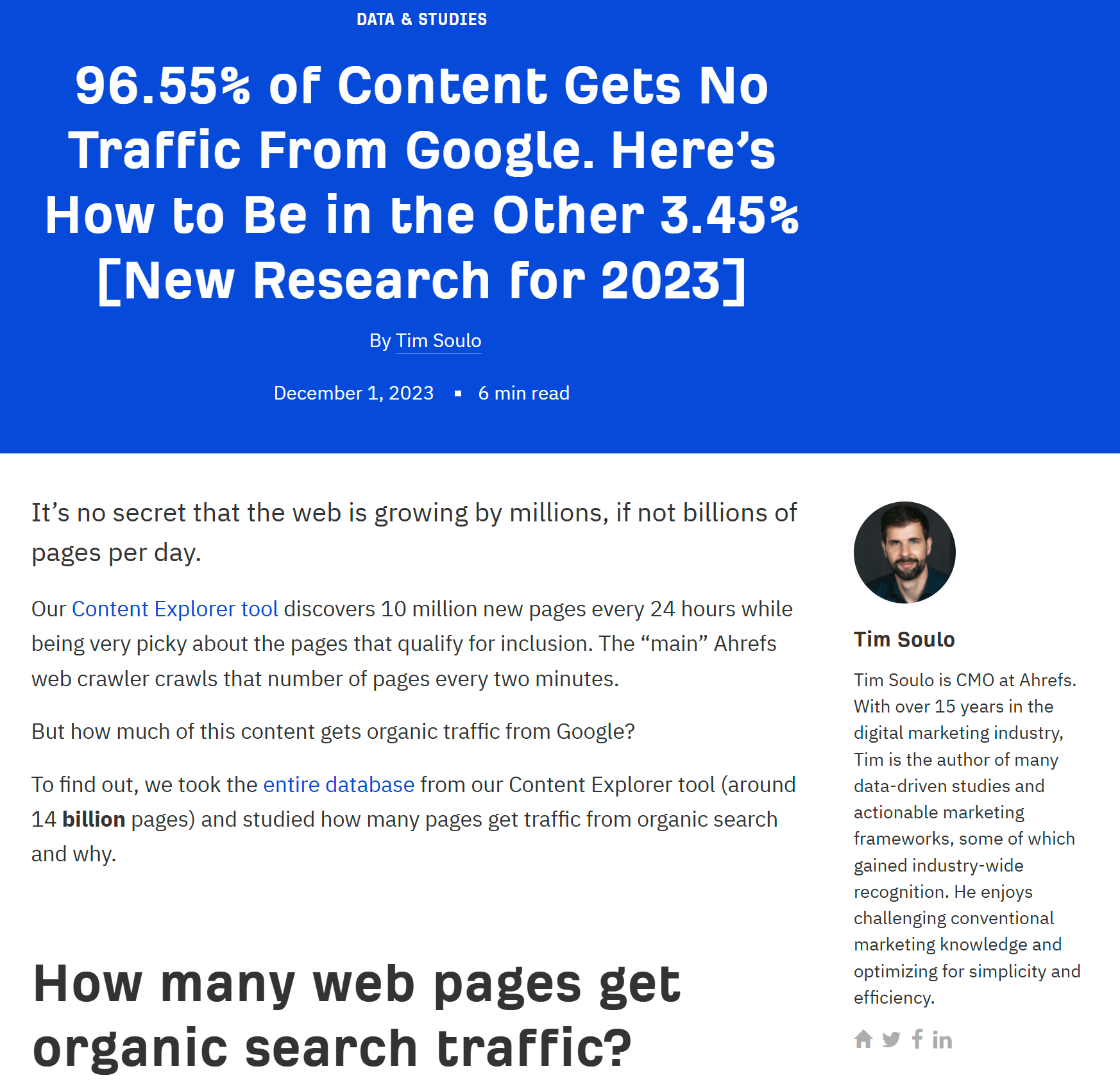
Original research, industry studies, and data-backed content tend to be particularly successful because they offer unique insights that others want to share and reference.
However, in reality, you can’t expect the content to generate backlinks – at least in a substantial amount – on its own.
You have to do proactive outreach to get good backlink placements, which leads us to the next section.
Claim Unlinked Mentions
One of the easiest ways to acquire free backlinks is by capitalizing on unlinked mentions.
These are instances where your brand or business is mentioned online, but the mention doesn’t include a hyperlink back to your website.
Think of it as someone talking about you in a conversation but forgetting to give their listeners a way to find you.
This is a low-hanging fruit opportunity because the very fact that you’re mentioned suggests that the website owner already considers your business relevant to their content.
By reaching out and politely suggesting they add a link, you can often convert these existing mentions into valuable backlinks with minimal effort.
It’s a win-win: they enhance their content by providing a helpful link for their readers, and you gain a backlink.
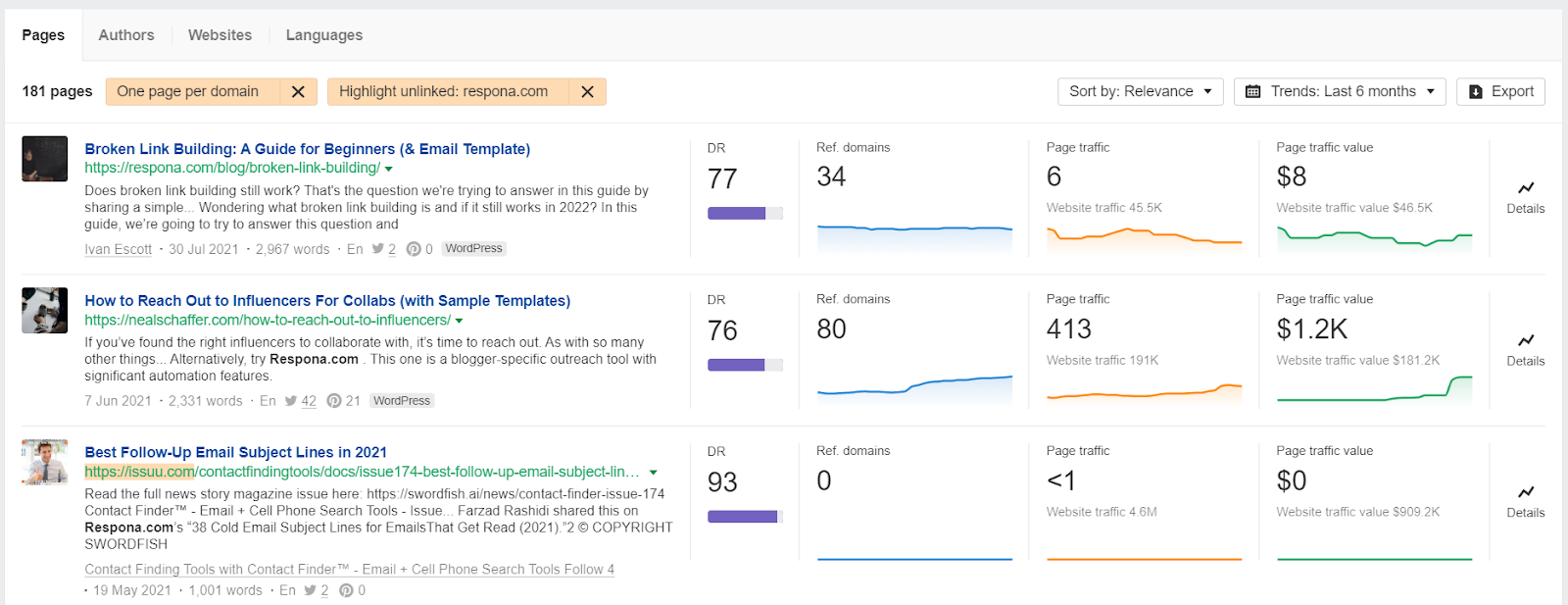
To effectively find unlinked mentions, you’ll need a tool that can identify unlinked mentions of your brand, such as Ahrefs or Respona.
Several backlink tracking and outreach platforms offer this functionality.
Guest Posting
Guest posting remains a highly effective link-building strategy, offering a versatile and relatively straightforward way to earn valuable backlinks.
It involves creating and publishing content on other websites, allowing you to tap into their audience and boost your own site’s authority.
A significant advantage of guest posting lies in the sheer number of websites that accept contributions.
Finding guest posting sites is often as simple as conducting a targeted Google search using phrases like “write for us” combined with your relevant keywords.
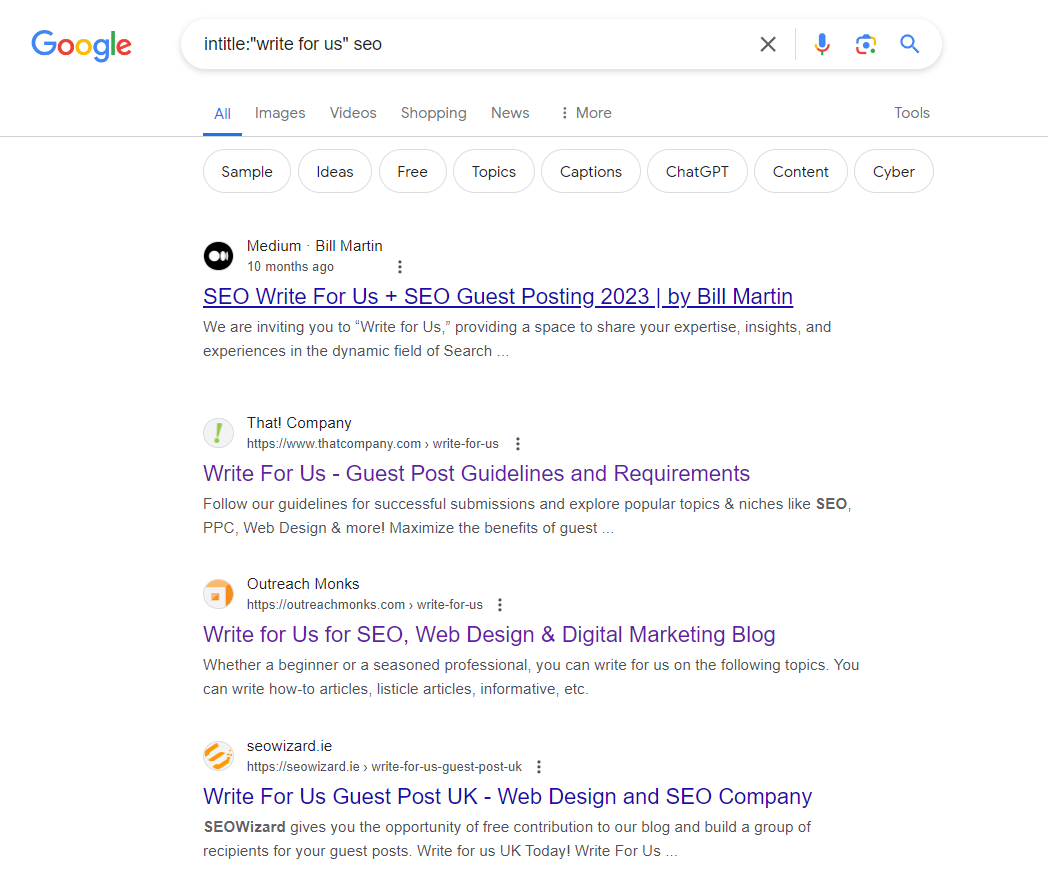
Guest posts typically allow you to include at least one high quality backlink back to your own website, often within the author bio or the body of the article.
Many sites also allow links to other relevant resources, creating an opportunity for strategic collaboration.
By linking to your partners’ content in your guest posts, you can build a network of ABC link exchanges. These partners can then reciprocate by linking back to your site from their own guest posts or website content, creating a mutually beneficial web of backlinks.
l your email accounts, eliminating the need to navigate multiple tabs.
ABC Link Exchanges
ABC link exchanges, also known as three-way link exchanges, are a link building strategy designed to mitigate the risks associated with reciprocal linking.
In a reciprocal exchange, site A links to site B, and B links back to A. This direct swap is easily detected by search engines and can be devalued or penalized.
An ABC link exchange, however, involves three sites: A links to B, B links to C, and C links back to A.
This indirect approach can be more difficult for search engines to identify, potentially passing link equity more effectively.
While considered safer than reciprocal links, ABC exchanges are not entirely risk-free.
Search engines are constantly improving their ability to detect external link schemes, including patterns that suggest coordinated link building.
Especially if you fall for link farms.
The safest and most effective way to implement ABC link exchanges is through guest posting, which we just talked about.
Competitor Backlinks
Analyzing competitor backlinks is a highly scalable link building strategy.
Every site linking to a competitor but not you represents a potential link opportunity.
This analysis also provides valuable insights into your competitors’ off-page strategies, allowing you to refine your own.
Identifying these “backlink gaps” is crucial for catching up to competitors in search results.
The process begins by identifying your true search competitors.
While you likely know your main competitors, you might be surprised by the number of other businesses you compete with on search engine results pages, especially for long-tail keywords.
Tools like Ahrefs, Semrush, or even free backlink checkers can then be used to analyze these competitors’ backlink profiles.
Focus on dofollow links from high-authority domains (DR 30+ or similar) with significant traffic (1K+ monthly visits is a good starting point).
These are the links that will have the most impact on your SEO.
Most SEO tools offer a “link intersect” or “gap analysis” feature.
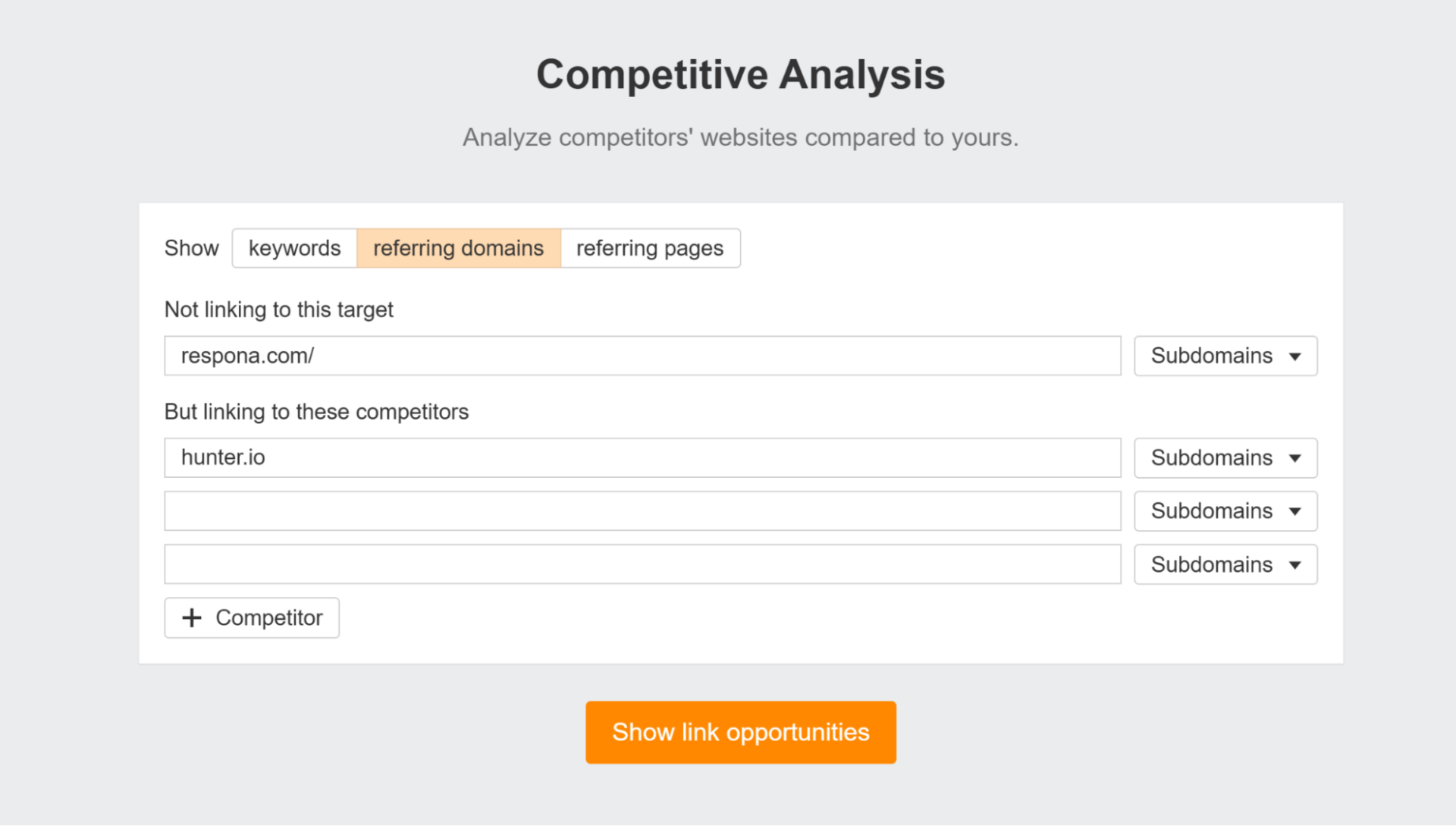
This allows you to compare the backlink profiles of multiple competitors and identify websites that link to them but not to you.
These are prime targets for outreach.
Export this list of potential link opportunities for the next phase.
Podcasting
Podcast guest appearances offer a wealth of benefits for building brand authority, expanding reach, and acquiring high-quality backlinks.
They provide a unique opportunity to connect with a highly engaged audience, as podcast listeners are often deeply invested in the topics discussed, making them receptive to your message.
This targeted exposure can translate into increased brand awareness, driving traffic to your website and generating leads.
Our Co-Founder, Farzad Rashidi, exemplifies this, having secured appearances on over 100 podcasts in just over two years through strategic outreach.
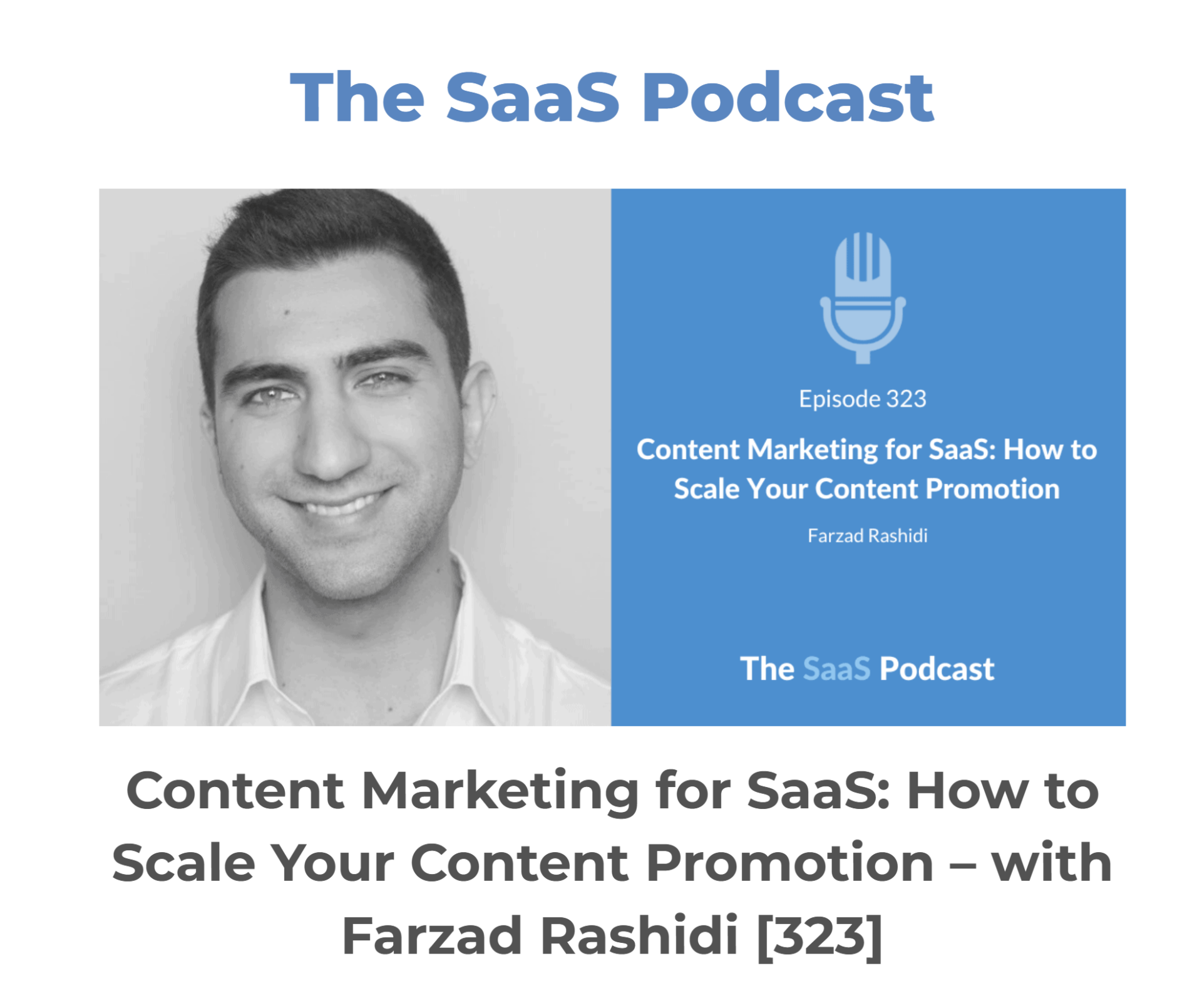
One of the most significant advantages of podcast guesting is the ability to showcase your expertise.
Unlike written content, podcasts allow for in-depth conversations, sharing knowledge and insights in conversation.
This builds trust and credibility, positioning you as a thought leader.
This format fosters authentic and relatable content, making it easier for listeners to connect with you and your brand.
For example, Farzad’s appearances often involve discussions on SaaS growth strategies, email marketing best practices, and the future of online outreach, showcasing his expertise and building his reputation within the industry.
Broken Link Building
Broken backlink building, particularly using tools like Ahrefs, is a highly effective, though sometimes niche, strategy for acquiring quality backlinks.
The core concept involves finding broken links on relevant websites and then reaching out to the site owners, suggesting your content as a suitable replacement.
This offers a win-win scenario: the website owner fixes a broken link, improving their site’s user experience, and you gain a valuable backlink.
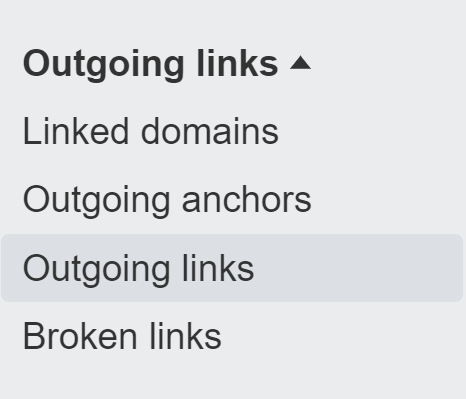
Ahrefs simplifies the process of identifying these broken link opportunities. By analyzing the outgoing links of competitor websites or sites within your niche, Ahrefs can pinpoint broken external links.
These are prime targets for your outreach.
The effectiveness of this strategy often depends on the niche; larger niches with more websites generally offer more opportunities.
A particularly fruitful scenario arises when a website in your niche shuts down.
In these cases, the entire backlink profile of the defunct site becomes a prime target, as many websites will still be linking to it.
Resource Pages
Resource page link building, while not as dominant as it once was, can still be a valuable search engine optimization strategy, particularly in niche markets.
It involves acquiring organic backlinks from web pages specifically designed to curate valuable resources on a given topic.
These pages, often categorized by niche, provide readers with quick access to helpful and relevant links.
While the sheer volume of links on some resource pages has diluted their individual value over time, securing a placement on a reputable resource page, especially one curated by an industry expert, can still offer significant benefits beyond just SEO.
Even if the “link juice” isn’t as potent as it once was, inclusion on a relevant resource page run by a respected figure in your field offers valuable social proof.
It enhances your site’s authority and makes it more appealing to other bloggers and potential link partners.
These pages also tend to attract a highly engaged, niche-specific audience.
Take, for example, Neil Patel’s link building resource page:
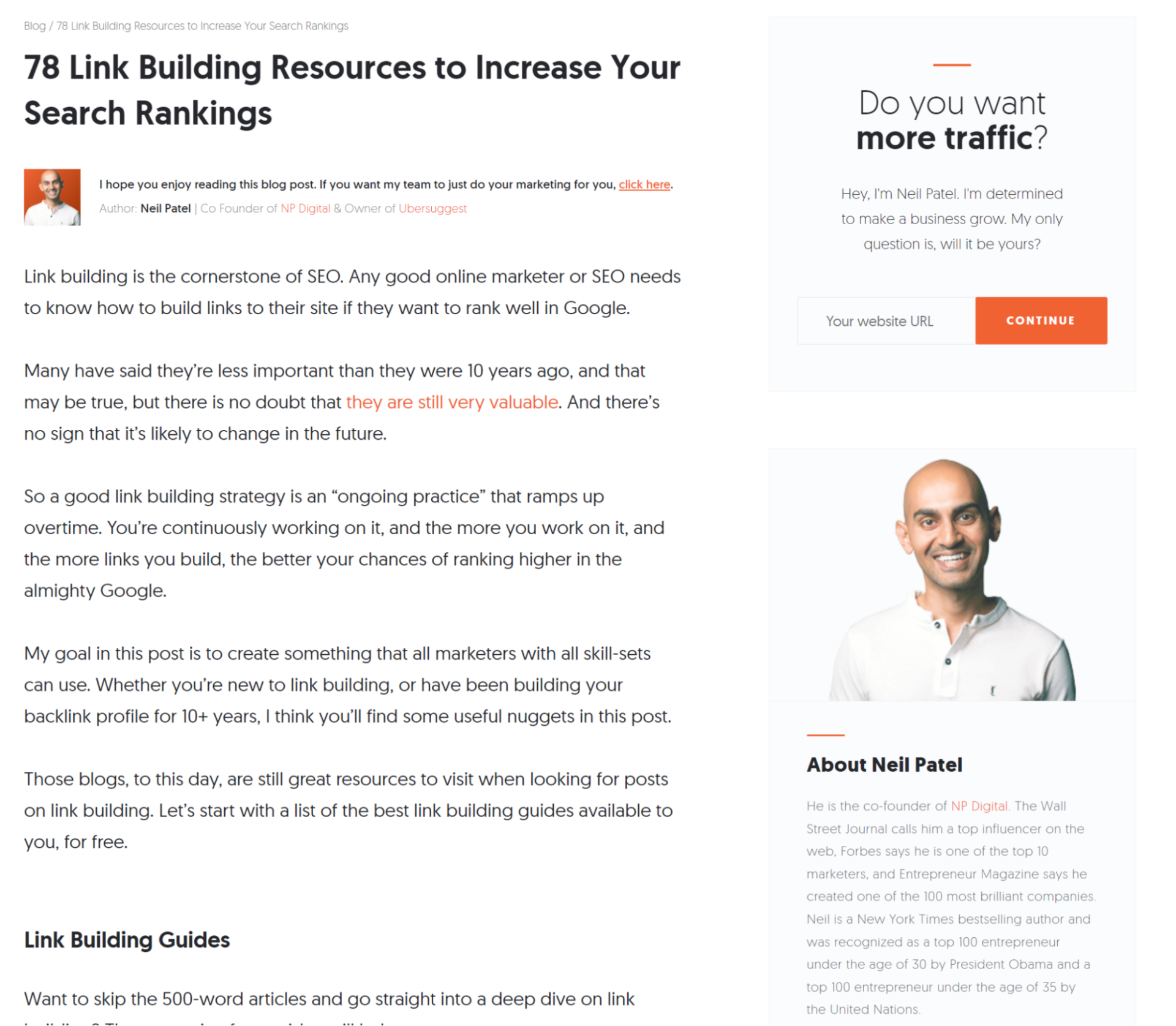
Directing even a small portion of that audience to your website can be incredibly impactful, especially for businesses with higher-priced products or services.
Local directories also fall under this category and are essential for local SEO.
Citation Link Building
Citation link building is a crucial strategy for businesses aiming to improve their visibility in local search results.
When potential customers search for services or products “near me,” citations help ensure your business appears prominently on platforms like Google Maps.
Citations are essentially mentions of your business online, including your name, address, and phone number (NAP).
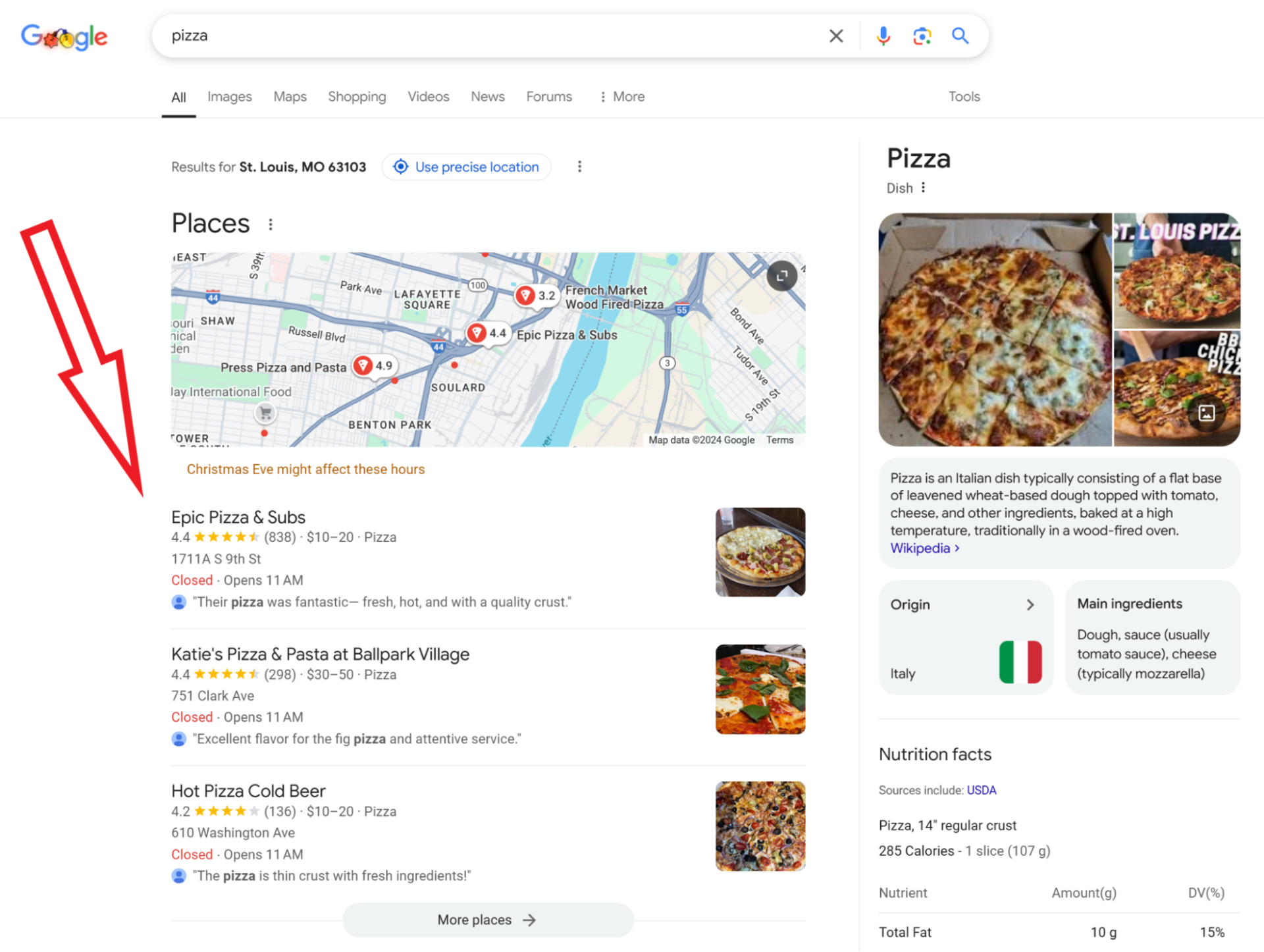
These mentions can appear on dedicated business directories like Yelp or Google Business Profile, but they can also come from social media platforms, local blogs, or even niche-specific websites.
The benefits of building backlinks through citations are twofold. First, they drive highly targeted traffic to your business.
People searching for local businesses are actively looking for what you offer, making them hot leads.
Second, citations often include backlinks to your website, which contribute to your local search ranking.
These backlinks signal to search engines that your business is a legitimate and relevant entity within your local area.
While some directories offer nofollow backlinks only, which don’t directly pass link equity, they still play a crucial role in improving local visibility and driving customer traffic.
“Dofollow” links, on the other hand, do pass link equity and contribute to both local and global SEO.
Beyond structured citations on directories, unstructured citations, which are mentions of your business on other relevant websites, can also be valuable, especially if they include dofollow links.
Blogger outreach can be a powerful way to secure these unstructured citations.
Getting Media Coverage
Digital PR, the modern evolution of public relations, focuses on securing online media coverage to build brand awareness, drive website traffic, and earn valuable backlinks.
Instead of traditional media like TV and print, digital PR leverages online platforms and publications to reach target audiences.
This approach offers several key benefits for link building.
Firstly, links earned through digital PR often come from highly authoritative sources. Publications like TechCrunch, The New York Times, or leading industry blogs have established credibility and domain authority.
Like the recent coverage of Archive getting Series B funding on TechCrunch:
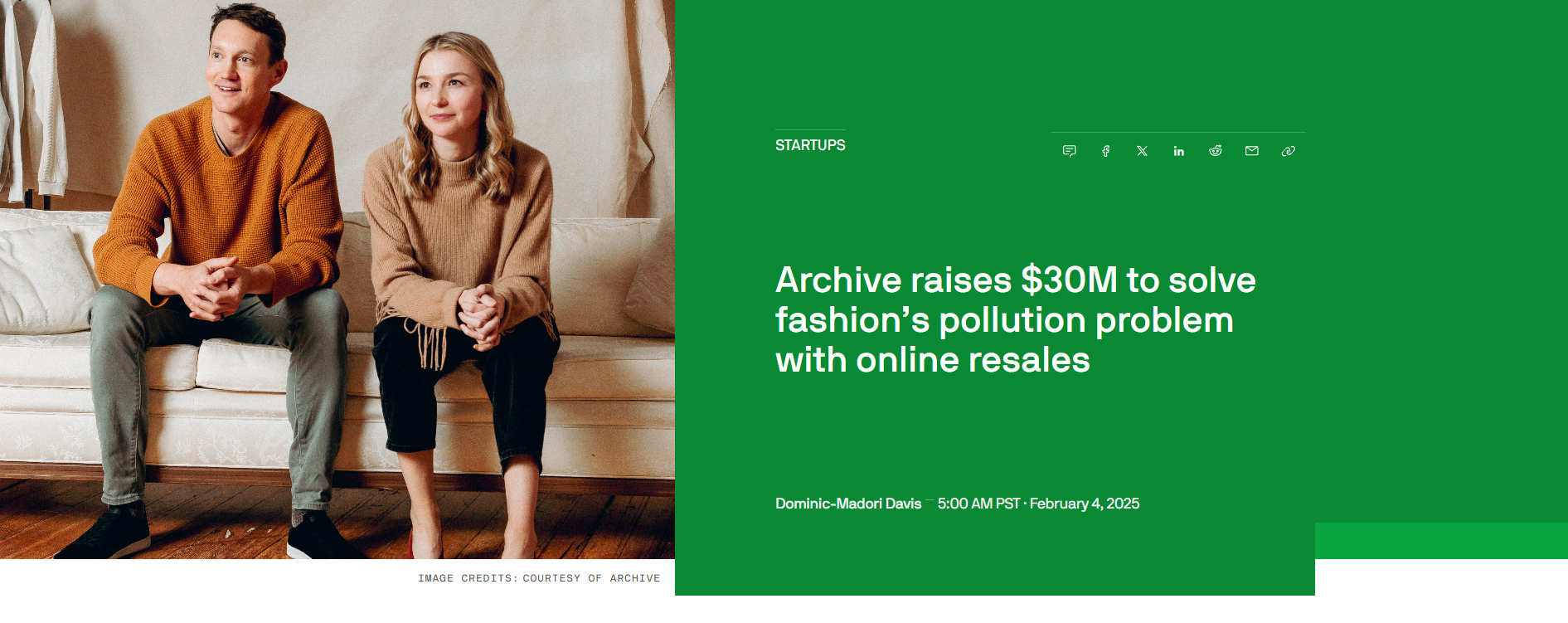
Links from these sources signal to search engines that your website is trustworthy, boosting your search engine ranking.
Secondly, these links are typically embedded within relevant and valuable content.
Journalists covering your story provide context and relevance, further strengthening the link’s value in the eyes of search engines.
Thirdly, digital PR can drive significant referral traffic to your website.
Established publications have large and engaged readerships, and an inbound link from their site can expose your business to a wider audience of potential customers.
Finally, being featured in reputable publications enhances your brand’s credibility and reputation.
It positions you as an expert in your field and builds trust with potential customers.
This positive brand association is an indirect but powerful benefit of digital PR.
A Better Way to Get Backlinks
Here’s the truth: backlinks are very rarely free.
Even the strategies above almost always involve some form of exchange. You write a guest post in exchange for a link. You make a podcast appearance in exchange for a show-notes link. You provide content for resource pages in exchange for inclusion. You set up ABC exchanges with partners who expect reciprocity.
That’s especially true for the highest-value placements: listicle spots in “best of” articles. Those are the placements that drive visibility in both organic search AND AI answer engines like ChatGPT and Perplexity.
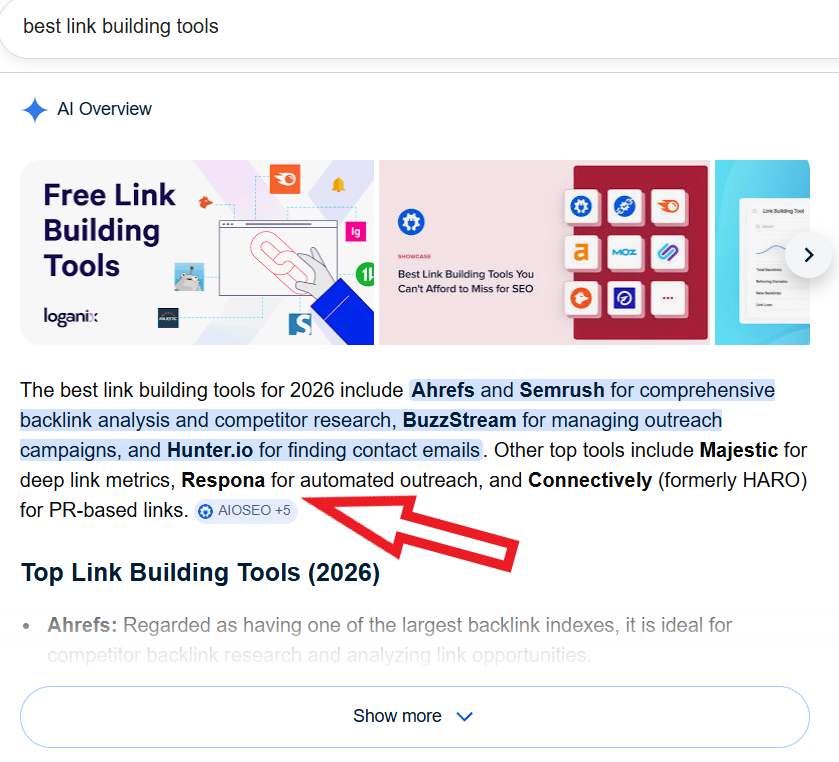
They’re also the most competitive to land. To get them consistently, you need:
- Active outreach across hundreds of publications
- Links to offer in return (your own resources, or partner links)
- At least one or two people actively building links every day to see meaningful volume
For most teams, that’s not realistic in-house. Which brings us to Respona.
Respona is a done-for-you link building service that handles the entire workflow on your behalf. Here’s how it works:
1. Place an order with custom guidelines.
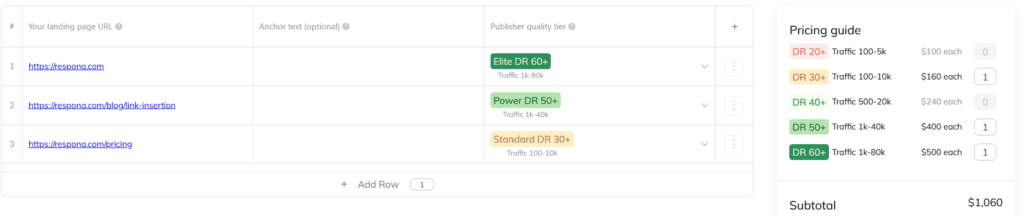
Place an order by telling us your target pages, target keywords, anchor text preferences, and which industries or types of publications you want featured on.
Every placement can approved by you, so nothing lands in your link profile that doesn’t fit your brand.
2. Check your current standings in answer engines.
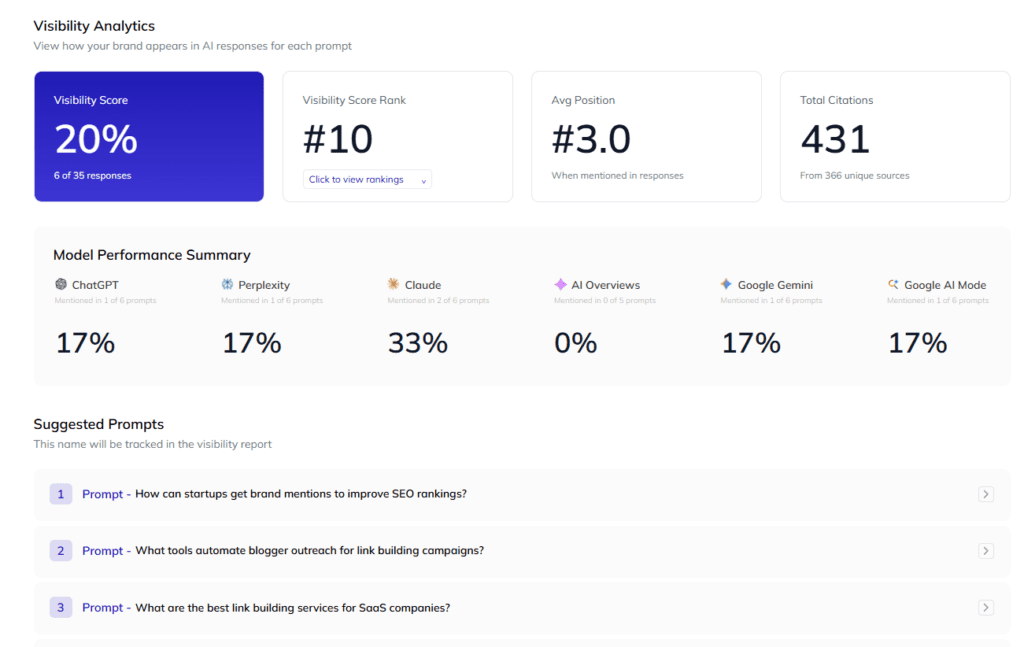
Respona’s built-in AI visibility tracker shows where your brand currently shows up across six AI answer engines: ChatGPT, Perplexity, Google AI Overviews, Gemini, Claude, and Copilot.
You monitor your target prompts and see exactly which ones cite your brand versus your competitors.
3. Review the link building action plan.
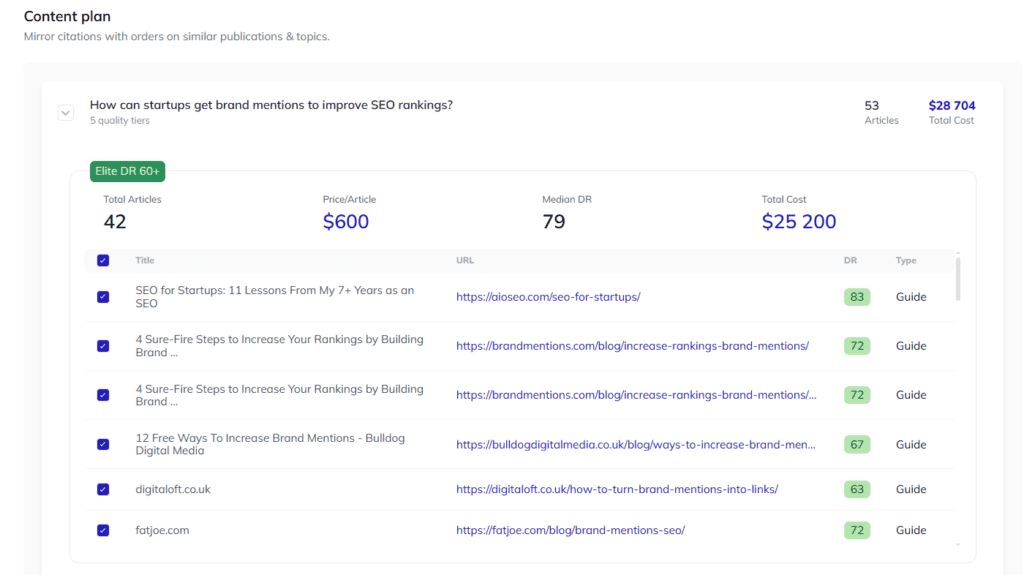
Respona’s link building action plan pulls the specific articles that already rank in Google AND already get cited inside AI engines for your target keywords.
These are the highest-value placements to pursue first because they’re already trusted by both search engines and AI systems.
Each placement on the plan guarantees impact for both organic and AI visibility.
4. Get the entire workflow done for you.
Respona’s team handles prospecting, pitching, drafting the angle, negotiating, and securing the live placement.
You pay per result, starting at $100 per placement.
No retainer, no minimum commitment.
The pricing model works at any scale, from a startup landing 5 placements per quarter to an agency running hundreds per month across multiple clients, and in any niche from SaaS to local services.
Link building cheat sheet
Now Over to You
By this point, you have a pretty good idea on how to get free backlinks.
You should:
- Regularly publish linkable assets
- Proactively reach out to webmasters to secure link placements
- Set up ABC link exchanges with your partners (and avoid reciprocal exchanges)
If you’d rather skip the manual outreach and have someone else handle the entire process for you, place an order with Respona.
We handle the prospecting, pitching, and securing quality links on a per-result basis, focused on the listicles and editorial features that drive both Google rankings and AI citations.
Frequently Asked Questions (FAQ)
What is the best way to get free backlinks?
There’s no single “best” way, as the most effective approach depends on your specific circumstances and goals.
However, creating high-quality, linkable assets and conducting outreach to promote them is generally a very effective strategy.
Guest blogging is another excellent way to earn backlinks, and broken link building can also be fruitful.
How can I get backlinks without paying for them?
Many strategies outlined in this article, such as creating linkable assets, claiming unlinked mentions with a branded anchor text, guest posting, and broken link building, can be done without directly paying for links.
However, some may involve offering reciprocal links or other forms of value exchange.
How do I get backlinks from high domain rating websites?
Creating exceptional content that naturally attracts links is key.
Focus on original research, in-depth guides, or unique data that provides genuine value to your target audience.
Digital PR, securing guest posts on authoritative sites, and building relationships with industry influencers can also help earn high-authority backlinks.
How long does it take to get free backlinks?
Building high-quality backlinks takes time and consistent effort.
There’s no magic bullet or overnight solution.
It requires creating valuable content, conducting outreach, and building relationships.
It often takes several months to see significant results from your link-building efforts.
Are all backlinks created equal?
No, backlinks from high-authority, relevant websites carry more weight than those from low-quality or irrelevant sites.
A dofollow backlink passes link equity, while a nofollow link does not.
Contextual links within relevant content are also generally more valuable than links in sidebars or footers.
Are free backlink generators actually worth using?
Most free backlink generators are not worth using. A typical free backlink generator or backlink maker creates web 2.0 backlinks, profile links, or directory submissions on low-quality sites that Google has already devalued.
The result is usually a bad backlink that adds nothing to your ranking, or in some cases actively hurts your site by associating it with spammy networks.
Skip these tools and focus on the manual strategies in this article instead.
What are the best free backlink sites for SEO?
The best free backlink sites are not actually backlinking sites at all. They’re regular publications, podcasts, and resource pages that your competitors already get links from.
Building your free backlinks through these channels (rather than generic submission networks) delivers links that actually move rankings. Generic free backlinks site networks usually deliver low-quality placements that Google ignores at best and penalizes at worst.
How do you check if a backlink is dofollow or nofollow?
You can check whether a link is a dofollow backlink or contains the nofollow attribute by inspecting the page source. Right-click any link, select “Inspect,” and look at the <a> tag. If you see rel="nofollow" in the attributes, it’s a nofollow link. If not, it’s typically a dofollow link.
Dofollow backlinks pass link equity (which improves rankings); nofollow backlinks do not. Most directory citations and social profile links are nofollow by default, while editorial links from blog posts are typically dofollow.
How do I find broken links pointing to competitor content?
Use a broken link checker like Ahrefs, Screaming Frog, or Check My Links (a free Chrome extension). The simplest method is to pull a competitor’s URL into Ahrefs Site Explorer, navigate to “Outgoing Links,” and filter by broken status. Each broken backlink represents a potential prospect for outreach.
You can also use a free tool like Dr Link Check or W3C Link Checker to scan specific articles. Once you find a broken link pointing to a defunct resource, email the site directly with a working alternative.
How does anchor text affect backlinks?
Anchor text is one of the most important signals Google uses to determine what a backlink is about.
Over-optimized anchor text (using your exact target keyword repeatedly) can trigger penalties, while natural anchor text (using brand names, naked URLs, and varied phrases) signals organic link building.
Aim for a mix: roughly 30% branded anchors, 30% naked URLs, 20% generic (“click here,” “this article”), 15% partial-match keyword, and 5% exact-match keyword.
A natural backlink from a relevant backlink source rarely uses perfect-match anchor text.
How do you use Google Search Console to find backlink opportunities?
Google Search Console shows which sites already link to you, what pages get those links, and the anchor text used.
To find new backlink opportunity targets, export your “Top linking sites” report and analyze the patterns. You can also use a google site search (e.g., site:competitor.com) on Google search itself to identify which articles on competitor sites have attracted backlinks.
Identify the kinds of publications already linking to you (industry blogs, podcasts, resource pages) and use Google search to find similar publications you haven’t pitched yet.
What’s the difference between a powerful backlink and a regular one?
A powerful backlink comes from a high-authority, topically relevant site with significant organic traffic on the linking page.
High quality backlinks like these can move rankings on their own; regular backlinks typically need volume to add up.
Three things separate quality links from regular ones: domain authority (DR 50+ is meaningful), topical relevance (the linking page is about your industry), and contextual placement (link sits inside body content, not in a sidebar or footer).
One placement that hits all three is worth dozens of low-quality directory submissions.
Can a free SEO tool help me grow my backlink profile?
Yes, several free tools and free SEO tools can help you grow your backlink profile without an Ahrefs subscription.
Search Console (already mentioned above) shows your existing backlinks. Ubersuggest’s free tier gives you basic competitor backlink data. Moz Link Explorer’s free version lets you check domain authority and limited backlink data.
A free SEO tool won’t replace a paid platform for generating backlinks at scale, but it’s enough to validate prospects and identify gaps in your backlink profile before pitching outreach.
How does a strong backlink profile impact SEO ranking?
A strong backlink profile is one of the top three signals affecting your SEO ranking and overall search engine ranking position.
Sites with diverse, high-authority backlink profiles consistently outrank sites with weak link profiles, all else equal. Quality links from topically relevant sites carry far more weight than volume of low-quality links.
To grow your backlink profile sustainably, focus on the 10 strategies in this article and complement them with outreach to relevant publications using a website link inserted into existing content where natural.