
Sponsored content has a bit of a reputation problem in SEO.
Mention it in a Slack group or on Twitter and someone will inevitably jump in with, “Careful, that’s against Google’s guidelines!”
And they are not entirely wrong.
At the same time, sponsored content is everywhere. Big brands use it. SaaS companies use it. Even sites that publicly preach “never pay for links” are quietly publishing sponsored posts behind the scenes.
So what’s the truth?
The short answer is this: it depends on how you use it.
In this article, I will break down what sponsored content really is, how it differs from traditional advertising, why it is so controversial in SEO circles, and most importantly, how to use sponsored content ethically without crossing Google’s red lines.

Link building cheat sheet
Sponsored Content vs Paid Ads
Paid ads are straightforward.
You pay Google, LinkedIn, or Facebook, and your content is displayed in clearly marked ad placements. Once the budget runs out, the traffic stops.
Paid ads like banner ads, text ads, and video ads:
- Do not pass link equity
- Have no direct SEO benefit
- Are designed for short-term visibility and conversions
Google has zero issues with paid ads formats because they do not interfere with organic rankings. Everyone knows they are ads, both users and search engines.
They are transparent by default.
Sponsored Content
Sponsored content lives in a much greyer area.
Instead of showing up in an ad slot, your brand appears inside editorial-style content on another website, social media platform, or digital marketing channel.
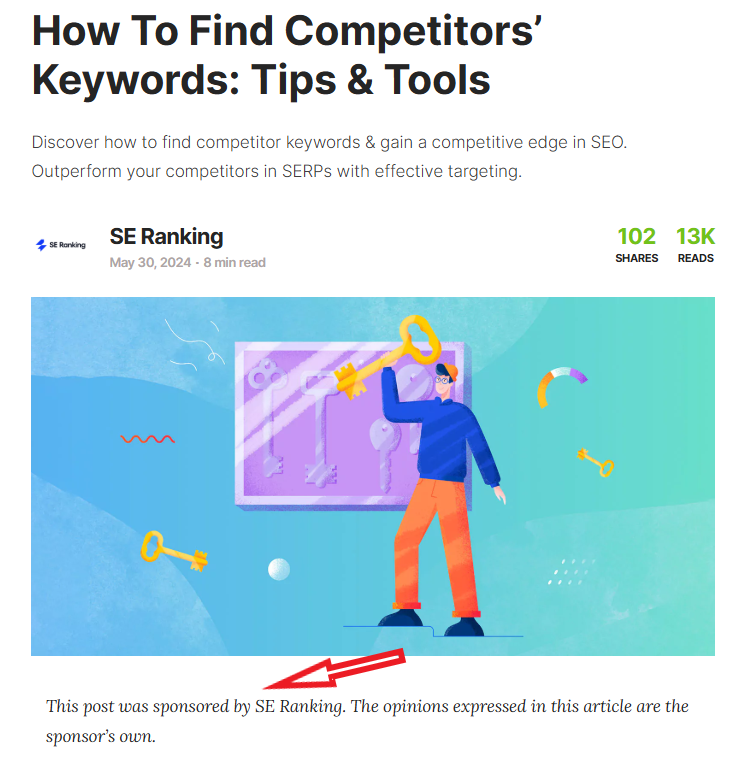
This could be:
- A sponsored blog post or sponsored article
- A paid product mention in an existing article
- A brand feature or collaboration
- Native advertising that blends with editorial content
- Influencer marketing partnerships
- A sponsored content campaign on a social media post
From a reader’s perspective, sponsored content often looks and feels like a regular article.
Even if it’s marked as sponsored, it usually gets completely glanced over.
That is exactly why it is so effective for brand awareness and referral traffic, and why publications like the Wall Street Journal and Huffington Post have embraced branded content and native ad formats as part of their content marketing strategy.
And also why Google watches it closely.
With paid ads, links are expected to be non-influential for rankings. With sponsored content, links can easily cross into paid link territory if they are not handled properly.
Which leads me to the next section.
Why the Stigma Around Sponsored Content?
Sponsored content did not earn its bad reputation by accident.
For years, it has been abused as a shortcut for link building in digital marketing.
Instead of earning links through valuable content and genuine relationships, many sites used sponsored posts as a thinly veiled way to sell dofollow links at scale. The content itself was often low effort, irrelevant, and written purely to host a link.
An unmarked link. Which is the whole issue. So long as the link has a rel=sponsored tag, it’s completely fine.
But in 99% of cases, it wasn’t, and that’s a direct violation of Google’s guidelines.
From Google’s point of view, the issue is not sponsorship.
The issue is manipulation.
Search rankings are meant to reflect trust and relevance. When sponsored messaging directly influences which pages receive dofollow links, that signal becomes unreliable.
This is simply not the case with document ads, LinkedIn ads, or any other advertising format.
How to Use Sponsored Content Ethically
Sponsored content is not inherently risky.
What makes it risky is trying to squeeze SEO value out of it in ways Google explicitly warns against.
If you treat sponsored content as a branding and distribution channel first, and an SEO tactic second, it becomes much easier to stay on the right side of the guidelines.
Here is how to do it properly.
Be Transparent About the Sponsorship
This is non-negotiable.
If money or any form of compensation changes hands, the content must be clearly disclosed as sponsored. That disclosure should be visible to readers, not buried in the footer or hidden behind vague language.
Whether you’re working with an influencer, content creator, or brand publisher, transparency protects everyone involved and maintains trust with your audience.
Use the Correct Link Attributes
This is where most people get it wrong.
If a link exists because of a sponsorship, it should not pass PageRank.
That means using one of the following attributes:
- rel=”sponsored”
- rel=”nofollow”

Either option signals to Google that the link should not influence rankings. The exact choice matters less than the intent and consistency behind it.
Trying to negotiate followed links as part of a sponsored placement is what turns sponsorship into a link scheme.
Prioritize Relevance and Quality
Effective sponsored content still needs to earn its place on the site.
That means publishing on sites that are:
- Relevant to your industry and audience
- Trusted by their audience
- Selective about who they work with
A sponsored content strategy focused on relevant niche publications can drive meaningful referral traffic, engagement, and brand recognition. The same post on a random blog network does nothing but raise red flags (and waste your marketing budget).
When you create sponsored content that provides valuable information and valuable insights to the target audience, you’re not just advertising, you’re building genuine connections across social media and other marketing channels.
Link building cheat sheet
Now Over to You
Sponsored content is not a shortcut. And it is definitely not a loophole.
Used carelessly, it looks exactly like paid link building and comes with all the same risks. Used ethically, it can be a solid branding and distribution channel that supports your broader marketing efforts without putting your site in danger.
The key is intent.
If your goal is to manipulate rankings, sponsored content will eventually backfire. If your goal is to build real visibility, trust, and referral traffic, and you handle links transparently, it can play a small but legitimate role in your strategy.
That said, sponsored content should never be the foundation of your link building efforts.
High-quality backlinks are still earned through genuine relationships, strong content, and consistent outreach. That process takes time, experience, and a lot of follow-ups.
That is exactly what our done-for-you link building handles.
We handle prospecting, outreach, relationship building, and link placement using fully white-hat methods that Google is happy with. You get high-quality, relevant backlinks without worrying about penalties, disclosures, or grey areas.
Frequently Asked Questions (FAQ)
Is sponsored content safe for SEO?
Sponsored content can be safe if it is handled correctly. This means clearly disclosing the sponsorship and using rel=”sponsored” or rel=”nofollow” on links so they do not pass PageRank. Problems only arise when sponsored links are used to manipulate rankings.
Can sponsored content help with rankings?
Not directly. Sponsored links should not pass link equity, so they should not influence rankings. However, sponsored content can still drive referral traffic, brand awareness, and indirect SEO benefits through exposure and engagement.
What is the difference between sponsored content and paid link building?
Paid link building focuses on buying followed links to influence rankings. Sponsored content is about paying for exposure or placement, with proper disclosure and non-influential links. The difference comes down to intent and link attributes.
Should I include dofollow links in sponsored posts?
No. If a link exists because of a sponsorship, it should not be dofollow. Using rel=”sponsored” or rel=”nofollow” is required to stay compliant with Google’s guidelines.
What is the safest way to build backlinks at scale?
The safest way is to earn links through white-hat outreach, content-driven campaigns, and genuine partnerships. Using done-for-you link building that follows Google’s guidelines removes the risk while saving you time and effort.