
Cold blogger outreach strategy for link building/Public Relations is a catch-22.
You need both volume (more prospects) and personalization to see significant impacts.
And combining both can feel impossible.
Scaling often leads to less personalization, as writing personalized pitches is incredibly time-consuming. But you need personalization if you want any hope of capitalizing on those link building or relationship opportunities.
Anything less than hyper-personalized outreach just comes across as spammy, annoying, fake, and ruins your conversion potential.
That’s why we developed this step-by-step cheat sheet to create your own personalized outreach strategy.
Without further ado, here is how to craft your own cold outreach strategy and put it to use.
Key Takeaways:
- A strong outreach strategy starts with finding relevant content and the right prospects
- Effective outreach depends on personalization, not mass outreach emails
- Email outreach is still the core channel, but it works best when combined with social media outreach and engagement
- Targeted outreach improves response rates by focusing on your target audience instead of random lists
- Listicle and blog outreach opportunities are some of the most effective for link building and partnerships
- A successful outreach strategy is built around consistency, clear messaging, and ongoing outreach efforts
- The best outreach strategies focus on building meaningful relationships, not just getting links
- Step 1: Outline Your Main Outreach Goals
- Step 2: Search For Niche Content To Build Your Outreach List
- Step 3: Segment Targets By Goals to Build Outreach Templates
- Step 4: Actively Engage With High-Value Prospects on All Mediums
- Step 5. Be Active (Not Annoying) in Your Follow-Ups
- Now Over To You
- Frequently Asked Questions (FAQ)
Link building cheat sheet
Step 1: Outline Your Main Outreach Goals
The first step of any successful outreach strategy is outlining goals.
Sadly, most take this for granted, spending ~10 minutes max jotting down simple goals like:
- Increase traffic
- More brand mentions
These goals are a total waste of time. We all want more traffic. Everybody and their insta-famous cousin wants brand mentions.
These goals are far too broad, generic, and lack any hint of actionability that an effective outreach strategy demands.
Just listing goals and going through the motions of this step is a big mistake.
What do good outreach goals look like? They are often broken down by a few big factors:
- Goal type
- Sub-goals
- Actionable steps
- Timelines
But first, what are some good, high-level blogger outreach goals in general?
- Link building: generating high-quality backlinks to content on your website from as many strong domains as possible. This helps your content rank better in search engines, drive targeted traffic from referring domains, and increase content relevance.
- Product review generation: getting natural product reviews is tough. Getting them without outreach efforts and doing some leg-work is nearly impossible. Product review generation focuses on getting good reviews from top bloggers in your space.
- Guest posting: guest posting is where you write a blog post for another website. It’s a stellar way to build active brand awareness and drive relevant traffic to your site.
While goals can be wide in range, these are fantastic main targets.
Let me give you a fleshed-out example of this.
Let’s say you just launched a new landing page for a new product/software. Naturally, you’ll want to build some high-quality links to it to start generating referral traffic and page/domain authority.
But merely listing “get links” as your goal leaves you quickly stalled. Where do you go from there?
A good goal is first outlined by goal type. In this case, building links would fall under cold outreach.
Breaking it down further, you should start listing sub-goals. Sub-goals are what help you achieve your primary target.
For instance, a sub-goal of building links would be developing relationships with editors. Sub-goals are great to break down different avenues that lead to your final goal. In this case, having editor relationships is one great avenue for acquiring top tier links.
But, without actionable steps, they are again worthless, as you have no actionable outreach plan.
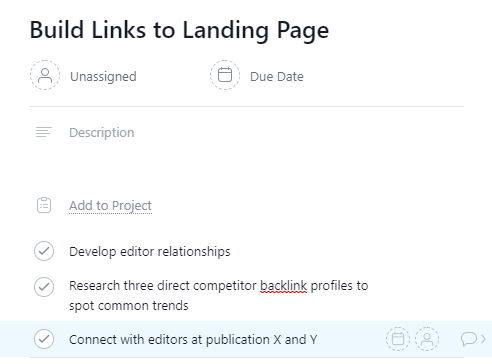
Now is where you start to list critical steps to achieving those sub-goals:
- Research top three direct competitor backlink profiles and analyze their strategy to spot common trends/editor relationships that you can leverage
- Connect with top publication editors on social and start engaging with them
You can do this with spreadsheets, task management software, or anything that works for you and your team:
Lastly, you’ll want to connect all of these actionable steps and goals to direct timelines. If you don’t, you’ll be spinning your wheels for months without concrete progress.
Let’s recap how to plan your goals fast, yet effectively. This can be done directly in a Google Sheet. For a template of this to-do list for your goals, click here.:
Step 1a. List out your main, overarching goal. I.e, building links to a new landing page:
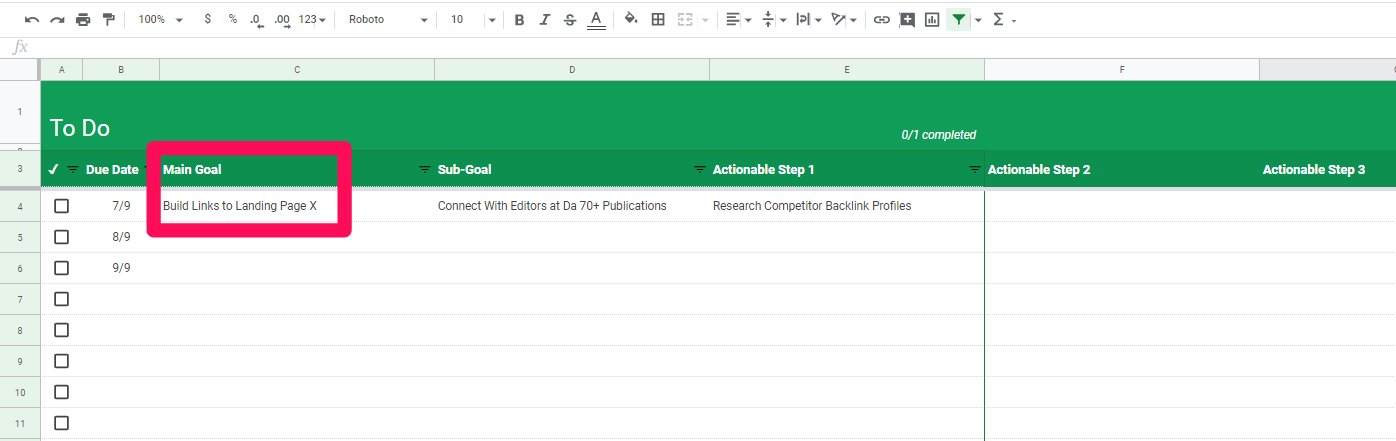
Step 1b. List out sub-goals, the avenues for achieving your main goal. I.e, building relationships with editors.
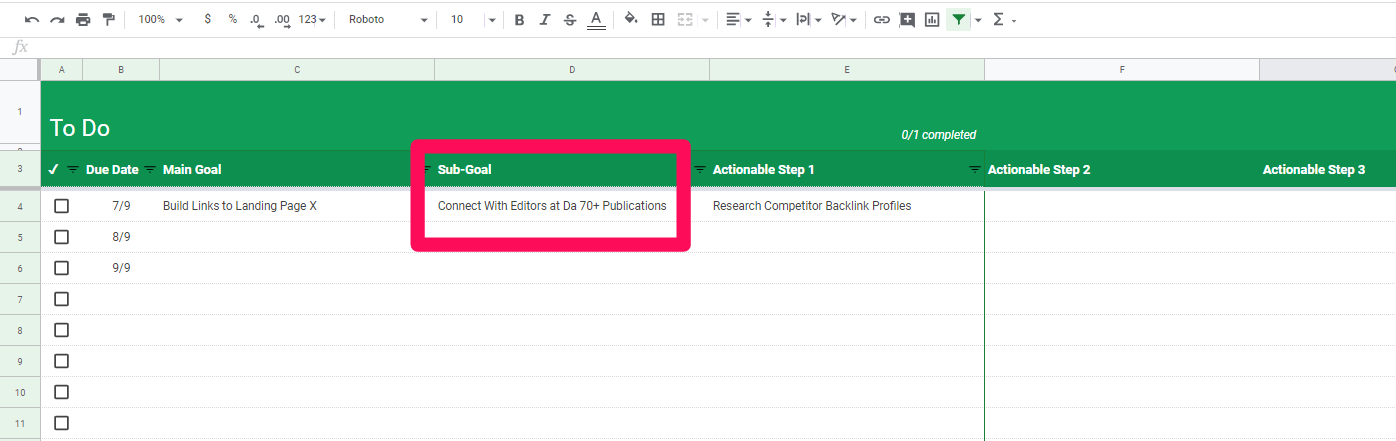
Step 1c. Develop a list of actionable steps to reach those sub-goals. I.e, research your top competitors backlink profiles to spot editor relationships you can leverage.
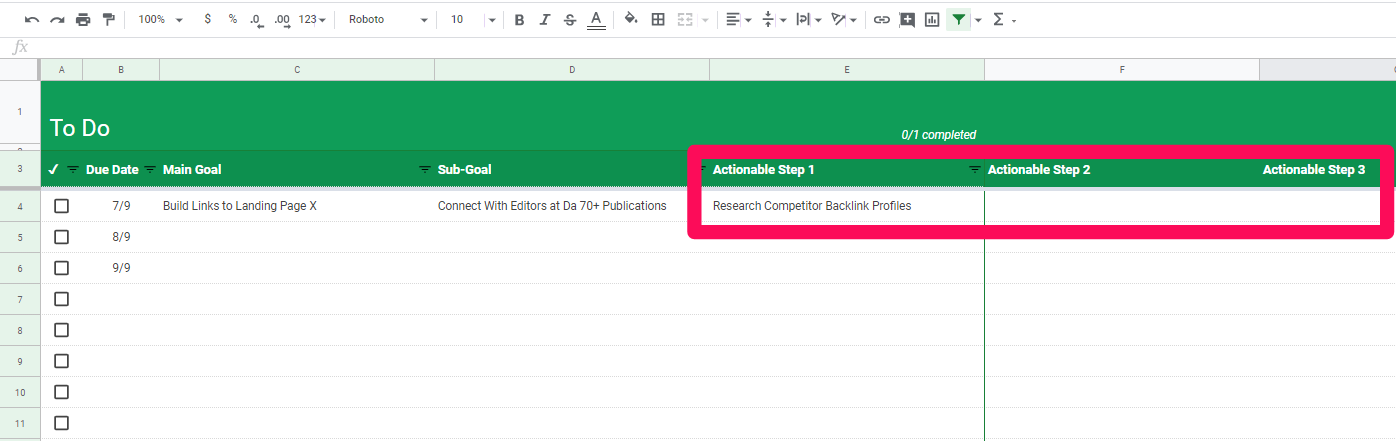
Step 1d. Put it on a timeline that is realistic and achievable. I.e, prospect three competitors this month and land contacts with three editors.
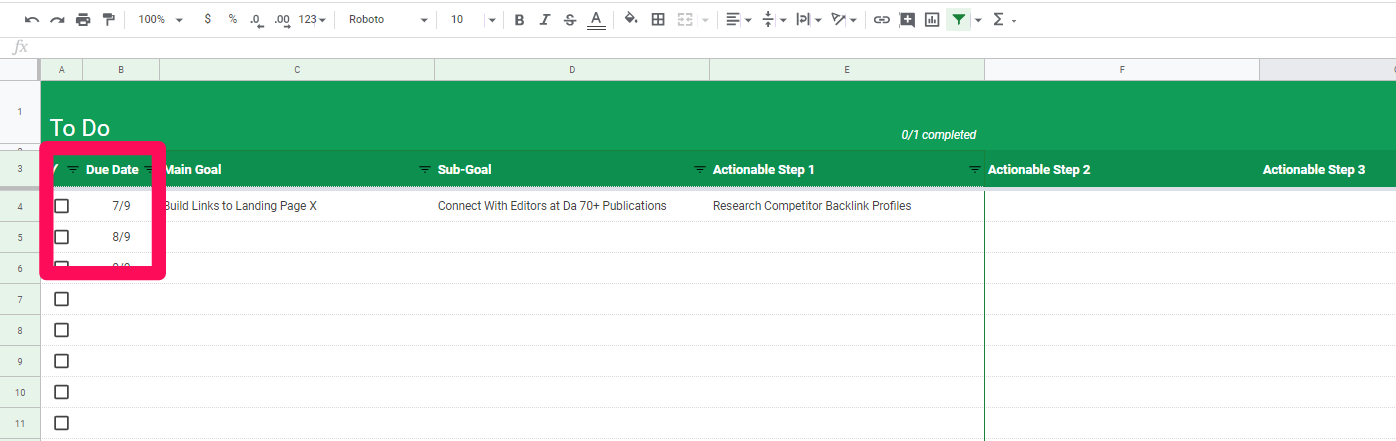
Once you’ve repeated this process for all of your main goals, you can start diving into the meat and potatoes of personalized outreach efforts.
Ready? Let’s dive in!
Step 2: Search For Niche Content To Build Your Outreach List
Most people go about creating an effective outreach strategy without knowing what prospects can do for them.
Depending on if you are link building, trying to acquire product reviews, or develop real partnerships, you need to know what type of contact you are conducting outreach with.
High-level editors and journalists aren’t going to be giving you product reviews. But they would be great for building relationships.
So, where do you start? What is the best jumping-off point for starting outreach?
Well, first, you need targeted prospects. And the best practice to do that is by looking for relevant content. Once you’ve found relevant content, you can reach out to their authors directly and build a connection.
Since these authors are writing about relevant content in your space, your chances of landing a backlink or mention are much higher than outreach to random lists.
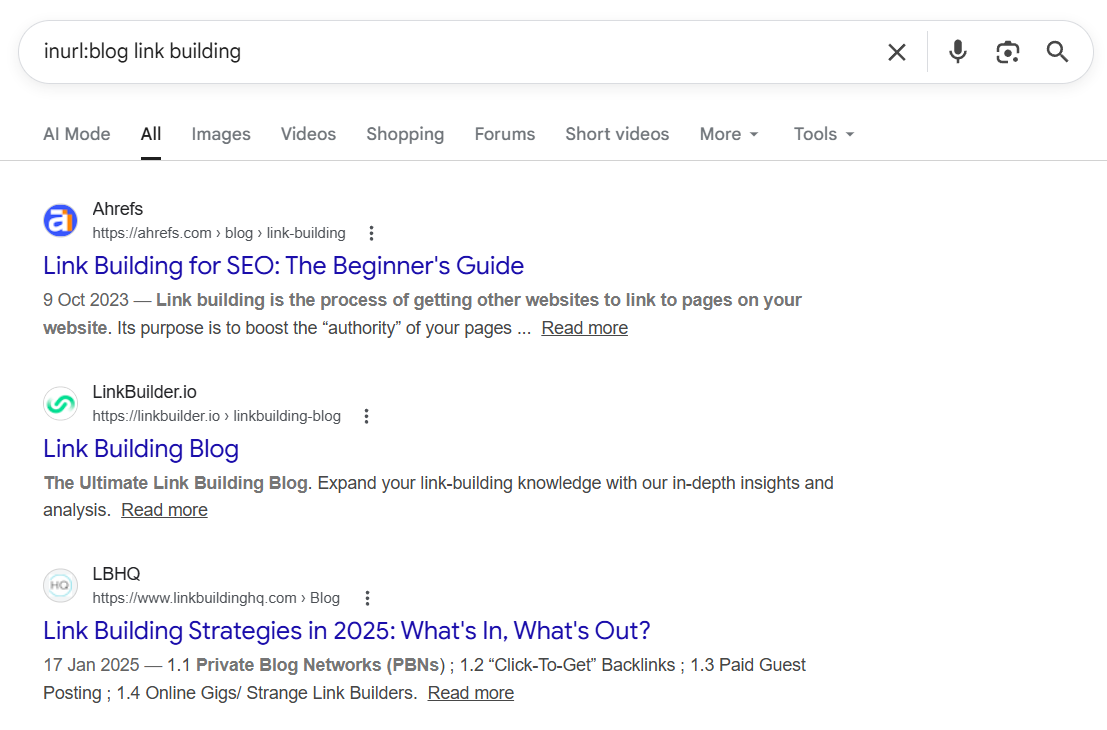
Start with inurl: to find blogs and resource pages:
- inurl:blog “your keyword”
- inurl:resources “your keyword”
This helps you find sites that regularly publish content in your space.
Next, use intitle: to find highly relevant articles:
- intitle:”best tools for x”
- intitle:”how to [your topic]”
These are great for finding listicles and guides, which are some of the best outreach targets.
Then use intext: to find mentions inside articles:
- intext:”your keyword” “guest post”
- intext:”your keyword” “write for us”
This is useful for finding sites that already cover your topic or accept contributions.
Step 3: Segment Targets By Goals to Build Outreach Templates
Most outreach strategy templates suck. Plain and simple. They aren’t going to land you big fish that generate real business growth.
If your goal is to get 1-2 backlinks out of 1,000 bloggers, sure, go for it. Send that generic template and roll the dice.
But if you want actual business impacting connections you need personalized email outreach templates.
And no, i”m not talking about the “I saw your blog post, here’s mine” template. That worked a decade ago. Not anymore.
Now, templates need specific points of personalization to show real effort. Just name-dropping a recent post doesn’t show that.
The best practice to scale templates that are actually personalized is to mention something about their article. This indicates you have taken the time to study and digest their content before reaching out. It shows that you received value from their insights.
Here is an example template we’ve produced, feel free to directly use this in your outreach. It’s a template we’ve personally seen huge success with when pitching high-level blogger targets:
Subject: Subject
Hi [First Name],
[icebreaker]
I’m writing a guest article about link building tips and would love to give you a mention.
I thought it’d be a good idea to exchange links since you just published a post on the topic.
Is that something you’d be interested in?
Cheers,
Farzad
Here are a few more essential tips to be aware of when sending outreach email templates for hyper-personalization:
- Showcase specific sections of the article that you found moving, and explain why.
- Don’t make it all about yourself. Instead, focus on how you can provide symbiotic value to them, too.
- Don’t ask directly for promotion or links. Build a relationship over a few back and forth emails before.
- Keep your intros short and sweet. Don’t self-promote!
- Study their social profiles (more on this in step five!) to gain valuable insights on their work, success, and career highlights.
Once you’ve made the first contact with your personalized emails, it’s time to actively engage on social and form your relationship.
Step 4: Actively Engage With High-Value Prospects on All Mediums
Personalized outreach strategy only works if you are genuine. If you really care about the prospects value and content.
High-level editors, influencers, and writers aren’t dumb.
They can spot insincere outreach the second it hits their inbox.
Select. Delete. Mark as spam.
Because outreach is becoming saturated, you have to take more steps to connect.
And one of the best ways to do that is via social media channel engagement or virtual calling: showing a direct interest in their content and success.
Look at your current contact list and start to engage on their profiles
Comment, like, and share their latest posts.
When commenting, seek to add value by telling them how that given post impacted your view on a topic:
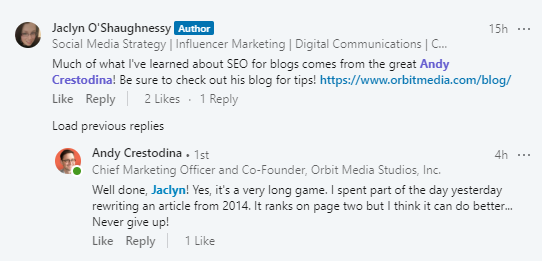
Mention the influencer you want to connect with in your comment, too.
Beyond social media channel engagement, take it one step further and start promoting their content on your own dime.
For example, using a platform like Quora, you can find relevant questions that people ask and use your prospects content as the answer.
Let me show you how.
Take the “18 incredible infographic tools” post from above that we used as an example for connecting with the writer/influencer.
Millions of bloggers and writers use infographics to condense information into a better reading experience. And since millions do this tactic, helping your outreach target to promote it would provide instant value.
How? Head to Quora and search for that parent topic, i.e, infographic tools:
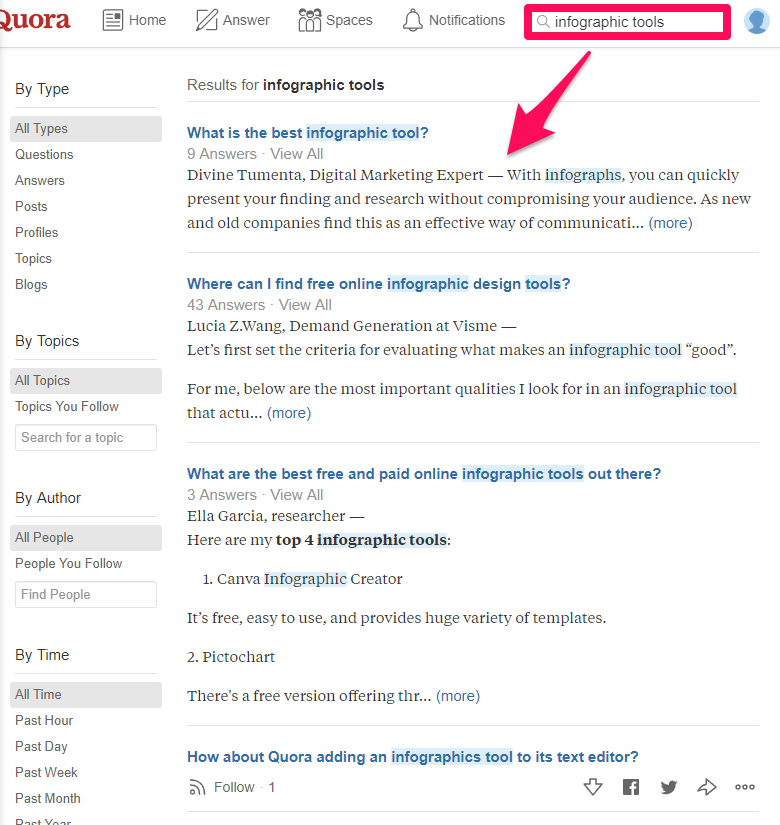
Depending on query popularity, you should see a few posts on the topic.
This is your chance to provide value to the influencer or editor you want to connect with!
Click on a given topic/post on the search results and craft your response:
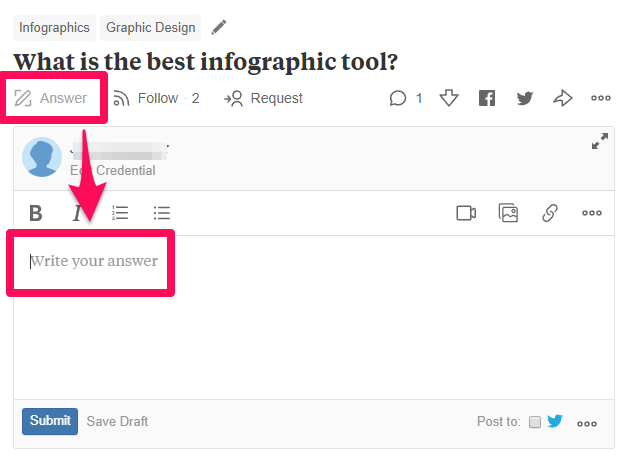
Answer the question and link directly back to your prospects blog post as a great source of information on the subject.
This will, in turn, drive relevant traffic to their post and increase their social footprint.
Now, grab the link to the Quora thread and email your prospect, letting them know that you utilize their post to answer a question on Quora, asking for their input on what else you can add to improve the response.
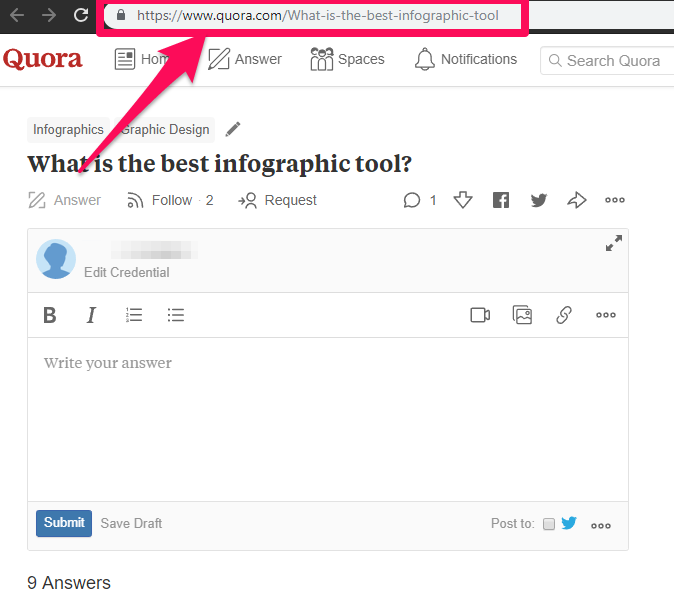
This is a fantastic strategy for high-level prospects that get bombarded with outreach emails daily.
This will help you (1) stand out from others and (2) provide unparalleled value without demanding anything in return.
Want better, personalized outreach success? Go the extra mile. You’ll thank me later.
Step 5. Be Active (Not Annoying) in Your Follow-Ups
Follow-ups are an inevitable part of any outreach strategy.
People get 121 emails per day on average at work. So the odds of them seeing your first one aren’t great.
Following up will be critical to your success, but doing it wrong can get you marked as spam faster than you can blink.
Most go wrong with follow-up emails by trying too hard:
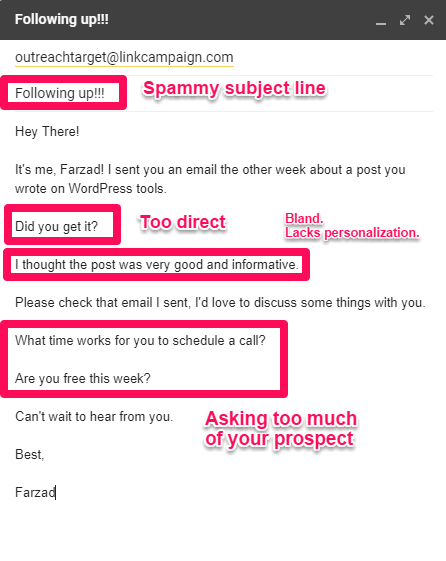
A simple follow up on the same email thread as your first email ensures you get the message across without being annoying or forcing the prospect to dig into their already filled inbox for the original message:
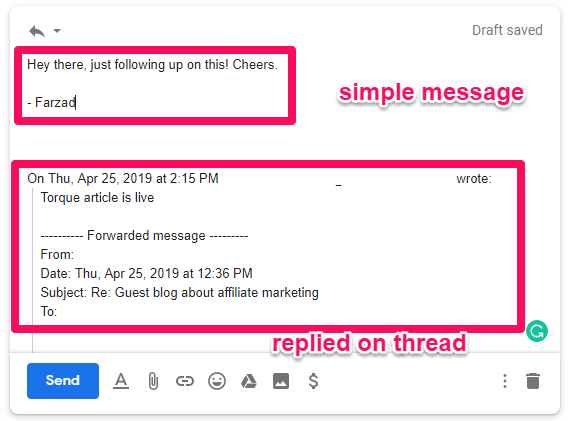
Keep your follow-ups simple, and limit them to 1-2 sentences max.
Even something like “Hey there, just following up on this! Cheers.” is perfect.
If you struggle to get a response after 2-3 follow-ups, try sending another introduction email and test a new headline/subject!
This can be a fantastic way to rejuvenate your campaign.
Key tips for active, not annoying follow-ups:
- Wait 3-5 days before sending your first follow-up
- Limit follow-up messages to 2-3 sentences
- Follow-up on the original message
- Test new subject lines if you don’t get a response
Link building cheat sheet
Now Over To You
A good outreach strategy starts with relevance.
You’re not blasting emails. You’re finding the right content, the right people, and reaching out with something that actually makes sense for them.
That’s why everything in this process builds on itself.
You define your goals, find niche content, identify the right authors, and then reach out with a clear reason to connect. Do that consistently, and your outreach stops feeling like spam and starts getting replies.
The challenge is scale.
Finding the right opportunities, personalizing outreach, and managing conversations takes time. And doing it manually gets messy fast.
That’s exactly what we built Respona for.
Instead of juggling spreadsheets and inboxes, you can streamline your entire outreach strategy in one place, from finding relevant content to reaching out and tracking responses.
And if you want to skip the execution altogether, our done-for-you link building handles the outreach for you, getting your brand placed on relevant pages without you having to manage the process.
Frequently Asked Questions (FAQ)
What is an outreach strategy?
An outreach strategy is a structured approach to contacting prospects, potential partners, or potential clients to build relationships, earn links, or promote content. It’s a key part of any digital marketing and marketing outreach process.
What makes an effective outreach strategy?
An effective outreach strategy focuses on personalization, relevance, and targeting the right audience. Instead of generic outreach emails, it uses tailored outreach messages to connect with the right prospects and improve engagement.
What is the difference between outreach and sales outreach?
Outreach is a broad term that includes link building, partnerships, and influencer collaboration. Sales outreach is more focused on converting a potential customer or potential client through direct communication.
What is targeted outreach?
Targeted outreach means focusing on a specific target audience instead of sending mass emails. This approach improves response rates and leads to more meaningful connections.
What channels should I use for outreach?
The most common outreach channels include email outreach, LinkedIn outreach, and social media outreach. Many teams also use tools like LinkedIn Sales Navigator to find and contact the right prospects.
What is B2B outreach?
B2B outreach is outreach focused on businesses instead of individual consumers. It’s commonly used in sales outreach strategy, partnerships, and marketing campaigns.
How important is personalization in outreach?
Personalization is one of the most important factors in successful outreach. It shows that you understand the prospect’s content and increases the chances of building meaningful relationships.
How do I improve response rates?
To improve response rates, focus on relevant prospects, write clear outreach messages, and keep your communication short and direct. Consistent follow-ups also play a big role.
What is blog outreach?
Blog outreach is the process of contacting bloggers or site owners to collaborate on content, earn links, or get featured. It’s a core part of many outreach marketing strategies.
How does outreach fit into a marketing strategy?
Outreach is a key part of a broader marketing strategy. It supports content marketing, link building, and brand awareness by helping you connect with your ideal customer and community members.
What tools help with outreach?
Tools like email marketing platforms, CRM systems, and prospecting tools like LinkedIn Sales Navigator can help you manage outreach campaigns and track engagement.
What is a successful outreach campaign?
A successful outreach campaign builds relationships, generates engagement, and creates long-term value. It’s not just about immediate results, but about building a network of potential partners over time.
What are some outreach best practices?
Some key best practices include:
- focusing on your ideal customer profile
- personalizing every outreach message
- keeping communication simple
- following up without being annoying