
We know how difficult it is to get your startup off the ground when you’re starting out.
This is why we’ve created a complete startup PR guide to help you get started.
Our guide doesn’t include hacks, silver bullets, or PR tips with short-term results.
Just a step-by-step process you and your small team can use to get press coverage.
In this article, you’ll learn how to define the key messages that you want to communicate, how to craft your messaging to make sure it resonates with your audience, as well as how to find and reach out to the right people to promote your startup
We’ve got a lot to cover, so we better get started.
Key Takeaways:
- Startup public relations covers every activity (online and offline) that helps your company get publicity on relevant media outlets, podcasts, and industry publications. The end goal is broader recognition, trust from investors, and a positive perception that helps you survive the early years.
- Press releases and traditional digital coverage still matter, but they no longer move the needle for sales the way they used to, especially for smaller companies. The new high-leverage channel is listicle inclusion in articles that Google AI Overviews and other AI engines cite as source material.
- The two highest-ROI tactics for early-stage founders are direct media outreach (pitching journalists and bloggers with personalized emails) and structured brand mentions on listicle and roundup articles that rank for commercial queries in your category.
- For most early-stage startups, doing it in-house works better than hiring an agency. As a founder, you build direct relationships with media, journalists, and investors that compound across future funding rounds and product launches.
- For teams that want to outsource the structured brand mentions side specifically, our done-for-you link building service handles the entire pipeline from prospecting to placement.
- What is Startup PR?
- PR Storytelling (And How to Find Your Brand Voice)
- Different PR Tactics You Can Employ
- Hiring a PR Firm vs Doing It Yourself
- Step #1: Get Your Target Audience Right
- Step #2: Craft Your Email Pitch (No, Not This One)
- Step #3: Make a List of Media Contacts
- Step #4: Personalize Your Pitch & Start Building Relationships
- Step #5: Measure the Success of Your Campaign & Iterate Based on Results
- Now Over to You
- Frequently Asked Questions
Link building cheat sheet
What is Startup PR?
The first and most important question when it comes to startup PR is what it is. So, if I had to give a definition on what startup PR is I’d say that,
Startup PR is every activity—both online and offline—that could help a startup company get publicity on a relevant media outlet, blogs, social media, podcasts, and industry publications. This publicity will eventually help the company raise awareness about its products and services and help its target audience create a positive perception of the company.
Why this is important is obvious: most startup tech companies—especially VC-backed ones—are destined to fail.
Thus, making a difference and surviving can be extremely difficult.
Can publicity and media relations help you increase the chances of surviving and eventually finding a product-market fit and start growing?
It could, but it’s not the only factor.
In 2018, a UK company that offers current accounts and money transfer services has raised it’s series B round of $60 led by investment firm Kinevik.
The announcement followed news articles on important tech publications such as TechCrunch.
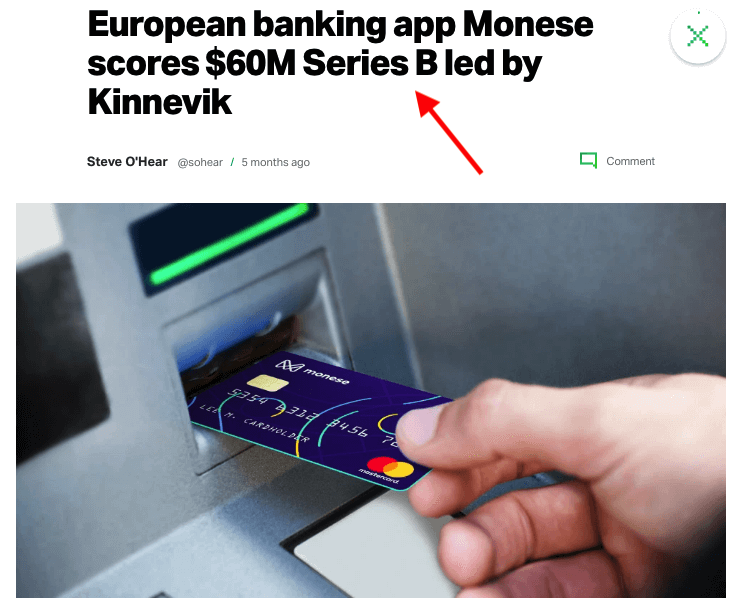
According to the company’s head of growth, Yannis Karagiannidis, “the day our funding round was announced, we got lots of people from San Francisco trying to open an account with us because that’s the most popular city for Techcrunch probably.”
So, this article got the company some free publicity and helped it—without being designed to do so—to boost its PR program efforts and get some people from San Francisco to learn about Monese’s company name and even get some new accounts.
Has it helped the company reach its business goals though?
And, most importantly, would it matter if Monese didn’t have a great product for all the users who would join the company and open their current accounts there?
What I’m trying to say is that PR is, of course, important, but it’s not the single most important factor.
Many startups are trying to get publicity online and get featured on popular publications such as the New York Times, VentureBeat, or Mashable, but few of them actually manage to survive after that.
Having a good story to tell is important, but having a strong value proposition and actually delivering on your promises is imperative.
Thus, startup PR only makes sense in the context of having a great product to support everything that you do.
Back in November 2019, Elon Musk announced the launch of a new (revolutionary) truck that would be put into production in 2021.
Following the announcement, you can see that there was a huge spike in interest for the term “Cybertrack”.
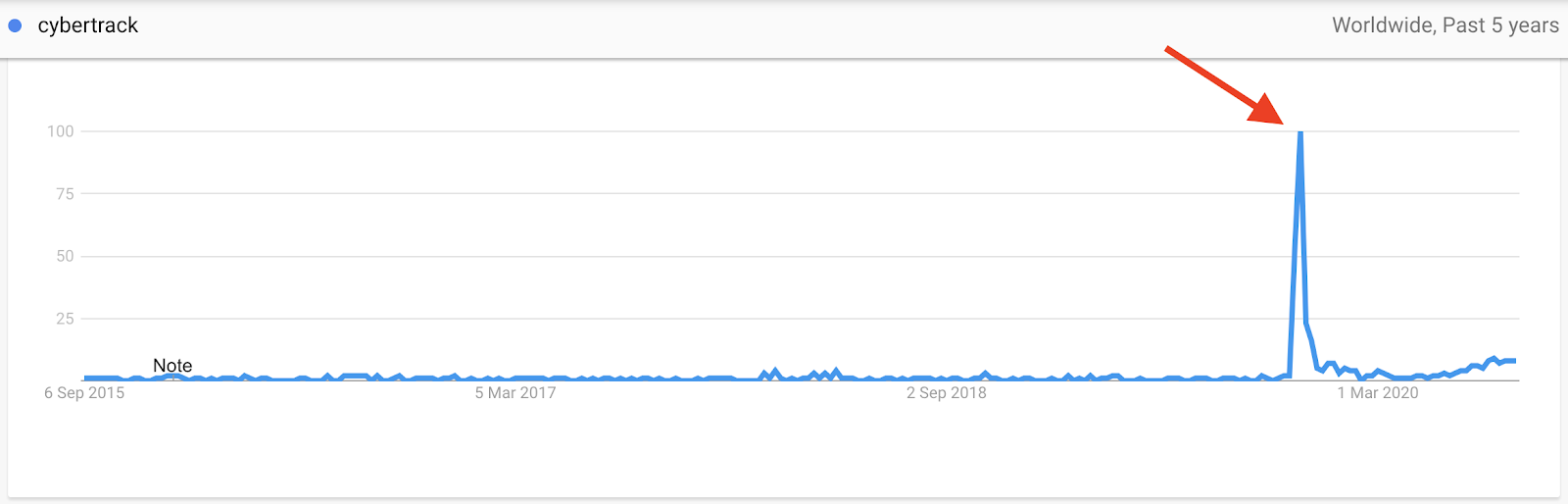
Of course, the announcement followed dozens, if not hundreds, of related articles in publications like Forbes, CNN, CNET, TechCrunch, The Verge among others.
What is interesting is not the publicity that Tesla’s announcement got, but the fact that it had an impact on the company’s bottom line.
As per Tesla’s CEO with a Tweet he made a few hours after the announcement, the Cybertruck had 146K orders without paid endorsements or advertising.
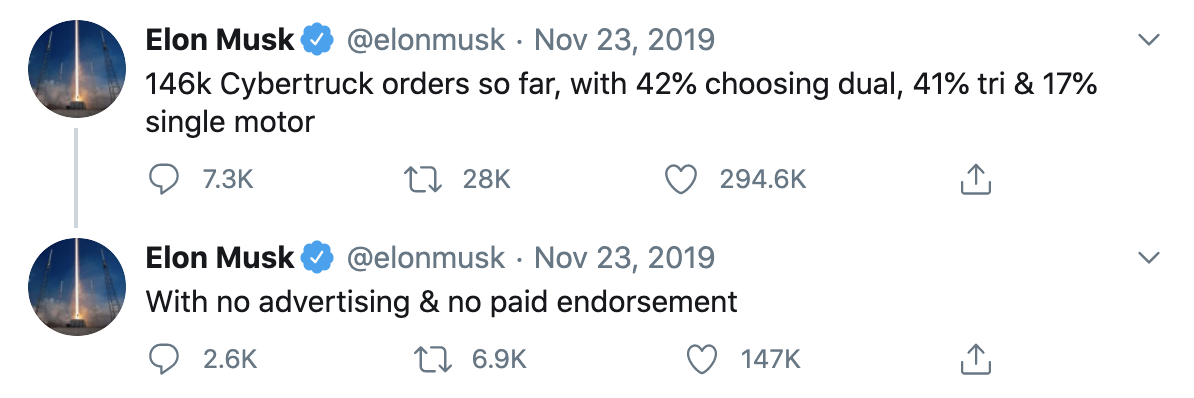
Of course, this type of publicity and virality doesn’t happen overnight.
Elon Musk and Tesla have proved their value many times in the past and thus it’s only natural that people got excited about the new product and that the media embraced it and helped spread the word about it.
Thus, it’s essential to keep in mind that even though startup PR is important, there has to be substance behind it.
You don’t want to be one of these tech startups that got coverage in big media outlets, got evangelized by influencers and bloggers, and then died.
Now that you know what startup PR is, let’s take a look at the two ways you can apply it for your own startup business.
PR Storytelling (And How to Find Your Brand Voice)
PR storytelling is a type of public relations strategy that uses story-telling techniques to communicate the brand’s message to the public.
Such techniques include but are not limited to:
- Creating a press release
- Developing a media pitch
- Networking with media and influencers
- Hosting a press conference
- Generating visuals such as videos, infographics, and photos
- Creating content such as blog posts, podcasts, and webinars
- Leveraging social media channels
They focus on using stories to create an emotional connection with the audience and help them to remember the message.
It is used to engage the target audience, build relationships and trust, and establish a positive reputation as well as thought leadership.
Finding your brand voice is an important part of PR storytelling.
It is the tone, language, and style that you use to communicate with your audience. Your brand voice should reflect your brand’s values, mission, and personality.
To find your brand voice, start by understanding your target audience.
Get to know them and their needs, wants, and values.
Then, brainstorm different ways to communicate your message that will resonate with your target audience.
Use market research, customer feedback, and competitor analysis to guide your decisions. Make sure your message is consistent across all platforms and channels.
Once you have established your brand voice, keep it consistent. Monitor customer feedback and adjust your message as needed. Regularly review and refine your message to ensure you are communicating your message effectively and accurately.
Think Apple – the most prominent example of an exceptionally powerful brand voice.
Different PR Tactics You Can Employ
A strong PR strategy consists of dozens of tactics, impossible to cover in a small sub-section.
So, we’ll only cover the three that we think are the most important.
Get Structured Brand Mentions
Press releases are still the default startup PR move, but the harsh truth is that for most early-stage companies, press releases don’t drive sales.
A few thousand impressions on Business Insider feels good, but if those readers aren’t in active buying mode for your category, the campaign won’t translate to revenue or even meaningful brand recognition.
The same logic applies to one-off mentions in news articles. Yes, getting featured on TechCrunch is great for credibility and the kind of signal that gets investors to take a meeting.
But ask any founder who’s been there: the post goes live, you get a small spike in signups, and traffic drops back to baseline within a week. Press releases distributed through wire services often perform even worse, since they’re treated as paid content by most publishers and rarely earn organic pickups.
What actually moves the needle now is more strategic: structured brand mentions on listicle and roundup articles that rank for commercial queries in your category.
These are the “Top 10 X tools for Y” or “Best Z platforms in 2026” pieces that show up for high-intent searches, AND get cited by Google AI Overviews when people ask an AI engine for product recommendations.
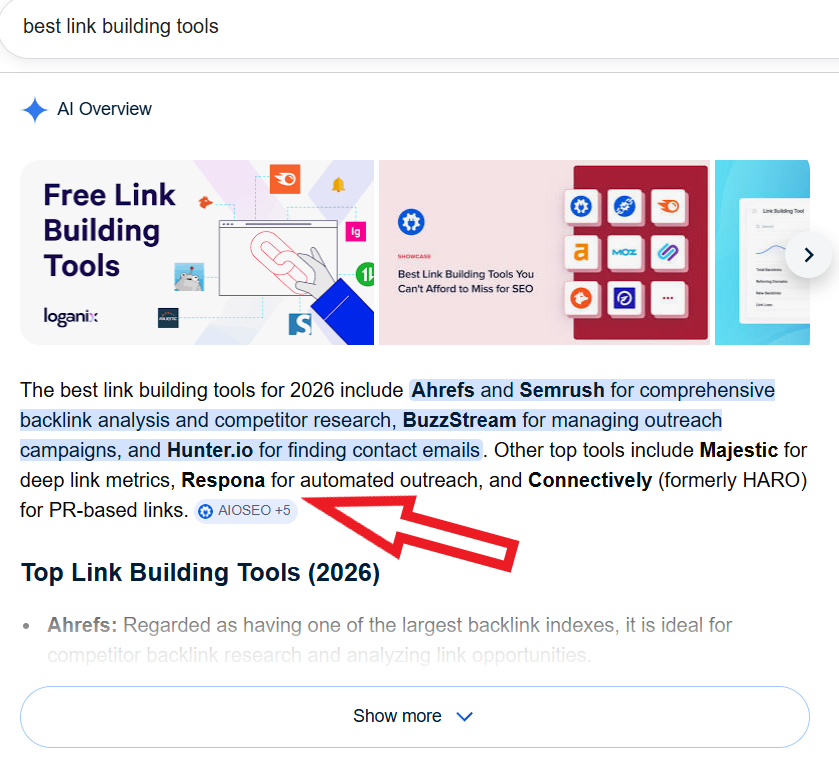
These mentions also tend to come up when investors do due diligence on your company by searching your category online.
The mechanic snowballs in two directions:
- Direct: people searching “best X” find the listicle, see your brand, click through.
- Indirect: AI engines pull from the same listicles to generate their answers. Your brand appears in AI-generated responses without you doing anything extra.
This is genuinely the highest-leverage PR activity available to smaller companies right now.
You’re not competing for the front page of the New York Times; you’re competing to be one of the 10 brands mentioned in an article that ranks for a buyer-intent keyword.
Way more achievable, way more measurable, and way more correlated with actual sales than any traditional outreach campaign or earned media play.
Now for how to actually get those placements at scale.
How Respona Handles Structured Brand Mentions
If you want to outsource the listicle inclusion side of your PR strategy, our done-for-you link building service is built specifically for this. Here’s the workflow:
1. Register and place an order.
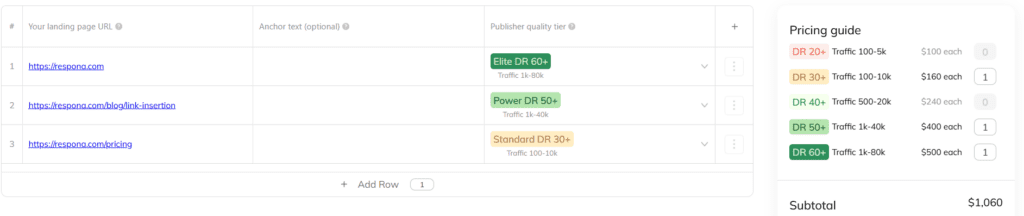
Specify the target URLs you want to build mentions for, the anchor text you’d like used, and (optionally) the AI prompts you want your brand to be cited for. There’s no monthly retainer or setup fee.
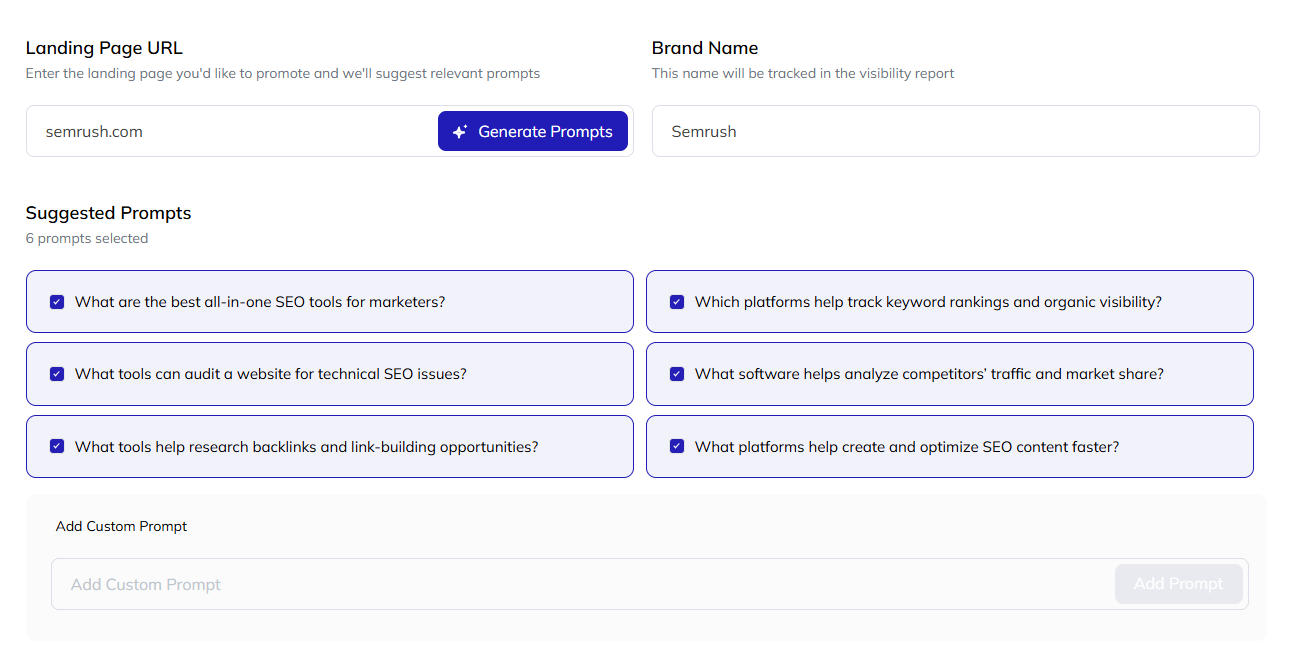
2. The tool automatically generates your action plan.
Respona’s prospecting engine pulls a ranked list of listicle articles and roundups where placements would drive the needle across both Google rankings and AI search. Each prospect is filtered for domain authority, topical relevance, and whether these pages are being cited by AI for your target queries.
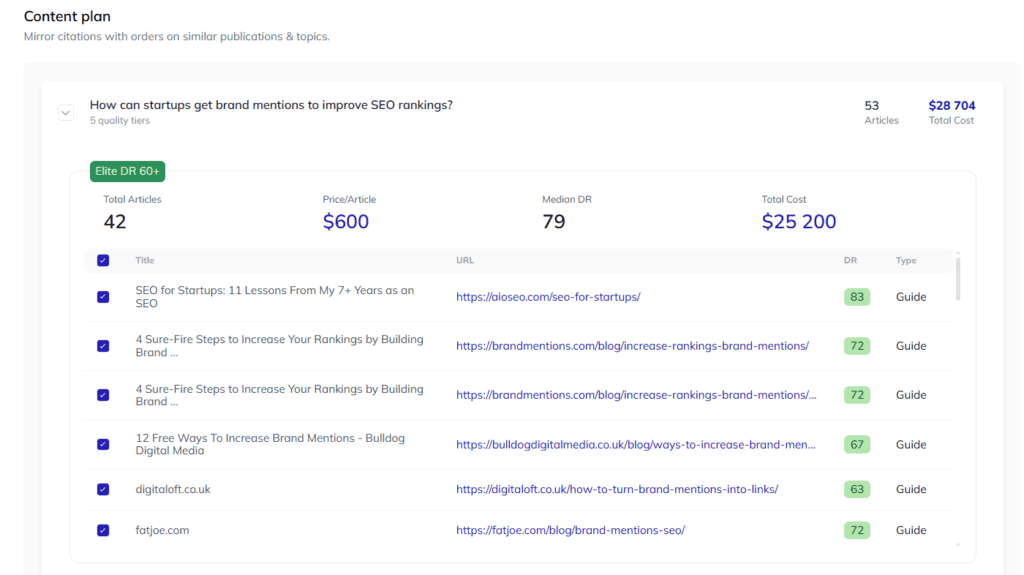
3. Place orders on specific placements.
Pricing is tiered by the publisher’s DR:
- Starter (DR 20+) at $100
- Standard (DR 30+) at $160
- Authority (DR 40+) at $240
- Power (DR 50+) at $400
- Elite (DR 60+) at $500.
4. The Respona team handles outreach end-to-end.
Pitching, follow-ups, negotiation with the publisher, and live placement on the article. You don’t lift a finger on the outreach work itself.
5. Track AI visibility separately.
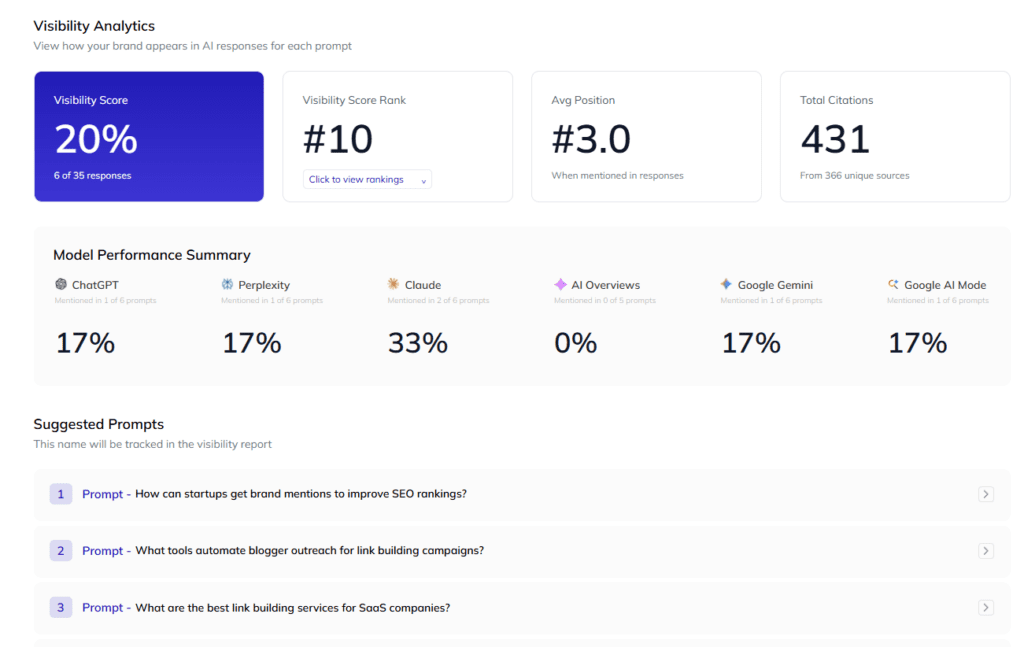
The platform’s AI visibility tracker monitors your brand mentions across six AI engines (ChatGPT, Perplexity, Google AI Overview, Gemini, Claude, Microsoft Copilot), so you can see which placements are translating into AI citations over time.
Around 80% of customers are agency partners that white-label the service to their own clients. For teams that want manual sign-off on every prospect before outreach goes out, pre-approval is available as a +20% paid add-on.
Grow Relationships With Influencers and Other Companies
Public relations are impossible as a solo entrepreneur.
Asking any PR person (especially PR professional teams) to do something for you out of the blue is hard, too.
This is why you need to build a PR expert network and get acquainted with other companies and their PR team members before investing time and resources into any particular PR Strategy.
We will dive deeper into how exactly you can do that further on in the article.
Create Compelling Content (In All Formats)
Content is the backbone of almost any online business.
It’s aimed both at your users and the search engines.
It allows you to communicate your message, educate your audience/potential customers (or even potential investors), and, of course, secure high spots on search engine results pages for relevant keywords.
All of this is good for PR, website traffic, sales, brand awareness, and the general well-being of your business.
Your company blog is the easiest place to start, followed by social media, videos, infographics, webinars, and other forms of content.
Write and Distribute a Press Release
Writing a press release is arguably the most traditional tactic in the entire world of Digital PR.
We’re not going to go in-depth on how to write one as we already have an extensive guide with templates on that topic.
However, all steps of using Respona that we’ll describe further along are also applicable to the press release distribution process.
Hiring a PR Firm vs Doing It Yourself
In general, there are two ways you can do public relations for your business:
- Hire a PR agency
- Do it by yourself
Here are the differences between these two ways:
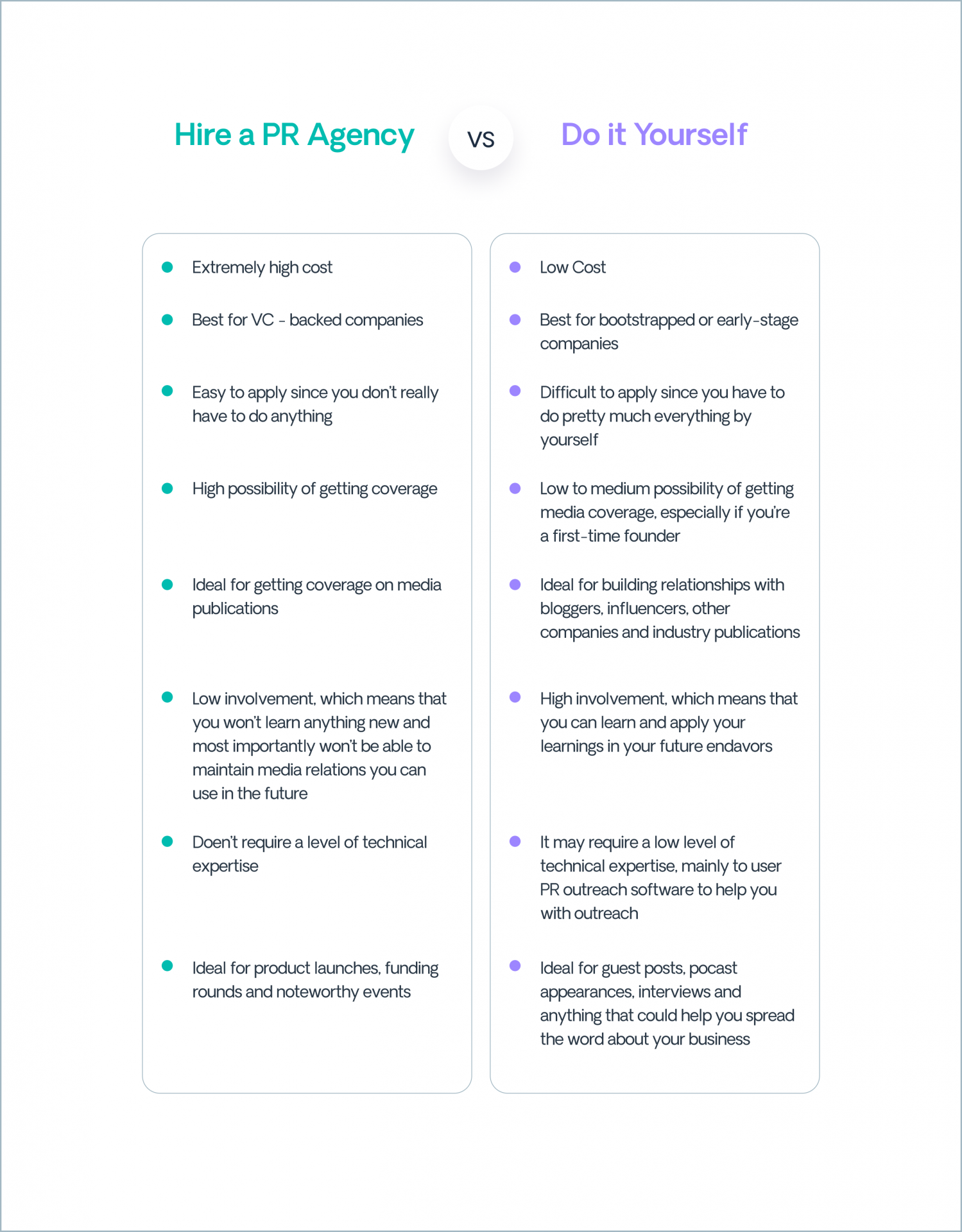
Even though we believe that both of those two ways can be effective for your PR efforts, it is obvious that the second way (doing it yourself) has many more benefits than hiring a PR firm or agency.
The truth is that especially if you’re an early-stage company, you can’t really afford to hire PR services.
In addition, doing it yourself as a startup founder will allow you to acquire knowledge and build relationships that you can later leverage, regardless if you’re going to do it for the same company or for another one.
The process we’re going to cover moving forward is based on the assumption that you’ve chosen to do digital PR for your tech startup by yourself.
Let’s get into it.
Step #1: Get Your Target Audience Right
The first step toward executing a successful startup PR is to get your target audience right.
To describe how that works for an actual startup, we’ll be using Blindlee — a dating app that previously used Respona for it’s startup PR needs — as an example.
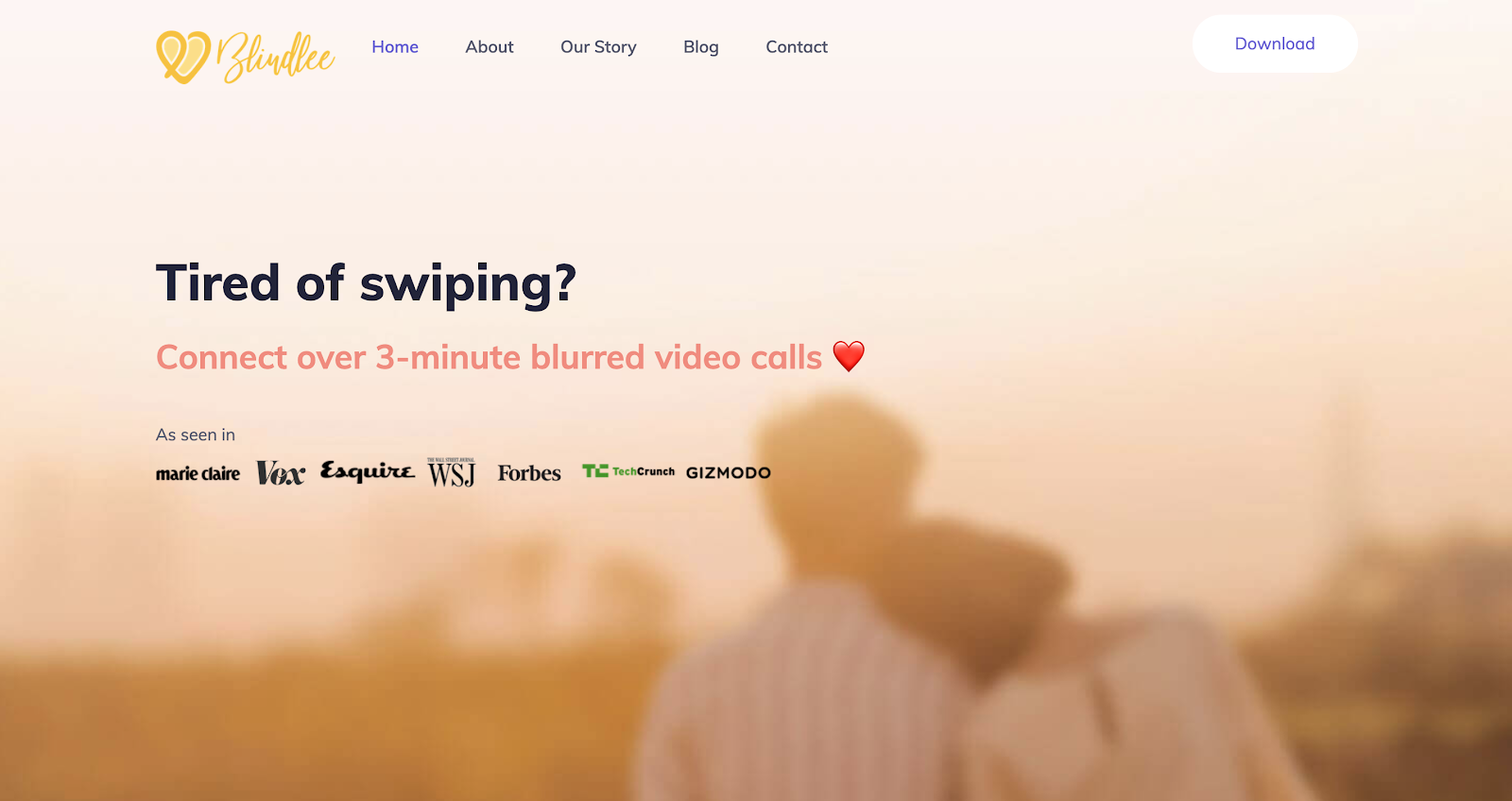
As you can see from the screenshot above, Blindlee is a startup that’s done a great job with their PR efforts.
The app has been mentioned in publications like TechCrunch, Gizmodo, Esquire, WSJ, Forbes, Marie Claire, and more.
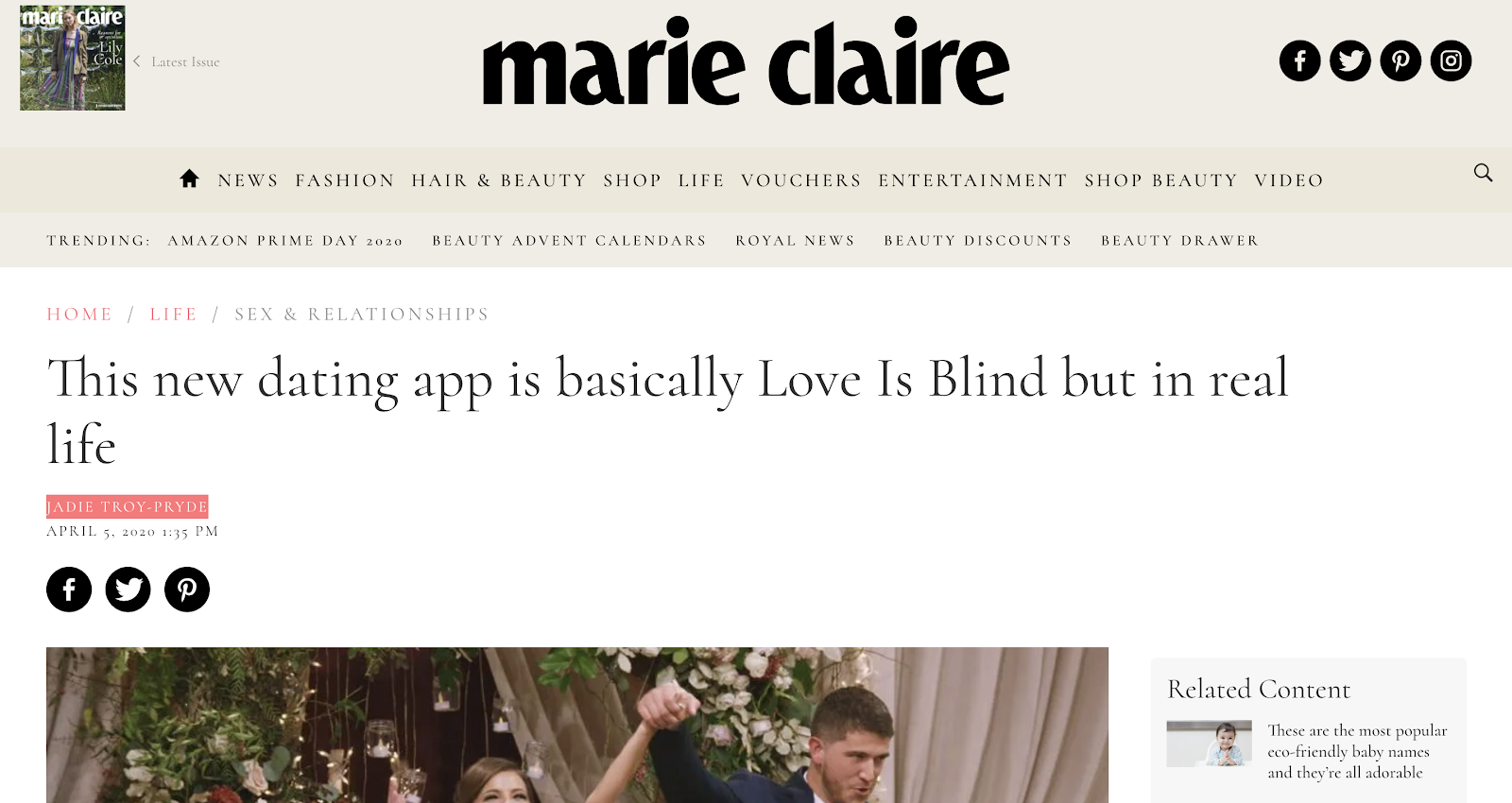
Besides getting them some really useful digital PR, this has helped the app’s website improve its authority and overall visibility.

Blindlee is one of the most successful case studies for the right use of media to get PR.
Throughout this guide, I’ll be sharing with you how Blindlee did.
This way, you’ll be able to follow the steps outlined below and generate some startup PR for your own company.
Let’s get into it.
First, we’re going to need to find some relevant publications that might be interested in covering our story.
Some of the search queries you can use would be the following:
- “online dating” site:techcrunch.com: search a specific publication for articles on your topic
- “online dating” intitle:top OR intitle:best: find listicle articles where you might secure inclusion
- “online dating apps” intitle:”best”: find ranked listicles in your category
- “online dating” “2026“: filter for fresh content (replace the year as needed)
- “online dating” -site:reddit.com -site:quora.com: exclude low-leverage platforms
- “competitor name” “alternatives” OR “vs”: find comparison articles where your competitor is mentioned (these often need updating with new entrants like you)
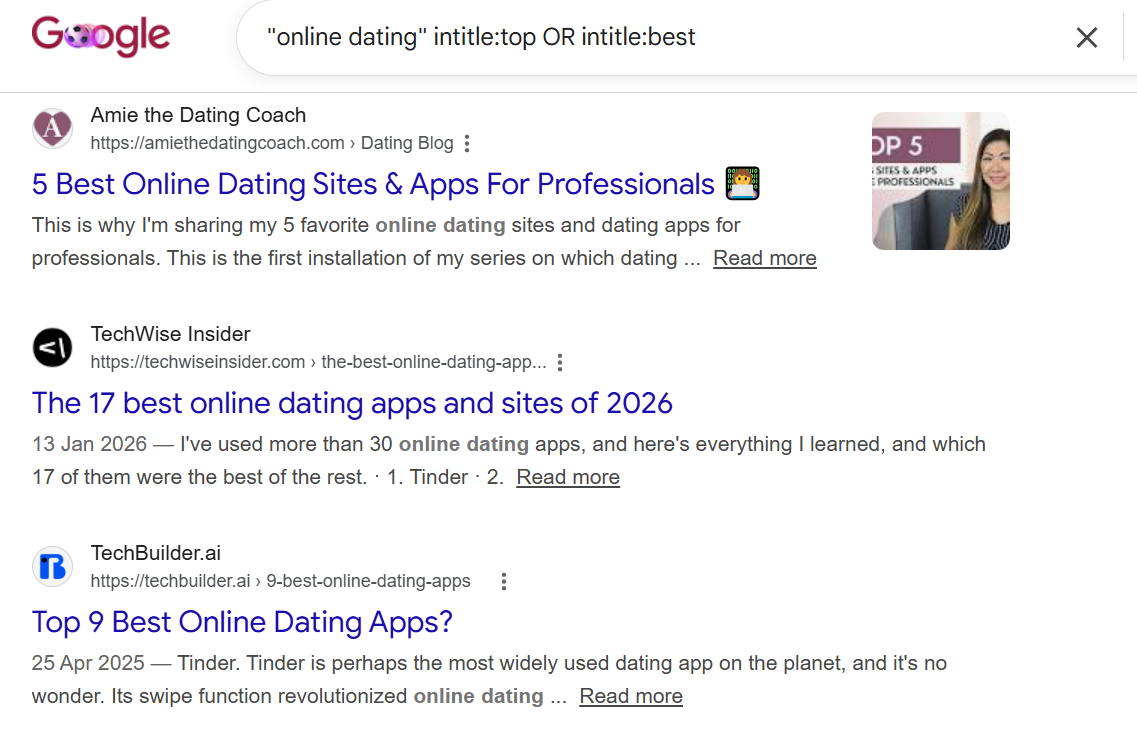
You can visit the results that seem to be most promising to see whether they are, indeed, relevant to what you’re looking for.
Here’s a great example:
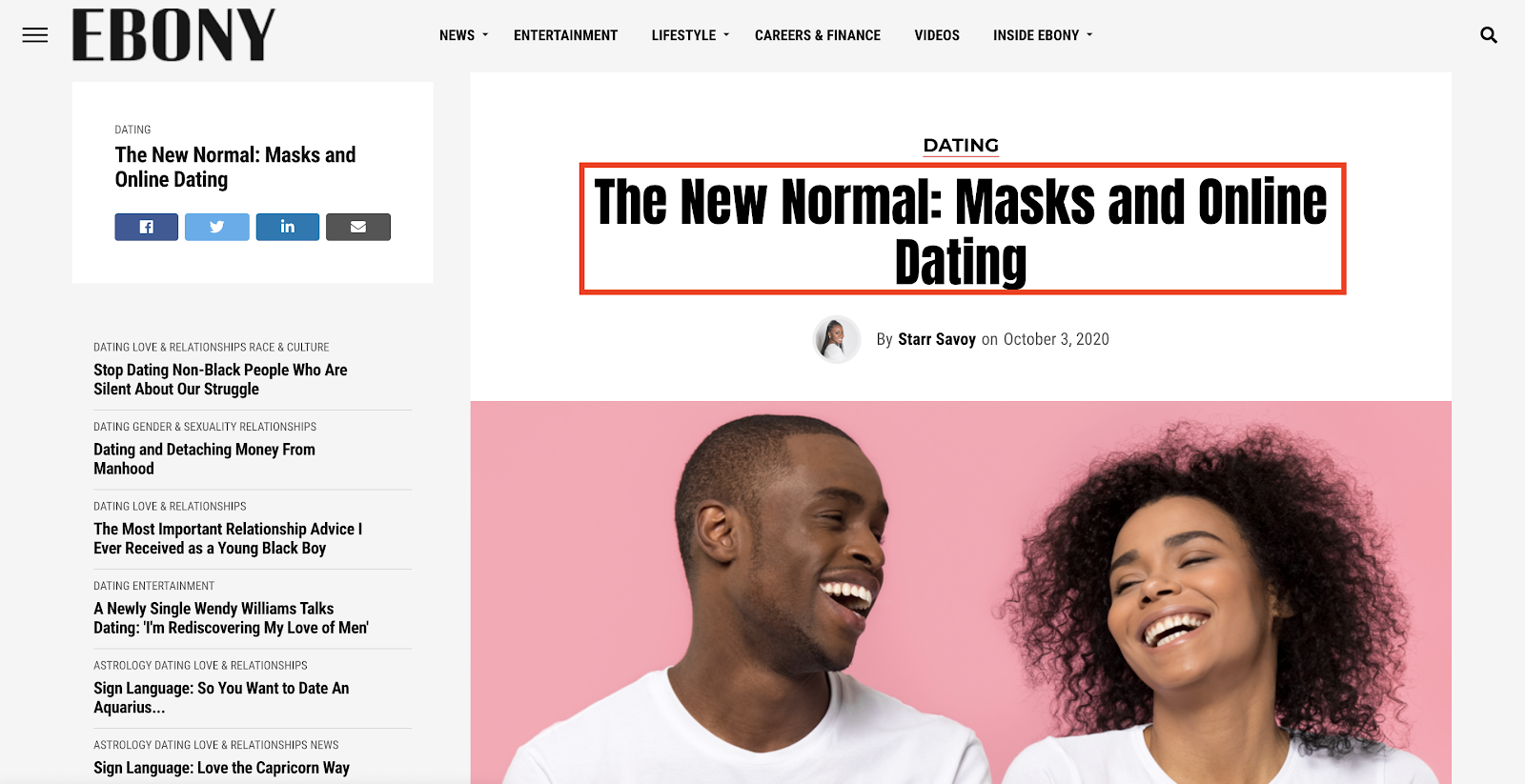
That’s a news article from Ebony.
It’s fresh, it has humor, and it’s time relevant, as of the writing of this piece on Wed, November 4th, 2020.
After vetting the opportunities based on your specific criteria, you can choose the ones that you consider to be relevant.
To be sure that those prospects are relevant to what your startup is doing, always make sure to check their Twitter and LinkedIn profiles, see what they publish online, and what they’re interested in.
This way, you’ll be able to separate the good opportunities from the bad ones.
Moving on to the next step.
Step #2: Craft Your Email Pitch (No, Not This One)
The next step is to create your email pitch.
Even though there are many outreach templates you can use to do this, for the purposes of this campaign, we’ll be creating a new email from scratch.
Author’s Note: Make sure that this is something you can use in other campaigns as well.
Even though there are no silver bullets for creating an email pitch that gets replies, there are some fundamentals you should be aware of:
- Try to make your subject line is as descriptive as possible
- Be very clear as to what you want to achieve from the email
- Include a relevant call to action (CTA) for your recipients to consider
- Try to avoid using spam words like here or now
Writing an email pitch that gets replies is something like an artform.
The email pitch that we’ve created for the purpose of this campaign is the following:
Subject: Subject
Hey {first_name},
I was reading your article on {website_name} regarding online dating.
I liked how you said that {Something from the article}.
It’s true that online dating in the era of covid has become more difficult.
This is why we’ve developed an online dating app that takes the swiping away and adds a human touch into online dating.
Would you like to take a look?
Let me know and we can provide you with any information you might need.
Thanks,
As you can see below, our email has scored a high grade according to our internal grading system:
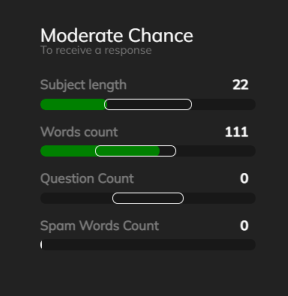
This is because the email has a good word count, a good subject length, it includes a question, and it doesn’t include a spam word in it.
In the next steps of the process, we’ll be assigning a contact to each opportunity in our media list.
Step #3: Make a List of Media Contacts
In the first step, we’ve identified our audience — journalists who are covering topics around online dating.
At this point, we have to make a list of media contacts, meaning that we have to identify the best contact for each opportunity.
For step one, look at the publication’s author archives, recent bylines, or staff page. Most outlets publish journalist bios with their coverage areas, which makes filtering for the right beat reporter straightforward. LinkedIn is also useful: search for “{publication name} journalist” or “{publication name} reporter” to see who’s currently writing for them.
For step two (finding the verified email), you have a few options:
- Hunter.io. Pull domain-level email patterns and individual verified emails. Pricing starts around $34/month for the basic plan, with a limited free tier.
- SalesQL. Browser extension that pulls verified emails from LinkedIn profiles. Strong fit if you’re prospecting from LinkedIn anyway. Free tier available.
- Respona’s free email finder. Single-prospect lookup with daily search limits, no credit card required. Useful for ad-hoc prospecting without committing to a paid tool.
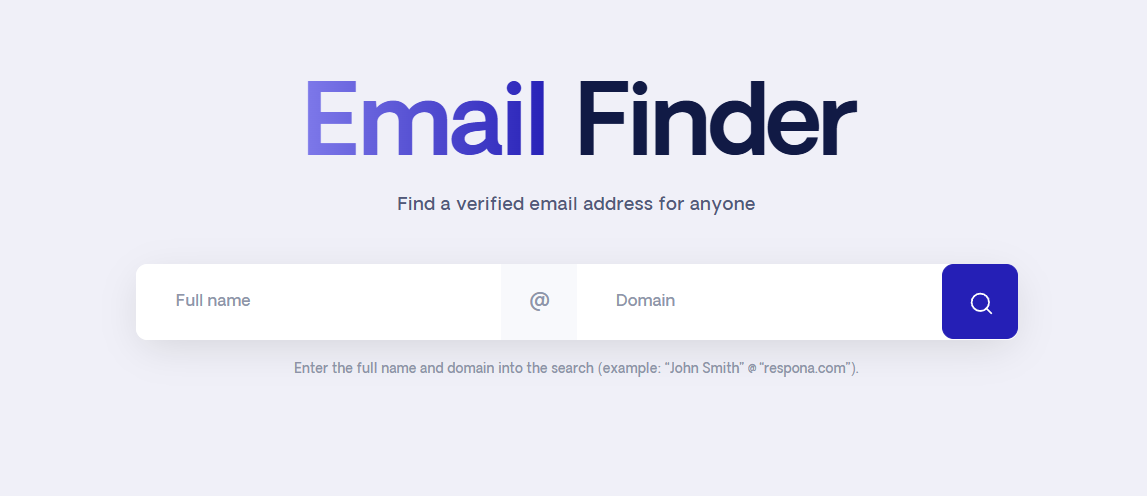
For best results, always run the email through a verification check before sending. Hard bounces hurt your sender reputation, which affects every campaign going forward (PR pitches, sales outreach, transactional emails, all of it).
If you’re running outreach at scale (50+ contacts per campaign), the few dollars per month for Hunter or SalesQL pays for itself quickly. For occasional pitches, Respona’s free email finder works fine.
Step #4: Personalize Your Pitch & Start Building Relationships
In this last step, the part of the email we’ll have to adjust is the highlighted one in the screenshot below.
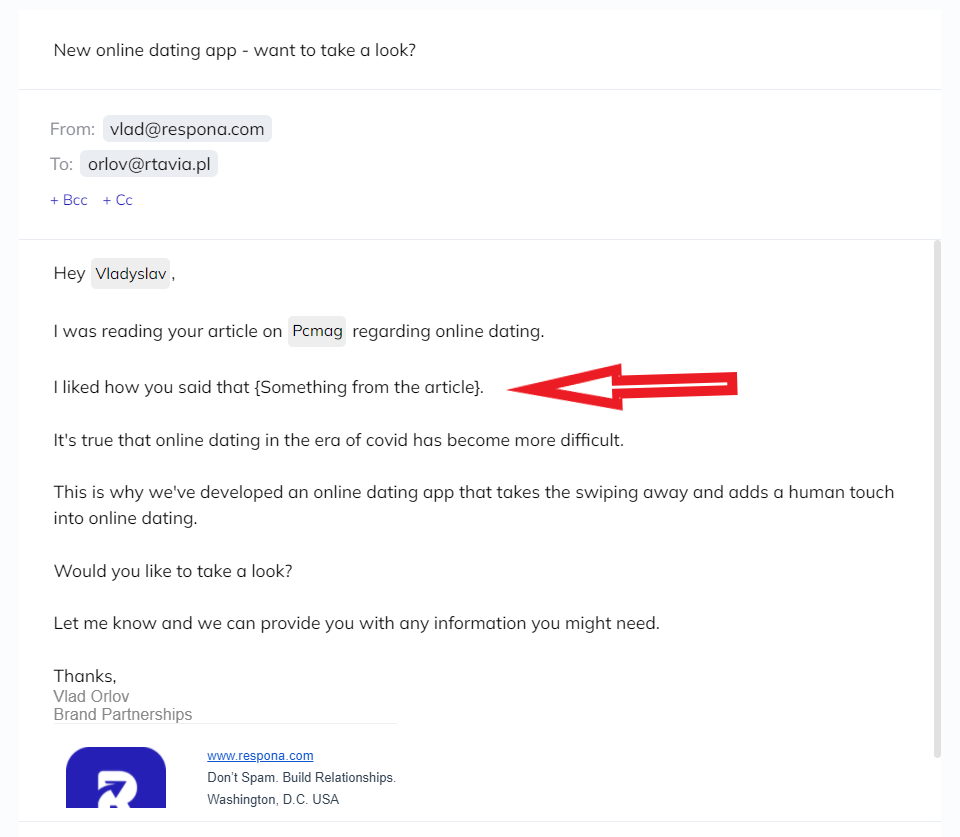
We’ll replace that with a relevant excerpt from the article we found so that we show to our prospect that we’ve actually read their article.
A few personalization tips that consistently boost reply rates:
- Reference the actual content of the article, not just the headline. Most pitches stop at “I loved your article on X.” A better approach: “I noticed you mentioned [specific quote or data point] in your article on X, and wanted to share something related.”
- Connect their angle to your story. If they wrote about [trend A] and your startup is in [related space], explicitly draw the line. “Your piece on online dating during COVID overlaps with what we’re building at [company]” works much better than “we have an online dating app, want to take a look?”
- Drop the boilerplate intro. Anyone who reads pitches all day can spot “I hope this email finds you well” from 100 yards. Start with the angle.
- Reference their recent work specifically. If they’ve posted on social media or LinkedIn within the last week about something relevant, mention it. This shows you actually pay attention to their work, not just their email address.
- Keep it short. A 4-sentence pitch outperforms a 12-sentence pitch nearly every time, especially for tier-one journalists who get hundreds of emails a day.
Step #5: Measure the Success of Your Campaign & Iterate Based on Results
The work isn’t over once your startup’s PR campaign is launched.
Now, you need to measure the success of your campaign and marketing KPIs to see if your strategy is working or if it needs to be adjusted.
For the hypothetical campaign we’ve been using as an example, metrics that could be of interest are:
- Reply rate
- Number of open conversations
- Number of online mentions and earned media
The metrics that you’ll monitor are different based on the goals of your startup PR campaign.
Also, the way you’re measuring success will differ based on the way you’re doing PR, e.g. hiring a PR firm vs doing it yourself.
For example, a PR campaign may have as a goal to get online mentions and backlinks back to your homepage.
Another one may have to get you featured on podcasts, virtual summits, shows, webinars, and anything in between.
You can find more information about measuring the success of your campaign in our recent article on how to write a PR plan.
This can be your playbook for making sure that you have everything you need to plan an effective PR campaign for your company.
Link building cheat sheet
Now Over to You
So, there you have it.
Getting media coverage for your new product through effective PR strategies can be a great amplifier of your overall business efforts.
When running a startup, especially when you’re an early-stage startup, you need that extra push to help you raise brand awareness and start building relationships with industry experts, media outlets, relevant journalist & PR teams, and other businesses.
Successful PR campaigns can help you achieve all of these things.
You just have to try really hard, be creative, and be prepared to hear many “NO’s” along the way.
And if you’d rather skip the time investment for the structured brand mentions side, our done-for-you link building service handles prospecting, outreach, and live placement on the listicle articles AI engines actually cite. Pay per link delivered, with no monthly retainer or setup fees.
Place your first order to get started today.
Frequently Asked Questions
If you are looking for additional information about startup PR or PR in general, we have compiled a list of frequently asked questions.
Q1. How do you get PR for your startup?
Hopefully, you have gathered some information about this through this guide but essentially, you get PR for your startup by building personal relationships and providing them with engaging content to reference or to solve a potential problem they are facing.
You can find more public relations resources on our blog.
Q2. Why do startups need PR?
There are a few reasons why startups need public relations but the most important reason is to introduce your business to the world. As a startup, not many people know about your business so pr helps you get the exposure you need without requiring a lot of money.
Startup PR also allows you to establish yourself as an expert in the industry while generating content for the ever-flowing media pipeline.
Q3. Is PR a dying industry?
Recently we have started to see more articles claiming that PR is a dying industry but those titles can be misleading because the PR industry is changing more than it is dying.
The need for expensive PR firms may be dwindling but PR tactics are still very effective, especially for startups and small businesses.
Q4. What is modern PR?
Modern PR has evolved beyond a simple press release about a product launch to a more advanced approach of planned persuasion. Modern PR is more about the connections you are making and the exposure your brand can get by taking advantage of those connections.
Instead of focusing on relevant reporters and media coverage, it has evolved to influencers and bloggers and guest posts or podcasts. The fundamental goals are relatively the same as traditional PR but the approach has changed to match the types of media we use more today.
Q5. What is a PR example?
We’ve already listed a few PR examples throughout this guide but another great example is the ALS ‘Ice Bucket Challenge’.
The viral challenge of pouring ice water over your head to symbolize the effects of ALS gave the little known charity global notoriety and raised millions in funds for the cause. It even got celebrities like Mark Zuckerberg and Bill Gates involved.
Q6. How long is a PR pitch?
There’s no set length a PR pitch has to be but you want it to be as clear and concise as possible. Busy people will not take the time to read a long email so it’s a good rule to keep your pitch under 3 or 4 paragraphs.
Q7. Is there a right amount of public relations for your startup?
Again, there is no standard for how much public relations efforts your startup should have. You will evaluate this based upon the PR resources available to your startup, the goals you are trying to achieve, and the effectiveness of your current PR strategy.
The amount of PR you will need also depends on the stage of your startup. Generally, you will need to invest more in this area at the beginning of your business journey and then you can scale back or adjust your strategy as time goes on.
Q8. Is it better to outsource your PR strategy or build a team to do it in-house?
We discussed this briefly at the beginning of this guide but there are pros and cons to both approaches. It’s cheaper to run your public relations in-house but you could have someone more experienced run your PR outreach by outsourcing.
You will have to weigh both options to decide which choice is better for your startup.
Q9. What is tech PR and how is it different from broader startup PR?
Tech PR is a focused branch of public relations specifically for technology companies. While general PR can cover any industry, tech PR involves pitching specialty publications like TechCrunch, The Verge, and Wired, and often includes product launch coverage, funding announcements, and technical thought leadership.
The work overlaps heavily with broader startup PR work, but the audience is narrower and the angle expectations are different.
Tech PR works best for companies based in Silicon Valley or other major innovation hubs, though companies elsewhere in the United States can succeed with the right pitch angles. The fundamentals (relationship-building, personalized outreach, timely angles) carry over regardless of geography.
Q10. How does crisis management fit into a startup’s PR strategy?
Crisis management is the side of PR most early-stage startups hope they’ll never need. But every founder should have a basic crisis communication plan in place before they need it, especially as the company grows past Series A.
A simple framework: when something goes wrong (a data breach, a product failure, a controversial public statement), you need a designated spokesperson, a pre-drafted holding statement template, and a clear escalation path.
Many companies also invest in basic media training for their leadership team so the first person fielding journalist questions doesn’t accidentally make things worse. Some bring in a specialized startup PR agency that focuses on crisis prep retainers, which can be valuable if your category is high-scrutiny (healthcare, fintech, defense).
Strategic communication during a crisis isn’t about spin; it’s about clarity and speed. The companies that recover from PR crises fastest are the ones that communicated honestly and quickly.
Q11. Should AI startups approach PR differently than other tech companies?
Yes, slightly. An AI startup typically faces two specific PR challenges that other startups don’t.
First, journalists are flooded with AI pitches. To stand out, you need a genuine angle beyond “we use AI”, preferably a concrete product win, a contrarian opinion, or unique data. Generic “AI-powered” framing gets ignored.
Second, there’s higher scrutiny on safety, ethics, and accuracy claims. What you say in the press gets quoted in academic papers and policy discussions, so tighten your claims, prepare for follow-up questions, and consider engaging a PR agency with specific AI and SaaS experience if your launch is high-stakes.
Many AI startups also benefit from earned media coverage in specialized publications (The Verge, Wired, IEEE Spectrum) rather than mass-market outlets.
Q12. How do you measure PR’s impact on investor confidence?
Investor confidence is harder to measure than direct sales metrics, but it does correlate with consistent media presence.
A few proxies that work: frequency of inbound investor inquiries (when more investors reach out unprompted, your PR is doing its job), reference checks (when prospective investors mention reading about you before the first call, that’s an attribution signal), and press kit downloads on your investor relations page.
VC backed startups in particular should track how their public profile correlates with each funding round. A strong PR base before a fundraise often translates to better valuations and more competitive term sheets.
For any founder who hasn’t yet raised, building visibility with investors is one of the most underrated returns on PR investment.
Investors notice patterns, and consistent positive coverage shifts their default assumption about your company from “unknown” to “worth a call.” Even a few placements on tier-one publications in the 6-12 months before a fundraise can make investors significantly more likely to take a meeting.
Q13. How does corporate communication for an established business differ from startup PR?
Corporate communication tends to be more structured, with dedicated comms teams, official statements, and stricter approval processes. The startup version is usually faster, more personal, and led by the founder directly.
Most early-stage companies don’t need formal comms structures until they cross 50+ employees or face heightened scrutiny (post-IPO, post-acquisition, post-controversy). Until then, the leaner approach works better.
Once a startup matures into an established industry leader, the playbook shifts: more structured comms, more spokesperson training, and more attention to consistency across channels.
At this stage, investors and analysts are watching every public statement, so the communication function moves from founder-led to team-led.
Q14. What’s the difference between PR for B2B and B2C startups?
PR for B2B startups focuses on positioning your company as the credible solution to a specific business problem.
The audience is decision-makers at potential customer companies, plus the analysts and trade journalists they read. B2B-focused publications like TechCrunch, VentureBeat, and category-specific trade outlets matter most here.
PR for B2C startups is more brand-and-story-driven. The goal is reaching the actual end-user through mass-market outlets, lifestyle publications, and social channels. Influencer outreach plays a bigger role here than in B2B.
For both, the fundamentals stay the same: clear angles, personalized pitching, and genuine relationships with journalists who cover your space.