
Ethical link building means building links without crossing Google’s guidelines, and, of course, not spamming people.
To future-proof your website, it’s important to avoid any black and grey hat techniques, and link building is no exception.
In this article, we’ll teach you exactly how to do that, and walk you through 6 Google-friendly link building strategy types.
Let’s get into it.
Key Takeaways:
- Ethical link building is the only kind that holds up long-term. Shortcuts get caught (or devalued by Google’s algorithm) eventually, and rebuilding from a manual penalty takes longer than just doing it right from the start. A clean, sustainable seo approach pays off because the gains compound rather than evaporate.
- High quality backlinks come from doing genuinely useful work. Original research, free tools, deep guides, and link worthy content earn links naturally. Outreach is the amplifier, not the substitute.
- Avoid anything that looks like a link scheme. Bulk-bought placements, sites that participate in obvious link farms, exact-match anchor text stuffing, and reciprocal exchanges done at scale all qualify. These tactics also hurt your backlink profile if Google notices the pattern.
- Anchor text variety matters as much as link volume. A natural mix (branded, generic, partial-match, and a small percentage of exact-match) signals authenticity. Over-optimised anchor text is one of the easiest ways a backlink profile gets flagged.
- Internal links and on-site optimisation are the foundation. Before chasing external backlinks, make sure your site’s internal structure routes authority to your most important pages. An seo audit before any external campaign saves money downstream.
- Manual outreach is slow. Most seo professionals can’t sustain in-house prospecting at the volume needed to compound, which is where done-for-you outreach services close the gap.
Link building cheat sheet
What is Ethical Link Building?
Ethical link building is the practice of acquiring white hat backlinks to your website in a way that aligns with Google’s search engine guidelines.
This means focusing on strategies that are not explicitly prohibited by Google and focusing on improving the overall user experience rather than attempting to manipulate search engine rankings.
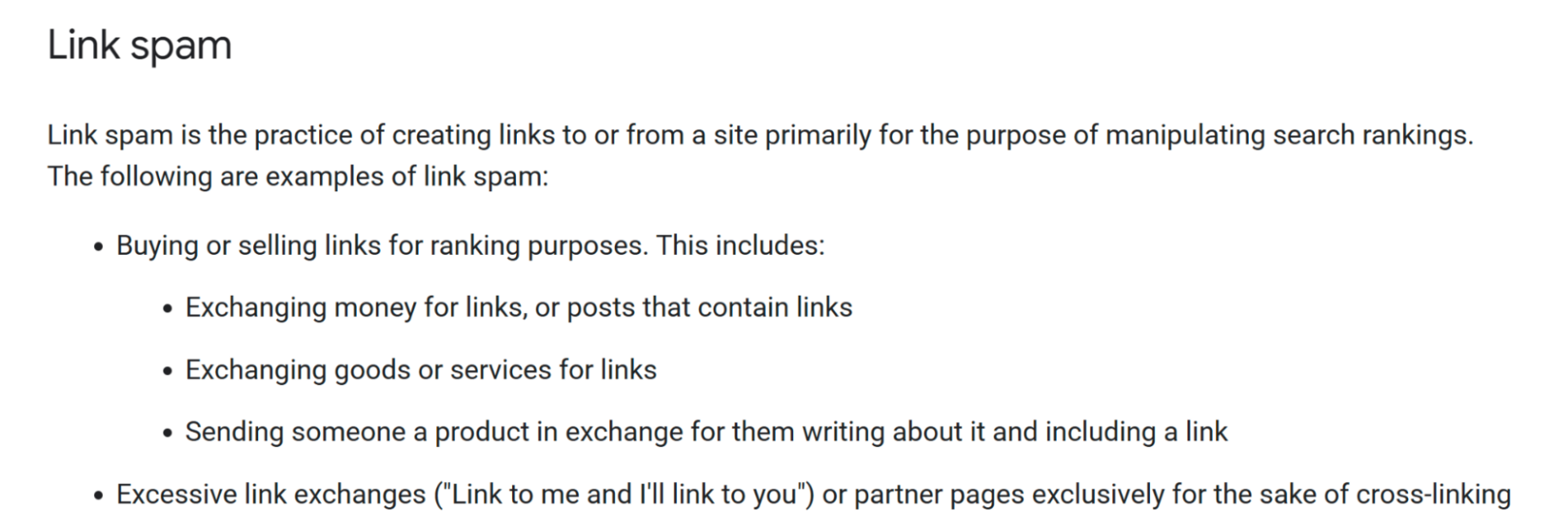
Google’s stance on link building is simple: no paying for links, and no link exchanges.
This even includes ABC link exchanges (where site A links to site B, site B links to site C, and site C links to site A).
Yes, they are safe because they are hard to track, and yes – everyone’s doing them.
But still, technically, they are prohibited.
Look for yourself:
If Google is Against Link Exchanges, How Can You Build Links Ethically?
However, this doesn’t mean you can’t build links at all.
The key is to focus on white hat link building strategies that prioritize creating high-quality, valuable content and building genuine relationships.
To build links ethically and stay firmly within Google’s “green zone,” you should focus on the strategies we’ve outlined in this article.
They include creating linkable assets, guest posting, generating reviews and other organic placements for your content rather than cramming your link on each and every anchor text you find.
Additionally, paid links can be Google-friendly – all you need to do is mark them as “sponsored”.
Even though they won’t pass any ranking signals, paying a big blogger in your niche for publishing a review of your product/service can net tons of hot leads – not just traffic.
Linkable Assets
Linkable assets are the cornerstone of any ethical link building strategy.
These are the pieces of content you create that are so useful, people just want to share them, and more importantly, link to them.
Also, to build links with the other strategies, you need content to link to – not just your home and product pages.
Plus, linkable assets help you rank better, for more keywords and open up new doors for getting your site seen.
So, what makes a good linkable asset? It’s all about providing real value. Think:
- Detailed how-to guides.
- Listicle posts (top 10 articles)
- Original research studies
- Free tools pages
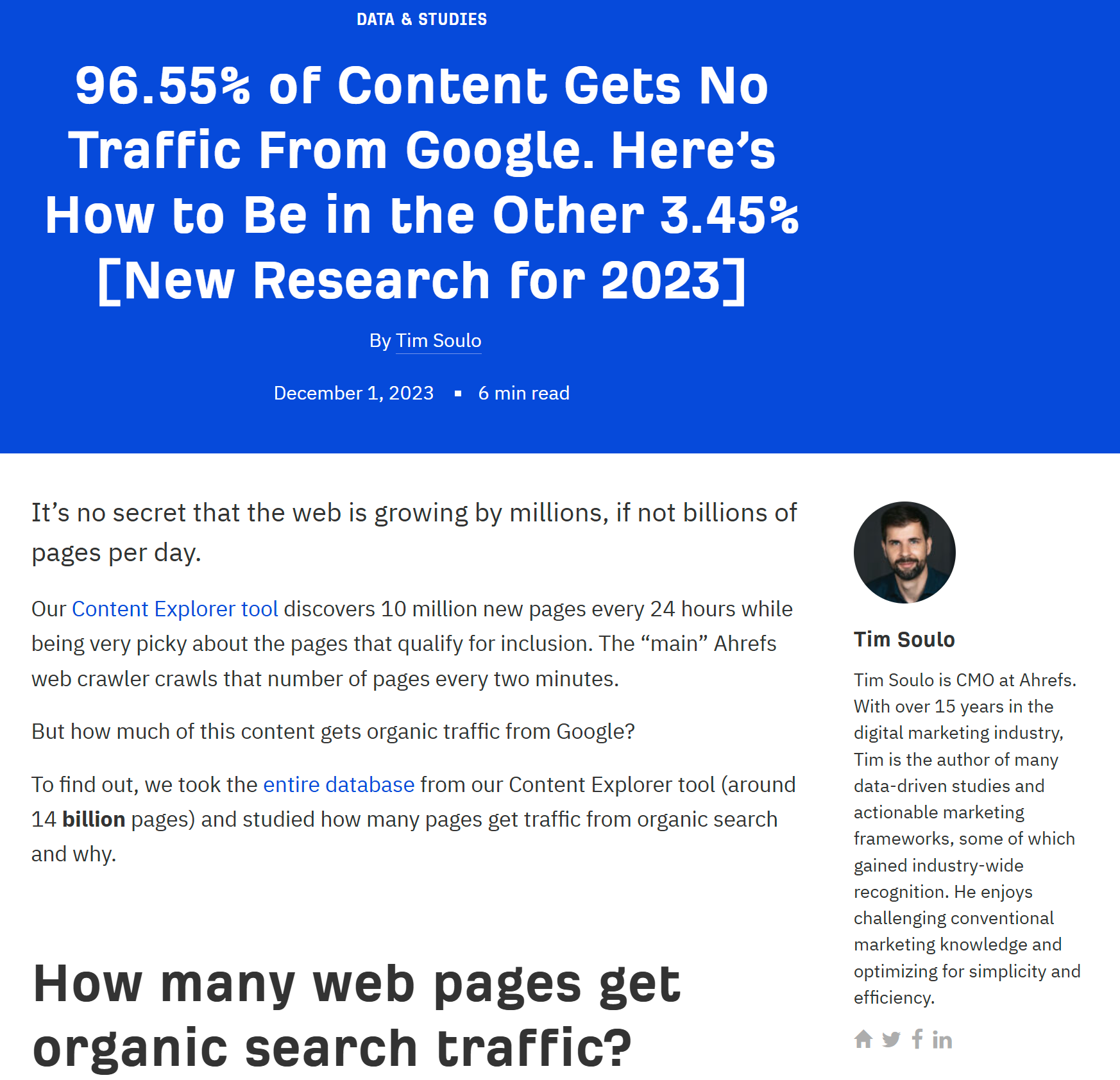
Just look at Ahrefs – thousands of organic backlinks per page, all because they provide genuine, useful info.
And they have just about every type of linkable asset there is.
Guest Posting
Guest posting is a tried-and-true method for building high quality backlinks, and when done ethically, it’s completely safe.
It involves creating valuable content for another relevant website in your niche, with a link back to your own site.
This not only drives traffic but also passes link juice to your site, improving your rankings..
While guest posting is generally a white hat strategy, it’s often used to set up an ABC link exchange we talked about earlier.
Google isn’t a fan of this, even if it’s hard to detect.
So, while it might be tempting to leverage guest posts for this purpose, proceed with caution.
Listicle Placements
You know those “Top 10” or “Best 5” articles?
They’re not just clickbait; they’re actually a solid, ethical practice to build links and drive targeted traffic.
Why? Because people love them.
They’re easy to read and often rank well in search results, meaning more eyes on your product.
Listicles are also fantastic for recruiting affiliates.
Many websites offer inclusion in their lists in exchange for an affiliate link.
It’s a win-win: they get a commission, and you get exposure.
Now, a quick heads-up: if you’re paying for a placement or using an affiliate link, make sure to mark it as “sponsored” to stay on Google’s good side.
How do you find these listicle opportunities if you’re not using Respona?
You can use Google search operators to find relevant listicles in your niche. Here’s the basic idea:
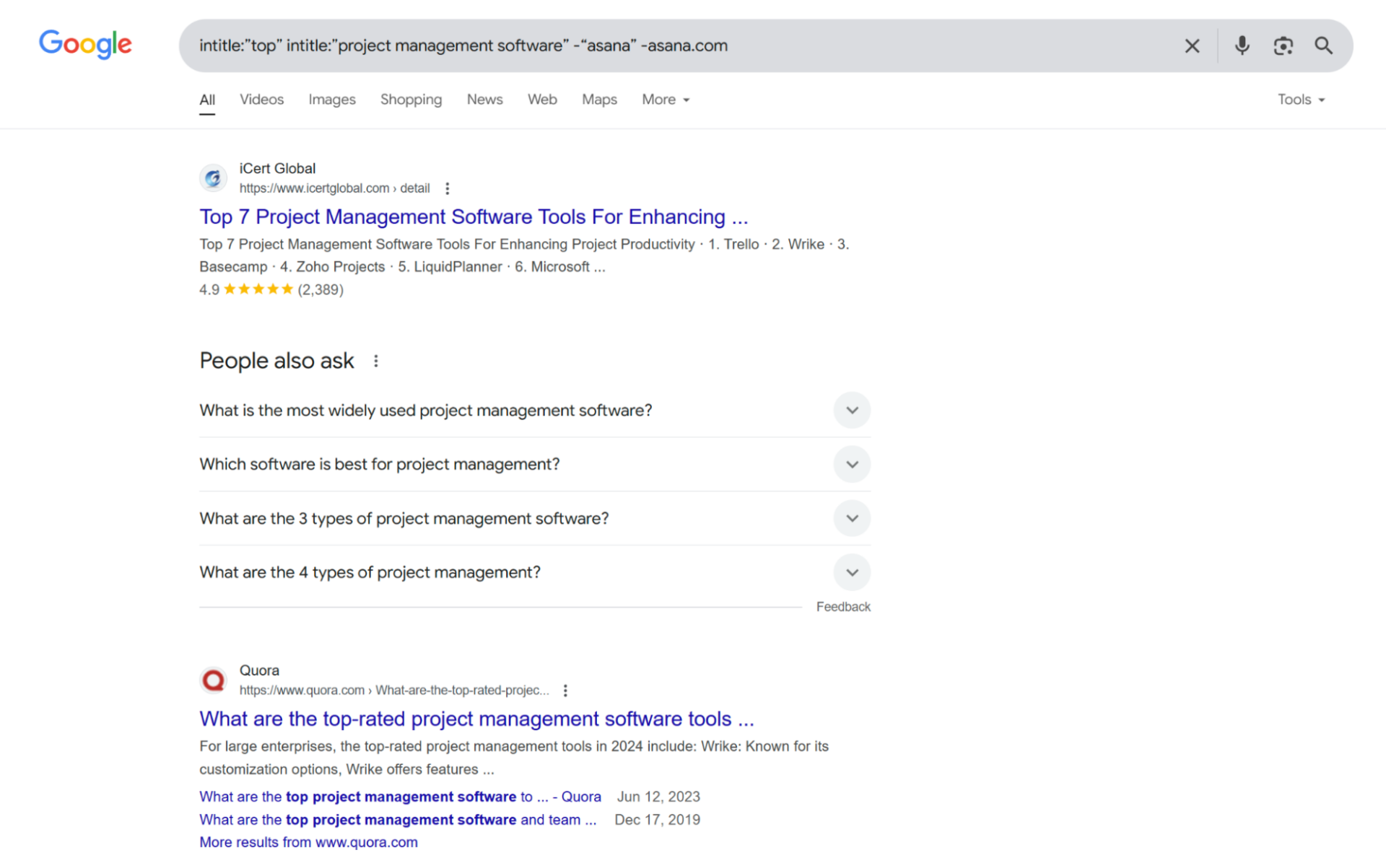
Here’s an example:
Let’s say you sell project management software. You’d search something like:
intitle:”top” intitle:”project management software” -“[Your Company Name]” -“[Your Company Domain]”
Just replace “[Your Company Name]” and “[Your Company Domain]” with your actual details.
This will show you relevant listicles where you could potentially get your product featured.
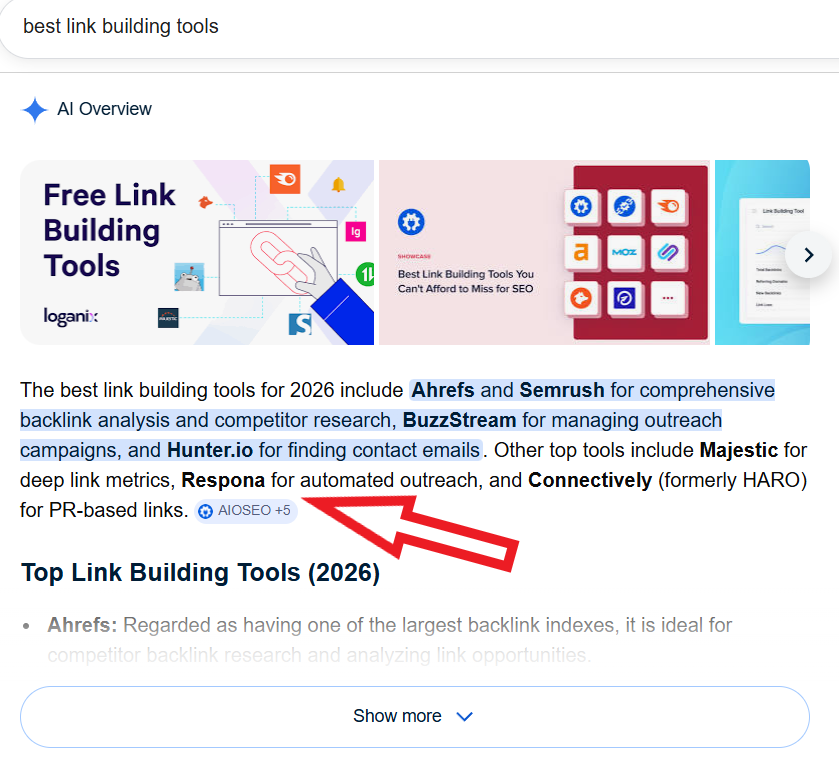
This strategy is especially powerful in 2026 becaue brand mentions in the form of listicles are the #1 driver of AI citations:
Product Reviews
When it comes to building authentic links, product reviews are as organic as it gets.
Even if you’re paying for a review (and remember, mark it as “sponsored” to stay Google-friendly), it’s still a genuine endorsement.
Just like listicle posts, they drive super-qualified leads. People reading product reviews are actively looking for solutions like yours. They’re hot leads, ready to convert.
How do you find these review opportunities?
Simple: target sites that have already reviewed your competitors.
If they’ve reviewed similar products, they’re likely open to reviewing yours, especially if you have unique selling points.
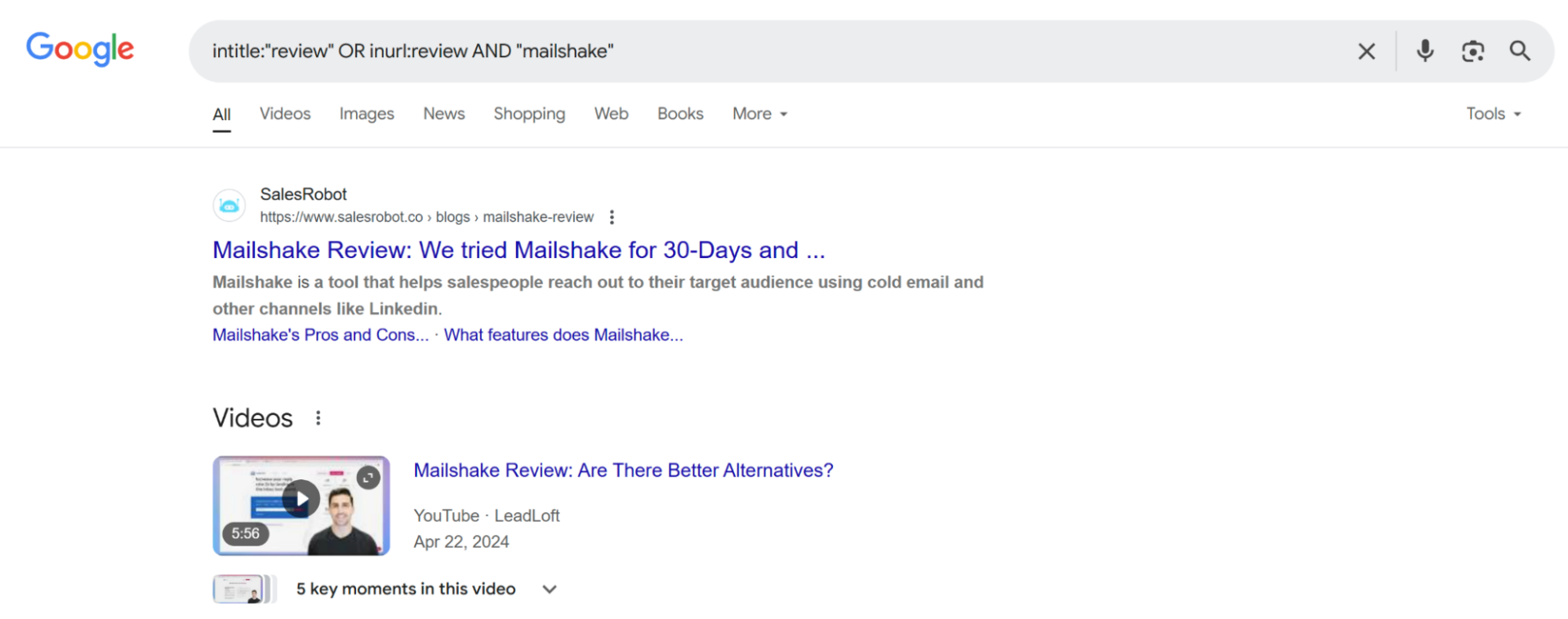
To find them, use a Google search string like this:
intitle:”review” OR inurl:review AND “[Competitor Name]”
It’s important to note that many of these reviews are paid. So, it’s a good idea to factor in the cost before diving in.
However, the potential return on investment, in terms of qualified traffic and brand credibility, can be well worth it.
Competitor Mentions & Alternatives
Once again, these two strategies leverage your competitors’ existing exposure to generate your own.
Basically, you’re looking to slide your brand into the conversation, and maybe even show you’re the better pick.
People searching for “alternatives” are basically saying, “This ain’t it.” That’s your chance.
By getting your product featured on these “alternatives” pages, you’re hitting up leads who are already looking to buy.
Plus, these pages often throw you a quality backlink, which is always nice.
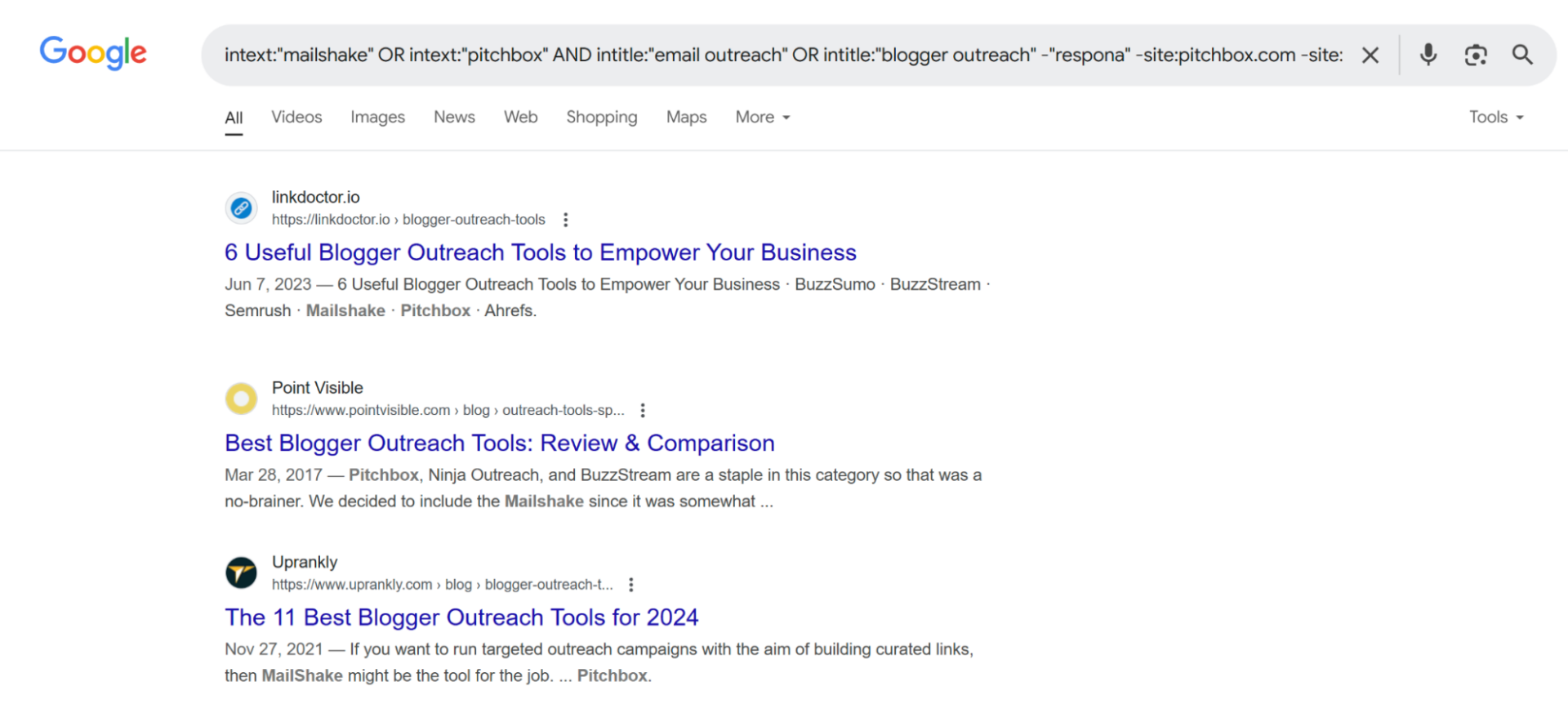
To find these opportunities, try Googling stuff like:
- “[Competitor Name] alternatives”
- “[Competitor Name] competitors”
- “Alternatives to [Competitor Name]”
- “Best [Product Category] alternatives”
Now, here’s another trick: find places where your competitors are mentioned, but you’re not – in other content, not just alternatives pages.
To find these mentions, try a Google search like this:
intext:”Competitor 1″ OR intext:”Competitor 2″ AND intitle:”Keyword 1″ OR intitle:”Keyword 2″ -“Your Company” -site:competitor1.com -site:competitor2.com
Swap out the placeholders with your competitor names, keywords, and your company info.
Resource Pages
Resource pages serve a specific purpose: providing curated links to valuable resources.
Because of this, Google considers them perfectly acceptable for link building.
While they might not provide the strongest ranking signals, these pages, along with local directories, can drive significant referral traffic.
Many websites, especially those in educational or informational sectors, maintain resource pages to offer their audience high-quality links to relevant tools, articles, and websites.
Because these pages are intended to be helpful, website owners are often receptive to suggestions if your content genuinely adds value to their list.
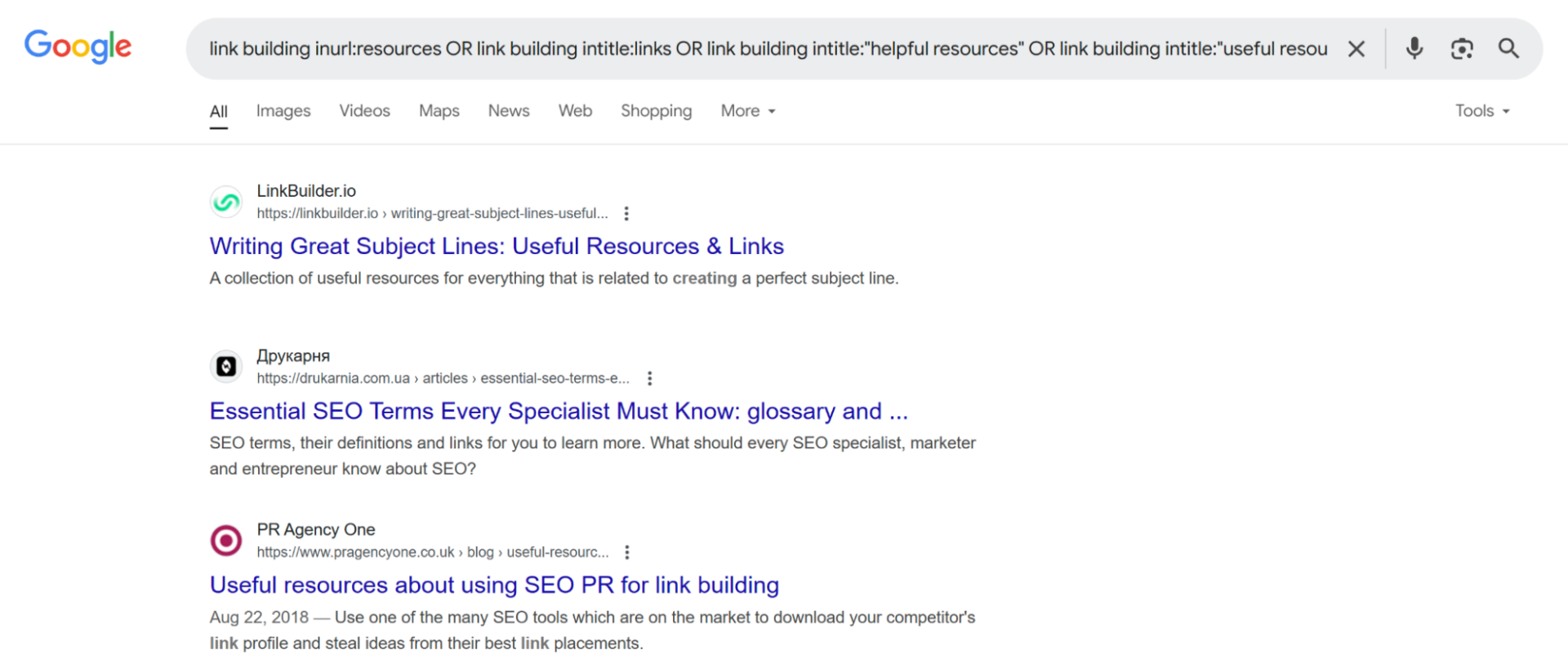
To locate these opportunities in Google, use search strings such as:
- Keyword inurl:resources
- Keyword intitle:links
- Keyword intitle:”helpful resources”
- Keyword intitle:”useful resources”
Tiered Link Building
Want to squeeze a bit more juice out of your best backlinks?
That’s where tiered link building comes in. It’s about building links to the sites that already link to you, rather than directly to your own site.
And the best part about it is that it can be completely under your control, no outreach required.
Tier 1 links are the ones pointing straight to your website. These are the heavy hitters, the most valuable.
Then, you have Tier 2 links. These point to your Tier 1 links, giving them a boost in domain authority.
And if you want to take it a step further, you can add Tier 3 links, which point to your Tier 2 links, adding another layer of support.
These Tier 3 links are often from social media, forum comments, and other less authoritative sources.
So, how does it work in practice?
Let’s say you have a really good link from a blog post that’s already driving traffic – but you’d like to increase that number even more.
You can then share that blog post link on your social media profiles, mention it in forum comments, and link to it from other platforms. This creates a chain of links, indirectly boosting the authority of your website.
While Tier 1 links are the most powerful, a well-structured Tier 2 and 3 SEO strategy can help you maximize the impact of your existing backlinks.
Customer Reviews
Customer reviews are a powerful tool for building trust and shaping your online image.
This includes Google reviews, testimonials on your website, and reviews on platforms like Yelp, G2, and others.
While these reviews might not always include direct links to your site (and if they do, they’re often come without a follow link), their value lies in establishing credibility and improving how potential customers perceive your brand.
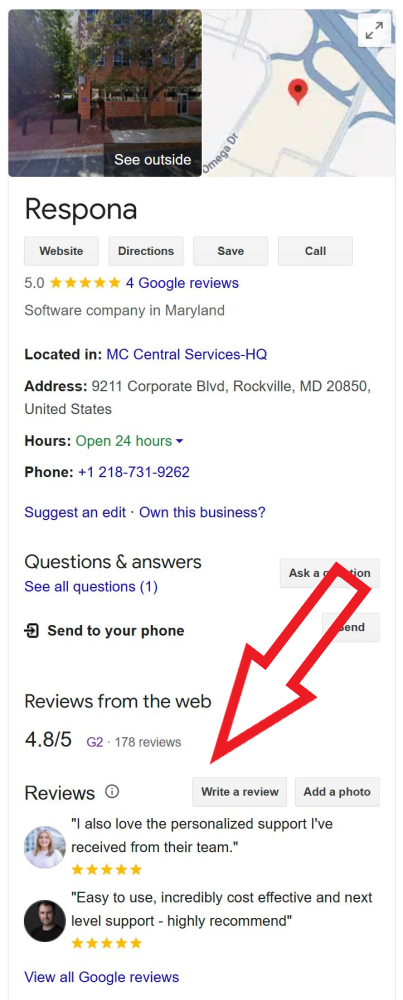
Positive reviews act as social proof, showing that others have had good experiences with your products or services.
This can significantly influence purchasing decisions and build a strong online reputation.
The simplest way to get reviews is to ask. Don’t hesitate to politely request a review after a positive customer interaction, whether it’s a purchase, service call, or consultation.
Streamline the review process. Provide a direct link to your Google Business Profile review section in follow-up emails, on receipts, or on your website.
Minimize the number of clicks required. Use URL shorteners or QR codes to make it even more convenient.
While some businesses offer small discounts or raffle entries, be transparent and avoid anything that looks like buying positive reviews.
Google’s guidelines discourage incentivizing reviews in a way that leads to biased feedback.
If you decide to offer an incentive, make sure to offer it to all reviewers, whether their feedback is positive or negative.
Speed Things Up With Done-For-You Link Building
Be honest: how many of the eight strategies above are you actually running consistently this quarter?
For most teams the realistic answer is one or two.
The rest are good intentions sitting in a Notion doc somewhere. There’s nothing wrong with that, it’s just what running a real business looks like when outreach competes for hours with everything else on the marketing team’s plate.
Respona is built around that reality.
It’s a done-for-you link building service. Our team owns the prospecting, the emails, the follow-ups, the editor negotiations, the QA on every link before it goes live.
You own the strategic decisions: which pages get pushed, which keywords matter, which sites you’d want your brand associated with.
What we go after, specifically, is brand mentions inside listicle articles (“Top 10 X tools”, “Best Y for Z”) that already rank in Google AND already show up in citations from ChatGPT, Perplexity, and Google AI Overviews.
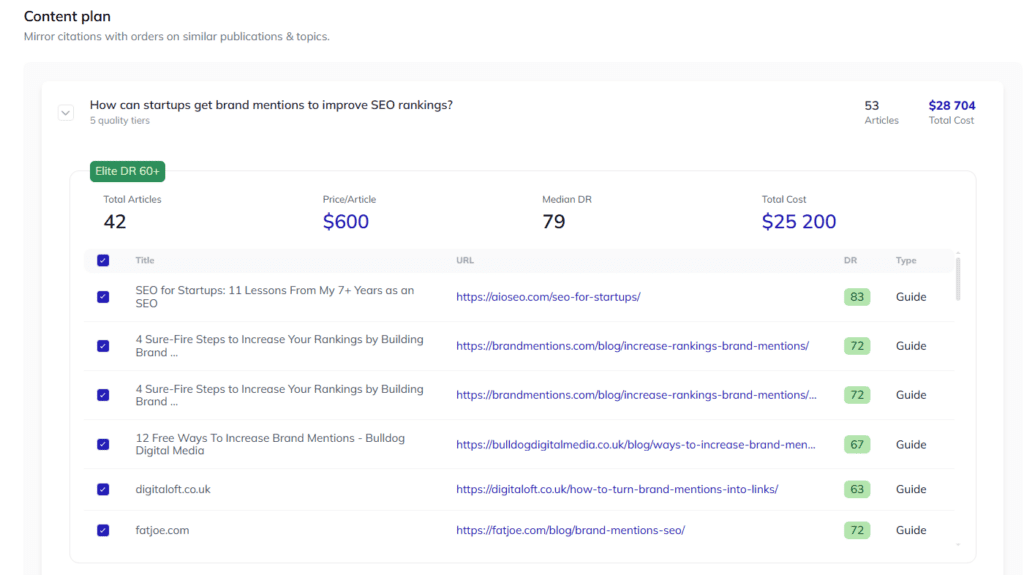
The reason for that focus is simple: those listicles are now the dominant input AI engines use when recommending who to buy from. Getting featured in them moves rankings AND moves AI visibility, off the same placement.
Which you can track right inside the dashboard.
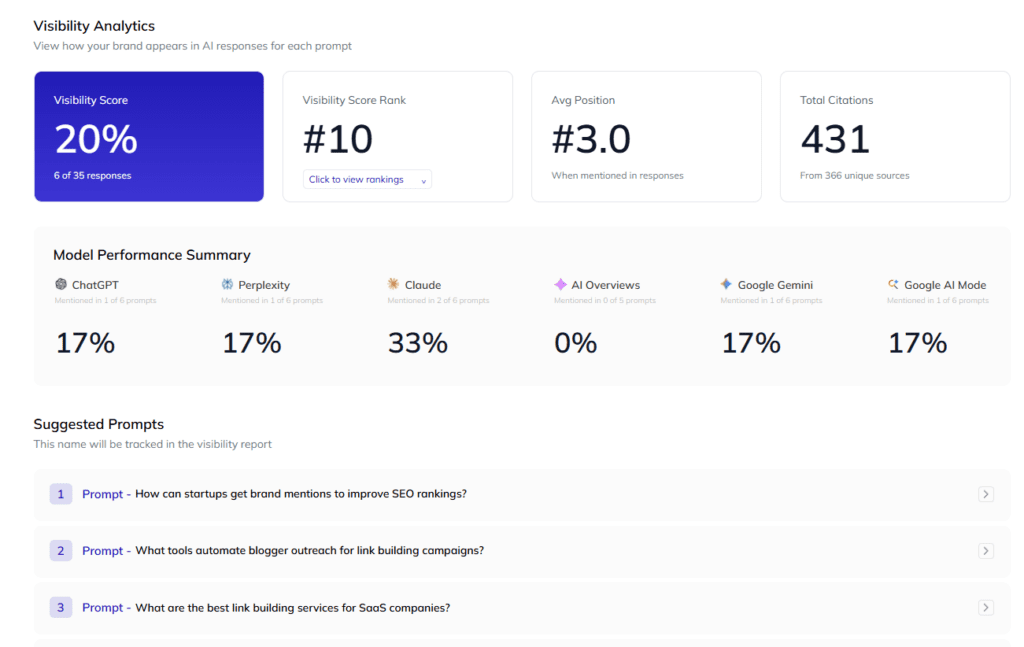
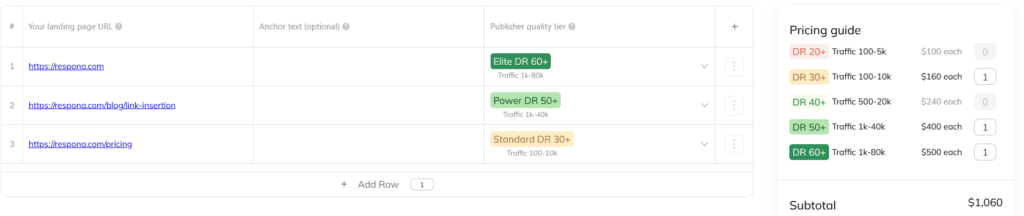
Pricing tiers are by Domain Authority. You pay per placement, not per month. And you green-light every site before we send a single email.
If that sounds like the kind of help you actually want, place your first order.
Link building cheat sheet
Now Over to You
The strategies above work. The reason most teams don’t see results isn’t bad strategy. It’s inconsistent execution. Earning authoritative backlinks from reputable websites takes more outreach hours than most marketing teams can spare, which is why so few teams stick with ethical link building long enough to see results.
If you’d rather skip the prospecting and outreach grind, hand it off to Respona. Share your target pages, target keywords, and any anchor preferences, and we’ll handle the rest.
Frequently Asked Questions (FAQ)
What’s the difference between white hat and black hat link building?
White hat link building follows Google’s guidelines, focusing on SEO content creation and earning links naturally.
Black hat link building uses manipulative tactics like buying links from a link farm, using an automated link building service or spamming, which can lead to penalties.
How long does it take to see SEO success from ethical link building efforts?
It varies, but generally, it takes time to see significant results from SEO link building. It’s a long-term strategy that requires patience and consistency.
Especially if you’re using small-scale strategies like broken link building.
Can I still buy links for my website?
While you can technically buy links, Google discourages it.
If you do, make sure to mark them as “sponsored” to avoid penalties.
How many links do I need to rank higher?
There’s no magic number.
Link quality matters more than the quantity for your backlink profile. Focus on earning links from authoritative and relevant websites.
How do I know if a link is good or bad?
Good links come from trustworthy, relevant websites and are earned naturally through valuable content.
Bad links often come from spammy or irrelevant sites and are acquired through manipulative tactics.
What’s the difference between ethical seo and white hat seo?
Mostly the same thing. “White hat” specifically means following Google’s guidelines. “Ethical seo” adds being honest with users on top of that.
How do I tell if a site is part of link farms before pitching?
Drop it into Ahrefs site explorer. If the Domain Authority is high but actual traffic is tiny, you’re looking at one of those link farms rather than a reputable website worth pitching.
Are nofollow links worth chasing for backlink building?
Yes. A nofollow link still drives referral traffic and keeps your profile looking natural to a search engine. Don’t ignore trust flow just because it’s nofollow.
Does ethical link building help with local seo?
Yep. Same playbook, narrower prospect list. Regional publications, local directories, community sites.
How do I measure success from ethical link building efforts?
Watch new referring domains hitting your backlink profile, anchor text distribution, page rankings in search engines, and organic traffic. SEO success shows up in months, not weeks. Solid seo efforts amplify each new placement on social media to compound the impact.
What counts as a valuable backlink in 2026?
Anything that drives both rankings AND visitors. A high quality backlink from a listicle that ranks in Google and gets cited in AI search hits both. Most quality backlinks worth pursuing share that double-duty trait.
Should I worry if someone asks me for a link exchange?
One-off swaps between sites that genuinely fit together are fine. The pattern Google catches is volume.
Can a website owner do all this solo?
Smaller sites in focused niches, yes. Build relationships first, then layer on the bigger tactics like broken link building or guest posting.
Do I need an seo audit before starting?
If you haven’t done one in the last year, yes. Spending budget on backlinks while technical issues silently cap your rankings is the leaky-bucket problem.