
Nicely. Just kidding!
If you are wondering how to ask for backlinks without sounding transactional or spammy, the answer is simple: focus on relevance, value, and timing.
Successful link building is less about asking for a favor and more about giving a website owner a good reason to add your link to their content.
Writing a cold email pitch that lands backlinks can seem difficult.
But with a bit of personalization and a strong incentive for your recipient to link to you, it’s really not.
In this article, we’ll walk you through every step of creating a pitch that converts, and break down the exact outreach template that landed us hundreds of links.
Key Takeaways:
- The best backlink outreach emails focus on value first, not just the request for a link.
- A strong subject line, relevant personalization, and a clear CTA can dramatically improve your chances of earning a backlink.
- Offering a guest post, relevant content placement, or another mutually beneficial opportunity is often more effective than directly asking for a backlink.
- One quality backlink from a relevant website owner is usually more valuable than many weak links from irrelevant sites.
- Respectful follow-up and genuine relationship building are essential parts of successful link building.
- Subject Line (Short, Intriguing, and Personalized)
- Opening Line (Introduction & Insight)
- Body of the Email (Value Proposition & CTA)
- Sign-off (Simple & Professional)
- Follow-up (Respectful Persistence)
- Our Favorite Template
- Want More Backlinks Without Sending Hundreds of Emails?
- Now Over to You
- Frequently Asked Questions
Link building cheat sheet
Subject Line (Short, Intriguing, and Personalized)
Your subject line is the first thing a recipient sees, and it significantly impacts whether your email gets opened.
Only about 22% of emails are opened, so you have to make that first impression count.
When you are trying to earn a backlink through email outreach, your subject line needs to stand out without sounding manipulative.
A good subject line should create curiosity while staying relevant to the recipient’s content, blog post, or website.
Aim for brevity and clarity, ideally keeping it between 2-7 words.
This range is short enough to grab attention but long enough to convey the gist of your message.
Any longer and it will get truncated in the inbox.
Personalizing the subject line by including the recipient’s name or company can also make a big difference, potentially boosting open rates by up to 30.5%.
And of course, steer clear of spammy words that could trigger filters.
In link building, even a great backlink opportunity can be lost if the subject line feels generic. That first impression matters because it determines whether your pitch email gets opened at all.
Pro tip: don’t capitalize the first letter of your subject line.
This way it looks more “human”, like a typo – but one that’s actually beneficial.
Example 1: “want a free link, [name]?”
Example 2: “upcoming guest post on [website]?”
Example 3: “can I include [website] in my post?”
Opening Line (Introduction & Insight)
Your opening line sets the tone for the entire interaction. 0
After a friendly greeting (like “Hi [Name],”), aim to establish a personal connection right away.
Your opening line should show the website owner or site owner that this is not a mass email. Mentioning a specific blog post, a recent case study, or a related article can help establish relevance immediately.
Show that you’ve done your homework by mentioning something specific you liked about their work—a recent achievement, a stat from one of their articles, or a challenge they helped a client with.
Just check the most recent case study they’ve published while it’s top of mind for them.
This shows you’re genuinely interested and not just sending a generic, impersonal message.
This kind of personalization helps build authority and trust early in the conversation, which is especially important when you are asking someone to consider your content for a backlink.
Example 1: “I’m working on a guest post for [website] and looking for resources to include in it.”
Example 2: “I’m reaching out because I’m putting together some resources on [Topic] for sites like [Example Site], and your expertise in [Specific Area] immediately came to mind.”
Body of the Email (Value Proposition & CTA)
This is where you clearly and concisely explain why you’re reaching out.
Aim for around 75-125 words and avoid bullet points, which can make your email feel mass-sent.
The body of your email should make it clear why your content deserves a link. If you want to earn a quality backlink, you need to show that your page adds real value and fits naturally into the recipient’s existing content.
Write in a natural, conversational style, as if you were chatting with the recipient.
The body should focus on two key elements: the value proposition and the call to action.
Value Proposition: What’s in it for Them?
This is the core of your pitch.
Clearly explain the mutual benefits of a backlink exchange.
For link building, this often involves offering a reciprocal link, perhaps within a guest post you’re writing for another website, or as a resource on your own site.
Your goal is not just to get any link, but to earn a high quality backlink from a relevant site with real authority. A quality link from the right page can support better search results, stronger authority signals, and more organic traffic over time.
Offering a link within a guest post is a particularly effective strategy, as it allows you to easily set up A-B-C link exchanges.
Other value propositions could include offering product samples for review, promoting their content to your audience, or even offering a collaboration on a future project.
Simple social media shares or newsletter shout-outs are usually not compelling enough for a backlink exchange.
Call to Action: Inviting Further Conversation
Make your CTA clear, concise, and easy to act upon.
Use action-oriented language (like “should I send over my draft?” or “would you like to add your link?”).
NEVER ask to book a meeting in a cold email. Trust us. They won’t.
Especially for link building.
A softer call to action, such as a question that invites further discussion, can be more effective than a direct request.
A good CTA should make the next step feel easy. In backlink outreach, the best CTAs are often simple questions that invite the site owner to continue the conversation rather than forcing an immediate decision.
Don’t use links in your initial email, it’s spammy. Just type the domain without linking it.
Example Body:
I’m currently developing a comprehensive guide on [Your Topic] and I think your article on [Their Topic] would be a great fit. I’d be happy to include a link to it in my guide.
I’m also writing a guest post for [Another Website] about [Related Topic], where I could offer a reciprocal link back to your site.
Would love to hear your thoughts on this!
Sign-off (Simple & Professional)
Use a warm and professional sign-off, such as “Warmly,” “Best regards,” or “Looking forward to hearing from you.”
Include a professional email signature with your name, title, website, and contact information.
A professional sign-off helps reinforce credibility, especially when you are reaching out to a website owner who has never heard of you before. Even small details can affect whether your pitch feels trustworthy.
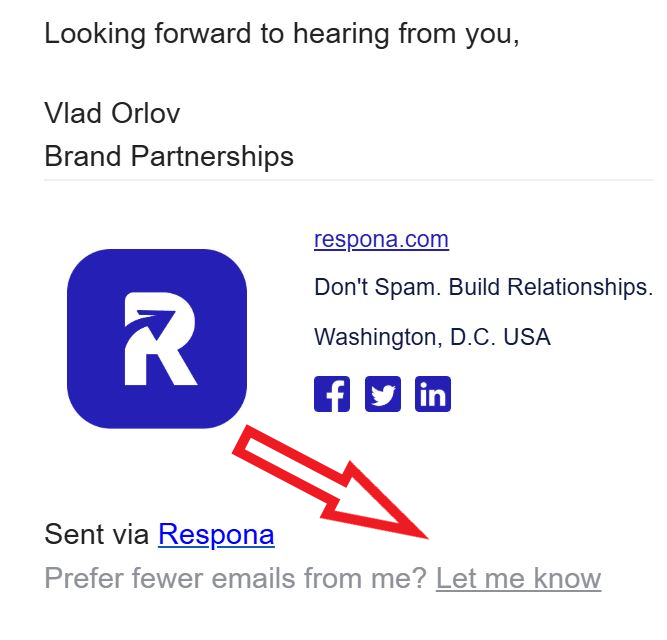
Always include an unsubscribe link—it’s not only a legal requirement but also builds trust.
Follow-up (Respectful Persistence)
Even the best-crafted emails sometimes slip through the cracks.
While most business emails are read within 24 hours, responses can take a bit longer.
Following up is an important part of email outreach because even relevant backlink opportunities can get buried in a busy inbox. A short, respectful reminder gives your original email another chance without making the interaction feel pushy.
It’s a good idea to wait a few business days (3-5) before sending a polite follow-up.
One follow-up is usually enough. In your follow-up, briefly reiterate your initial message and acknowledge that you understand they may be busy.
Also, a great strategy is to introduce a sense of urgency – but carefully.
Example Follow-up: “The deadline for submitting my post is tomorrow. Would you like to still be included?”
This is especially true in digital marketing and link building, where editors, marketers, and website owners often receive a large number of outreach emails every week.
Our Favorite Template
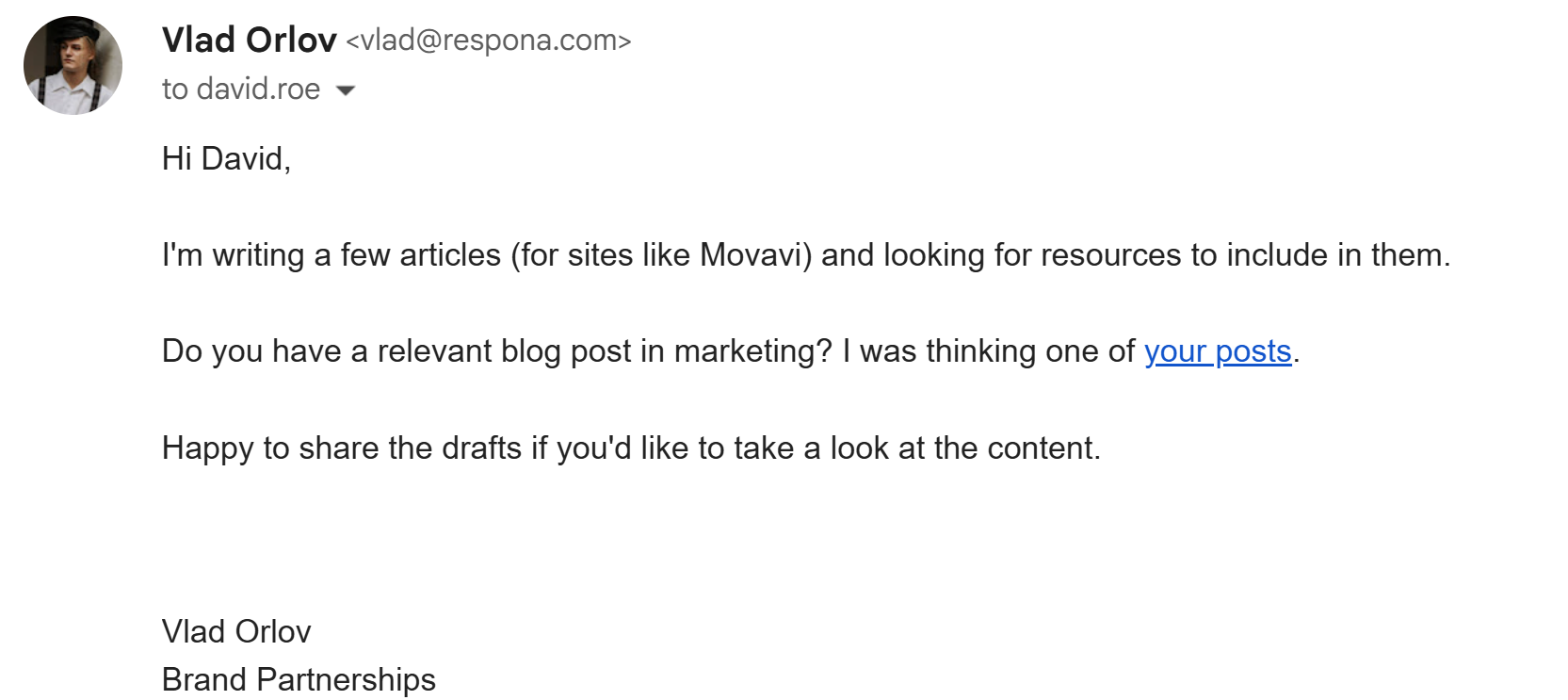
This template works best when you have already identified a relevant page, blog post, or guest post opportunity where your content would fit naturally. Like any link building tool or outreach workflow, the template is only as effective as the research behind it.
This one has worked well for us in securing backlinks:
Subject: can I include (organization) in my post?
Hi first_name,
I’m writing a few articles (for sites like [example]) and looking for resources to include in them.
Do you have a relevant blog post in [niche]? I was thinking one of your posts.
Happy to share the drafts if you’d like to take a look at the content.
P.S It would be great if we could get a slot in your article as well :)
Why it Works:
- Focuses on Shared Value: It immediately highlights the potential benefit for both parties.
- Clear and Concise: The message is easy to digest and understand.
- Inviting Tone: The language is friendly and encourages a conversation.
- Fits naturally into real content: The email suggests a relevant placement instead of forcing a random backlink into unrelated content.
- Builds authority through context: It frames the request around useful content and collaboration, not just link acquisition.
Key Takeaways for Asking for Backlinks:
- Start With the Incentive: cold email recipients only really care what’s in it for them, why would they help out a stranger for free?
- Do Your Research: Understand the recipient’s content, audience, and overall online presence.
- Show Genuine Interest: Make your outreach personal and show that you’ve taken the time to learn about their work.
- Be Respectful and Patient: Respect their time and inbox, and don’t be pushy.
- Aim for quality over quantity: One high quality backlink from a relevant page can be more valuable than several weak links.
- Think beyond direct asks: Opportunities like broken link replacements, unlinked brand mentions, and guest post placements can all help you earn backlinks more naturally.
- Prioritize authority and relevance: A backlink from a site with strong authority in your niche will usually have more SEO value than a random mention on an unrelated page.
Want More Backlinks Without Sending Hundreds of Emails?
Even with a solid backlink outreach template, this is where most people get stuck.
Finding the right websites, identifying the right contact, personalizing each email, and following up consistently takes time. A lot of it.
And if any part of that process breaks, your results drop fast.
That’s why most link building efforts don’t scale.
Our done-for-you link building handles this entire process for you.
We:
- find relevant websites and backlink opportunities
- reach out to the right website owner or editor
- personalize every pitch based on their content
- and secure placements on pages that actually drive results
So instead of chasing backlinks one email at a time, you get consistent placements on sites that already rank and get traffic.
And those placements don’t just help with SEO.
They improve your AI visibility too.
A lot of AI tools now pull from third-party content when generating answers. If your brand keeps showing up across relevant blog posts, listicles, and guides, you’re far more likely to be included in those responses.
We’ve also built our Campaigns feature to track this.
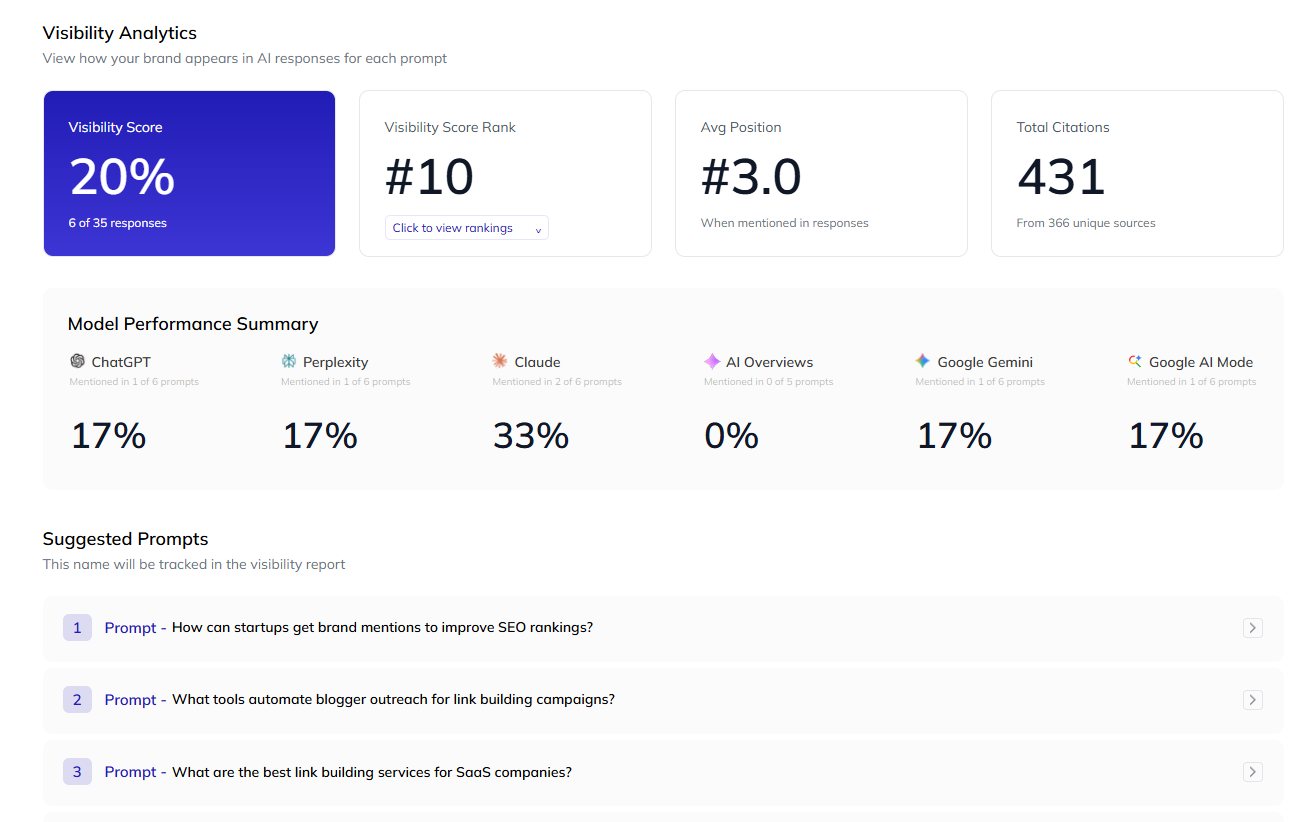
It monitors how often your brand appears across major AI platforms for the prompts that matter to your business, then shows you which sources are getting cited and where you should be getting placements.
So instead of guessing where to build links, you’re working from real data.
Link building cheat sheet
Now Over to You
If you’re wondering how to ask for backlinks, it really comes down to this:
Don’t ask for a link. Offer a reason to add one.
The best outreach emails focus on relevance, value, and timing. When your pitch fits naturally into someone’s content and actually improves it, backlinks become much easier to earn.
That said, doing this consistently is where things get difficult.
Prospecting, personalization, follow-ups, and relationship building all take time. And without a structured process, results are hard to predict.
If you want to skip the manual work and focus on results, our done-for-you link building can help.
We handle everything from prospecting to outreach to placement, securing high-quality backlinks on relevant websites in your niche.
Frequently Asked Questions
How do I find the right websites to ask for backlinks from?
Start by identifying websites in your niche with a strong online presence, relevant content, and engaged audience. Look for sites that have published blog posts similar to yours and consider using an SEO tool or backlink checker to review their backlink profile, authority, and domain authority.
What should I do if a website owner says no to my backlink request?
If a website owner declines your request, be respectful and thank them for their time. Do not push the issue. There are plenty of other link building opportunities out there, including broken link outreach, guest post opportunities, and unlinked brand mentions.
How many follow-up emails should I send when asking for backlinks?
It’s generally recommended to send only one polite follow-up email after about 3-5 business days if you haven’t received a response.
Sending multiple follow-ups can be perceived as pushy and could damage your chances of building a relationship with the website owner.
What are some common mistakes to avoid when asking for backlinks?
Common mistakes include sending generic, impersonal emails, not offering a clear value proposition, using spammy language or tactics, and being too pushy or demanding.
Focus on building genuine connections, offering value in return, and respecting the recipient’s time.
Is it okay to ask for a backlink in exchange for something other than a link back?
Yes. While reciprocal link exchanges are common, you can also offer other forms of value, such as promoting their content on social media, featuring them in a related article, contributing a guest post, or offering a free trial of your product or service.
The key is to offer something genuinely valuable and relevant to their audience.