
Interested in learning everything there’s to know about SEO outreach?
This is the right guide for you.
Inside, you’ll find what SEO outreach is and why it’s important for SEO, the types of backlinks you can get through SEO outreach, and how to do it.
We’ve got a lot to cover, so let’s get started.
Key Takeaways:
- SEO outreach is the process of contacting site owners and bloggers to earn backlinks from authoritative websites.
- Backlinks remain one of the strongest signals search engines use to decide rankings, which is why outreach belongs in every serious SEO strategy.
- Common types include broken link building, guest blogging, link reclamation, resource page outreach, unlinked mentions, and influencer outreach.
- A successful SEO outreach campaign comes down to research, a personalized outreach message, and consistent follow-up, not blasting templates.
- Beyond rankings, link outreach drives referral traffic, brand awareness, social media exposure, and increasingly, AI citations inside Google AI Overviews and answer engines.
Link building cheat sheet
What is SEO Outreach and Why Is It Important for SEO?
First things first, let’s try to define what search engine optimization (SEO) outreach is.
To put it in as straightforward terms as possible, we would say that SEO outreach is basically a combination of activities and processes that target helping a company come closer to its link prospects.
Furthermore, the aim of doing SEO outreach is to acquire high-quality, valuable links from authoritative websites.
In other words, SEO outreach (AKA link building) refers to the process of reaching out to prospects in order to amplify a company’s SEO efforts.
Many companies hire link building and SEO agencies or an SEO outreach specialist to help them, others use their own resources to make their digital marketing moves, whereas many use a combination of the two.
Why is this necessary, or even important?
In one sentence, because backlinks are one of the most powerful factors that help websites rank higher, in relation to what the Google search algorithm is looking for.
According to a study by Ahrefs, only 5.7% of all pages rank high in the search engines within a year after they’re released.
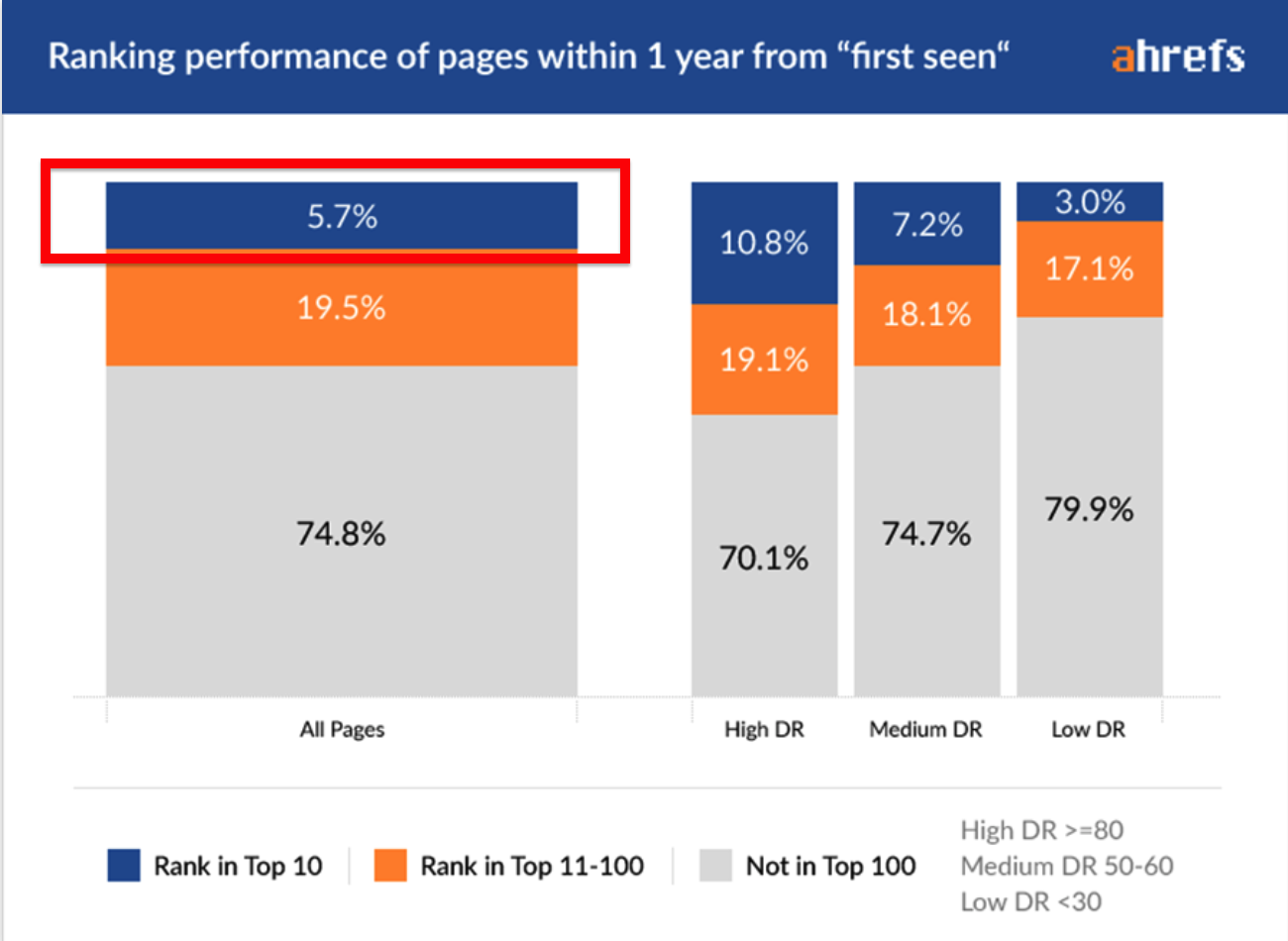
Having written high quality content or having put great effort in creating your web pages and then watching your content going unnoticed can be disappointing.
That’s where a high-performing and thought through outreach process comes in – to help make sure your high quality content will score well.
Given that quality backlinks help increase a site’s organic search engine ranking, a successful and successful outreach strategy can have a lot of important benefits, such as:
- Acquire white-hat links
- Create valuable content partnerships
- Increase organic traffic
- Boost referral traffic
- Increase your website domain authority
- Maximize social media signals
- AI citations
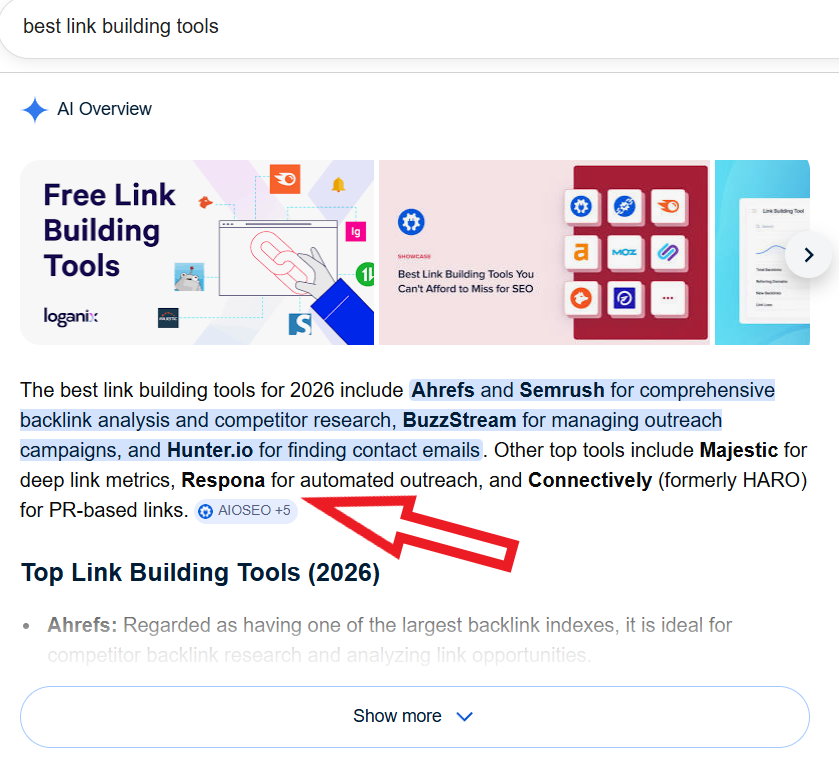
The last part matters most in 2026. Brand mentions, especially on listicle posts are the biggest driver of AI visibility in Google AI overviews, ChatGPT, and all other answer engines.
Keep reading to find some of the most valuable types of backlinks you can get through SEO outreach.
Types of Backlinks You Can Get Through SEO Outreach
We’ve already given you a bit of context in terms of the benefits of SEO outreach.
Having a closer look at the type of backlinks you can get from reaching out to prospects will make the whole process clearer for you.
Let’s get to the first type we have for you.
Type #1: Broken Link Building Strategy
What is it?
Let’s say that you spot a blog that gets a significant amount of readers, but it has a broken link to websites that are relevant to your website.
In such a case, and because no one likes broken links, you should think of that broken link as an opportunity for you to reach out to the blogger and let them know that one of their links is faulty.
In doing so, it’d be great if you’d have a relevant resource that the prospect could link back to and replace the broken link with, thus enhancing their readers’ experience.
Template to use
Subject: broken link :(
Hi {first_name},
I was on your site and wanted to give you a quick heads up about a page you’re linking on this post – [custom variable: website URL]; looks like it was taken down by the host: [custom variable: broken page]
Also, if you’re interested in suggestions for a replacement, we’ve actually written an extensive [guide/post] on [related topic] here: [your article URL]
Feel free to take a look – this might be a good fit for your readers :)
Either way, I hope it helps!
Thanks,
[Name]
Relevant resource: A Simple (But Complete) Guide to Broken Link Building
Type #2: Infographics
The second type of SEO outreach effort we have for you is the infographics one.
What is it?
Having a wide range of linkable assets on your posts makes it easier and more efficient for you to reach out to people and ask them to give you a link.
In other words, referring to a well-made infographic or other linkable asset, like a study, is one of the most prominent ways to get inbound links to your website.
Template to use
Subject: New Infographic on (Topic)
Hi {first_name},
Just finished reading your [topic] article. Thanks for the awesome post! Shared with our team over at [your company name].
Loved the way you said [insert article summary].
We’ve actually written a few in-depth articles about [topic] in the past and our design team has put together a really neat infographic to go along with it!
Let me know if you want to take a look!
Thanks,
{Name}
Relevant resource: What Are Inbound Links & How to Build Them (Guide for 2021)
Type #3: Guest Blogging
Guest blogging is firmly linked as an SEO activity and that’s why we couldn’t miss mentioning it here.
What is it?
Guest blogging is a great outreach link building strategy.
It’s all about promoting yourself and bringing more brand awareness, while also connecting with people and creating partnerships.
Guest blogger outreach is the process of reaching out to people and asking for you to write a guest post on their blog so you can build links for your brand and your link exchange partners.
This, as you can imagine, is a win-win situation for all parties, given that you get to promote your business and your prospects get to publish an SEO-optimized piece of content on their blog.
As this is a lengthy process, you can use AI for SEO to automate the entire workflow.
Template to use
Subject: suggesting content ideas
Hey {first_name},
My name is {name} and I am a {role} at {company name}—{something about the company}.
This may be a bit out of the blue, but we decided to reach out as we are actively searching for guest posting opportunities.
We’ve been following your blog for a while now, and we think that we could add some value to the {organization} audience through an engaging and well-written guest post.
Everything that we write is SEO-optimized and well-researched.
These are some content pieces we’ve published on websites like {website 1}, {website 2} and {website 3}:
{Title & URL 1}
{Title & URL 2}
{Title & URL 3}
Would you like to hear a couple of topics we have in mind for you guys?
Thanks,
{Name}
Relevant resource: Guest Blogging: A (Complete) Step-by-Step Guide for 2021
Type #4: Unlinked Brand Mentions
The fourth type of outreach link building we need to mention is the outreach you’d do in case of unlinked brand mentions.
What is it?
When someone has mentioned you in one of their blog posts, but they haven’t linked back to you, then you can reach out to them and kindly ask them to give you a link.
This one can happen naturally, given that the prospect already knows who you are and are probably familiar with your business.
Template to use
Subject: unlinked mention :(
Hey {first_name},
My name is {name} and I am a {role} at {company name}—{something about the company}.
I saw that you mentioned us on {page URL} and I just wanted to reach out and say thank you for the shout out! I’ve already shared the post with the rest of our team.
Could I ask you a quick favor?
I’d really appreciate it if you could link back to our website from the text where you mention us.
This will help any visitors interested in learning more about us to directly visit our website.
Let me know if there is anything I can do as a thank you :)
Thanks,
[Name]
Relevant resource: Link Prospecting: Beginner’s Guide for Successful Link Building
Type #5: Link Reclamation
Link reclamation, like the unlinked brand mentions we just discussed, is yet another reason why you’d want to do some effective SEO outreach work.
What is it?
Link reclamation, as the name suggests, is the process of trying to get back a link that’s been removed.
In other words, let’s say that someone gave you a link six months ago but the link isn’t there anymore, although the content is still relevant and your link would still go great in the prospect’s piece.
In that case, all you have to do is use the power of backlink outreach and make sure to get your link back in the game.
I think I might know what you’re thinking right now.
How are you supposed to know what links aren’t there anymore?
The process of finding them can be extremely time consuming.
I hear you, but the process might actually be more straightforward than you think.
In fact, you could simply use the Ahrefs SEO tool, more specifically, their valuable backlink checker:
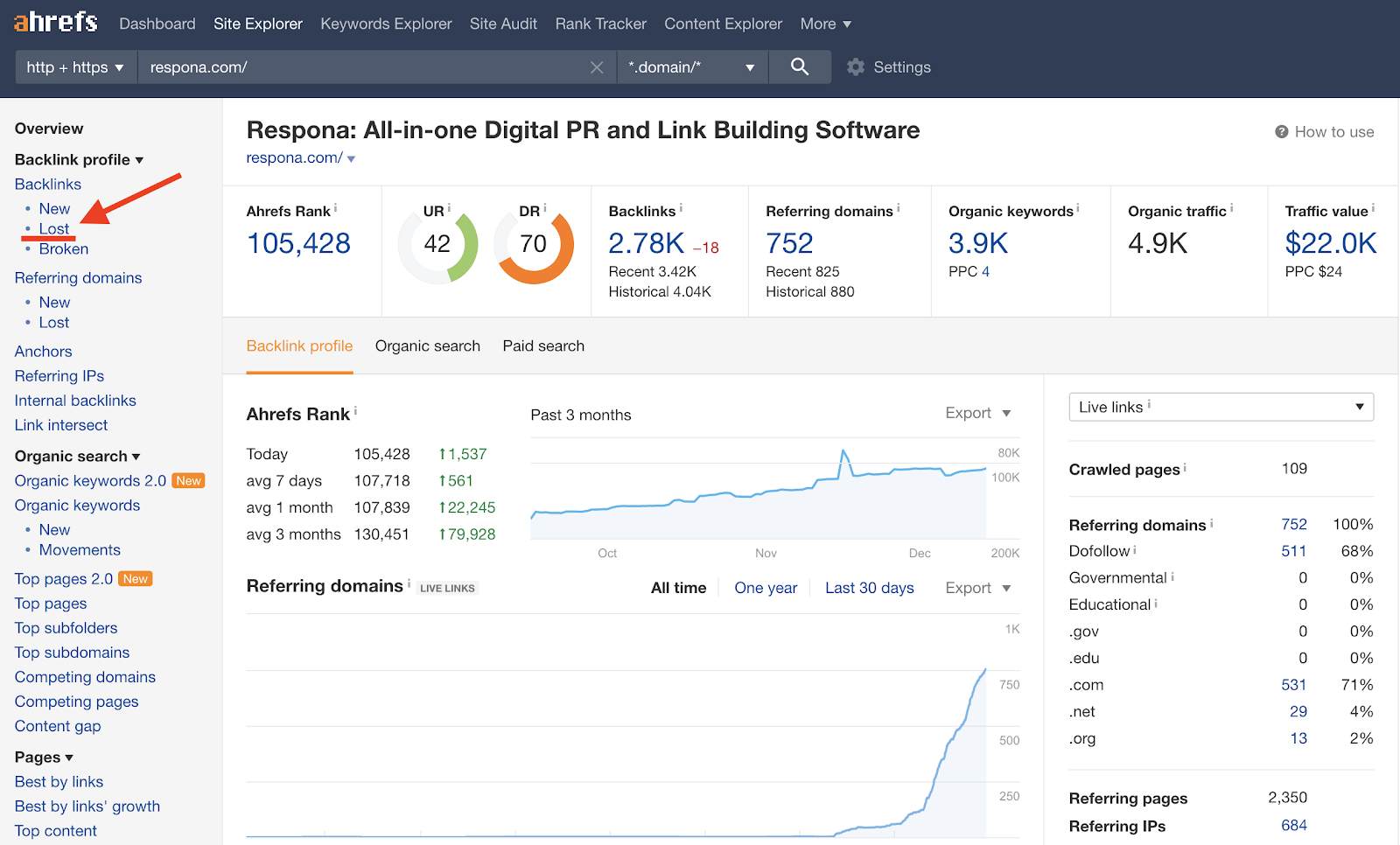
As shown above, you can simply check the lost links from your backlink profile.
Additionally, you can even define a specific timeframe that you might be interested in knowing about.
We went looking for the last seven days.
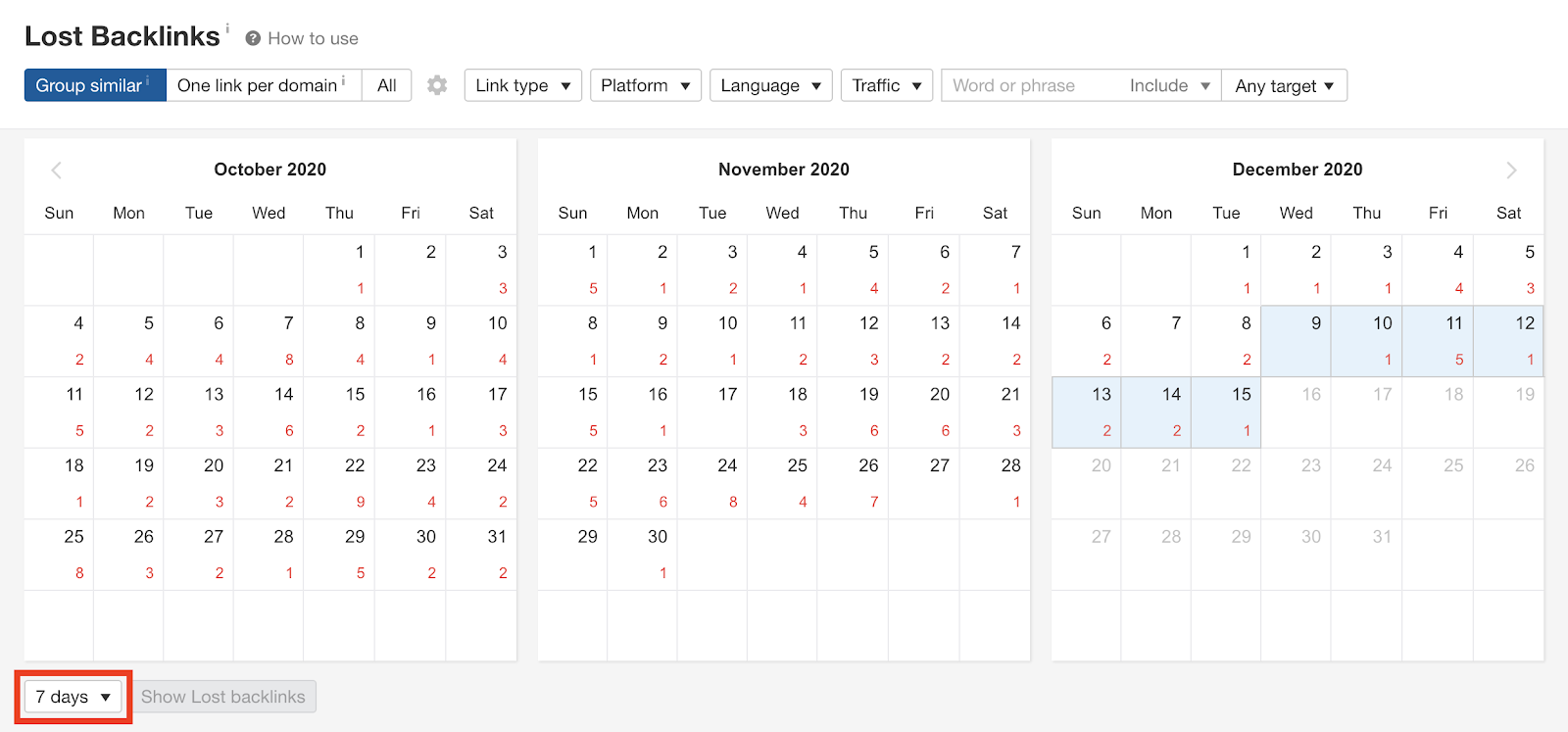
Getting your results would probably look something like this:
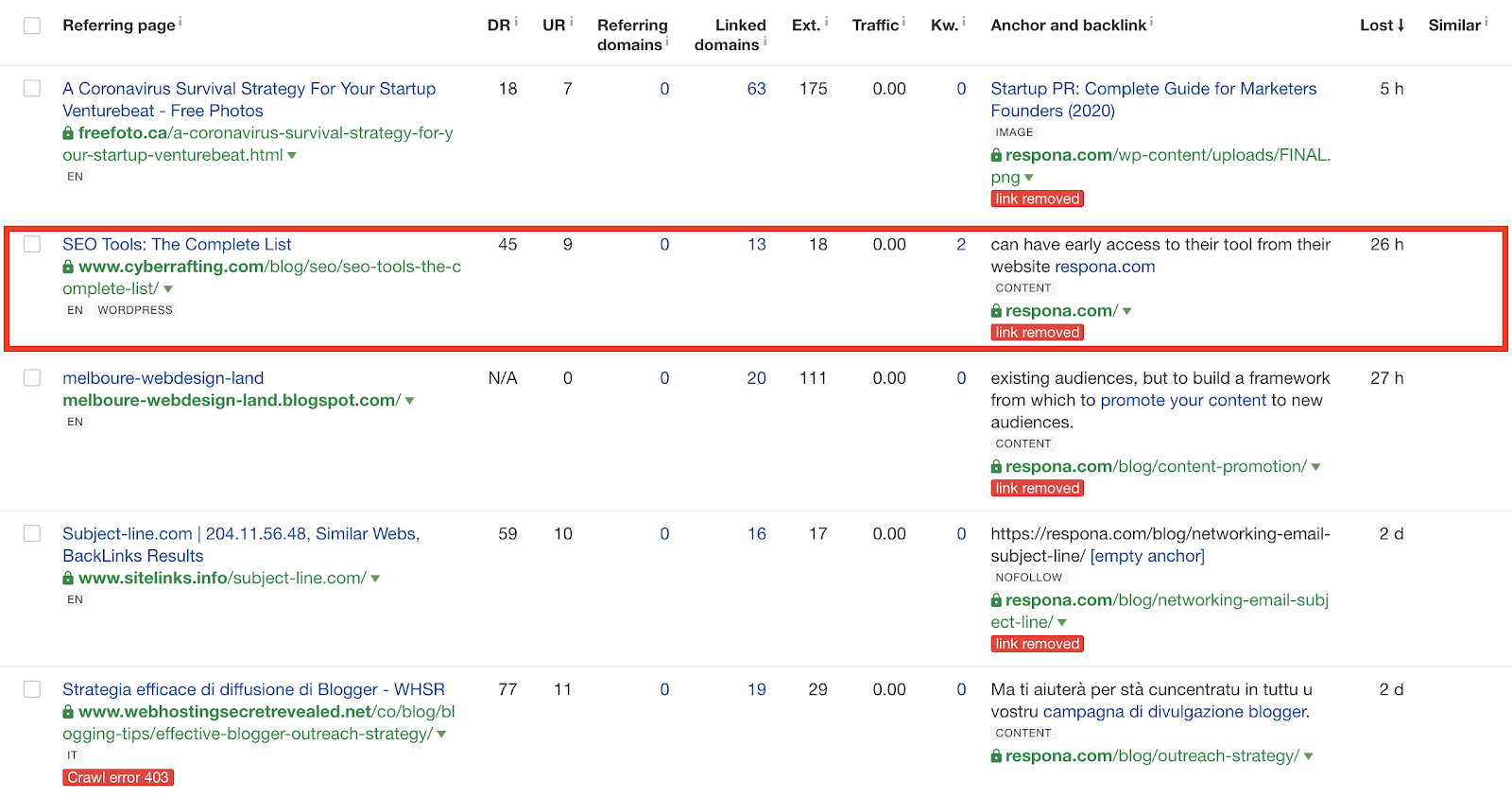
You can review the links you’ve recently lost and find the ones you think are worth reclaiming.
Here’s a link reclamation email template you can use for exactly that.
Template to use
Subject: thanks for our mention
Hey {first_name},
My name is [name] and I am a [job title] at {company name}—{something about the company}.
I saw that, up until recently, you were mentioning us on {page URL}. Thank you for that — we really appreciate it.
However, I noticed that the link back to our website was recently removed.
Could I ask you a small favor?
I’d really appreciate it if you replace the link.
Here’s the page where you originally linked back to: {lost link URL}
Let me know what you think!
Thanks,
[Name]
Relevant resource: Link Reclamation: How to Easily Find (and Reclaim) Lost Backlinks
Type #6: Resource Pages
The sixth type, and one of the most common for SEO outreach, is the resource pages one.
What is it?
This type is about connecting with and reaching out to prospects’ that have published content that’s relevant to you and your brand, but might have missed mentioning you.
For example, it might be a guide that talks about a number of your competitors and is addressed to your target audience.
In such a case, we can totally reach out to them, explain why we think our business would be worth including, and how it might help enhance their piece of content.
Template to use
Subject: your resource page
Hi {first_name},
I wanted to quickly show my appreciation for your {url_title} resources post: {url}
Thought you’d be interested in including [your post/company/product]?
[A sentence or two about the differentiating factors of your pitch].
I’d be happy to share your post with our [# of followers] followers on social to drive website traffic to the article.
Looking forward to your reply!
Thanks,
[Name]
Type #7: Roundups
Let’s have a look at another prominent type of SEO outreach: roundups.
What is it?
Roundups are all about compiling information on a topic – it can be links to relevant websites or quotes from experts – and sharing it with your audience.
In other words, whether you want to organize an expert roundup with authorities in your industry sharing their opinion about a specific topic, or you want to participate in link roundups other people have published, a well-structured outreach activity will help.
In all cases, you need to reach out to people, connect with them, and give them a very clear idea of what your roundup is about or why you should be included in their link roundup.
Template to use
Subject: your recent roundup feature
Hello {first_name},
My name is {name} and I am a {role} at {company name}—{something about the company}.
I found you on a roundup post you participated a while back:
{referring_url}
We’re organizing an expert roundup post on [topic] and we are hoping to get some quotes from [industry] experts.
Would you be interested in participating?
All you need to do is to say yes and I’ll send through {x} short questions for your reply.
If you feel there’s something important to share, please do!
Look forward to hearing from you!
Thank you,
[Name]
Relevant resource: Link Roundups: Learn How to Get Quality Links Using Them
Type #8: Content and Brand Promotion
Our second to last type is content and brand promotion.
What is it?
Content and brand promotion outreach is basically the process of emailing a prospect and letting them know about a piece of content you’ve published or a service your business is offering.
Such an outreach email is usually in relation or in response to something the prospect has recently published, as we’ll see in the content promotion email template we’re sharing with you here.
Template to use
Subject: your post on (keyword)
Hey {first_name},
[Name] here from [company].
I just finished reading your post on [topic]. Loved the way you mentioned [insert article summary].
I noticed, however, that your post doesn’t present a step-by-step process on how to [topic].
We happen to have a detailed [type of resource] on [topic].
You can have a look:
{referring_url}
Let me know what you think!
Thanks,
[Name]
Relevant resource: Content Promotion: The What, Why & How Behind It (2021)
Type #9: Content Partnerships
The final type of SEO outreach efforts is the content partnerships one.
What is it?
Content partnership outreach is when you go reaching out to people that are in your niche in order to establish a relationship and explore the possibility of a partnership between the two of you.
How many times you thought that collaborating with that influencer, that blogger, or this brand can benefit both you and the other side, right?
Writing a killer email to someone explaining why you’d make a great team in terms of the content you both produce is a great way to start building towards boosting your SEO and bringing more brand awareness.
Template to use
Subject: go at it together?
Hey {first_name},
[Name] here from [company].
We’re really impressed with the work you’re doing when it comes to [topic].
We’re into [topic] as well.
The reason why I’m reaching out is because we could help each other out.
We’re already building links for a growing list of partners and they’re doing the same.
It’s a win-win situation – I guess you know that already.
Would you be interested in discussing this further?
Let me know and we can work something out.
Thanks,
{Name}
Now that we’ve presented some of the most popular types of SEO outreach, we can move forward with a step-by-step process for launching a successful SEO outreach campaign.
What’s the Best Way to Do SEO Outreach?
If you’re running outreach yourself, the workflow is fairly consistent across most teams.
You start by finding link opportunities. Use an SEO tool like Ahrefs or Semrush to surface pages already ranking for your target topics, and Google Keyword Planner to identify the keywords worth pursuing. From there, you build a list of potential outreach targets: resource pages, listicles, competitor backlinks, and unlinked mentions on reputable websites.
Next, you find contact information. An email finder pulls verified emails for the website owner, editor, or content lead behind each page.
Then you send a personalized outreach message. Generic cold outreach gets ignored, so the best outreach campaign is built on real research: reference something specific about the prospect’s site, explain why your link adds value, and keep the message short.
After that, you follow up. Most replies come from follow-ups, not the first email. Two to three follow-ups spaced five to seven days apart works well for most outreach efforts.
Finally, you track and measure. Google Analytics and your SEO tool together let you monitor link acquisition, domain rating, referral traffic, and overall SEO performance.
That’s the manual version of an effective outreach strategy. And it does work.
The problem is that doing it consistently is tedious. Finding outreach opportunities, exporting backlink data, sourcing the right people, sending every outreach email yourself, negotiating, tracking replies, chasing slow responders, and keeping spreadsheets up to date… it turns into a full-time job fast.
Most marketing teams either burn out trying to do it in-house, hire an SEO agency that takes months to spin up, or pay for cheap SEO outreach services that never quite deliver the placements they promised.
This is the gap Respona is built to fill.
The process starts with your campaign goals. You choose the pages you want to promote, the keywords or AI prompts you care about, your preferred anchor text, niche requirements, and any other placement guidelines you want our team to follow.
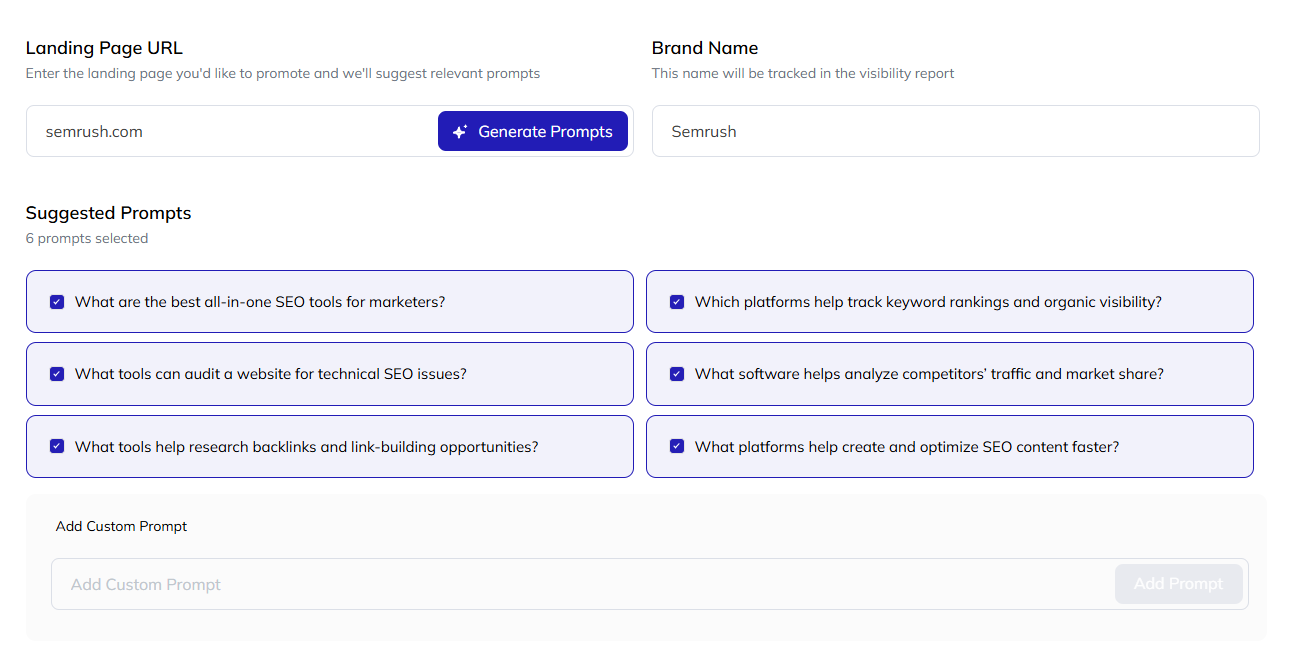
From there, Respona’s Campaigns feature brings up articles that already perform in search results and already show up in AI-generated answers for your target queries.
These are the pages already influencing visibility in your niche, so a link from them actually moves the needle on rankings and AI search presence at the same time.
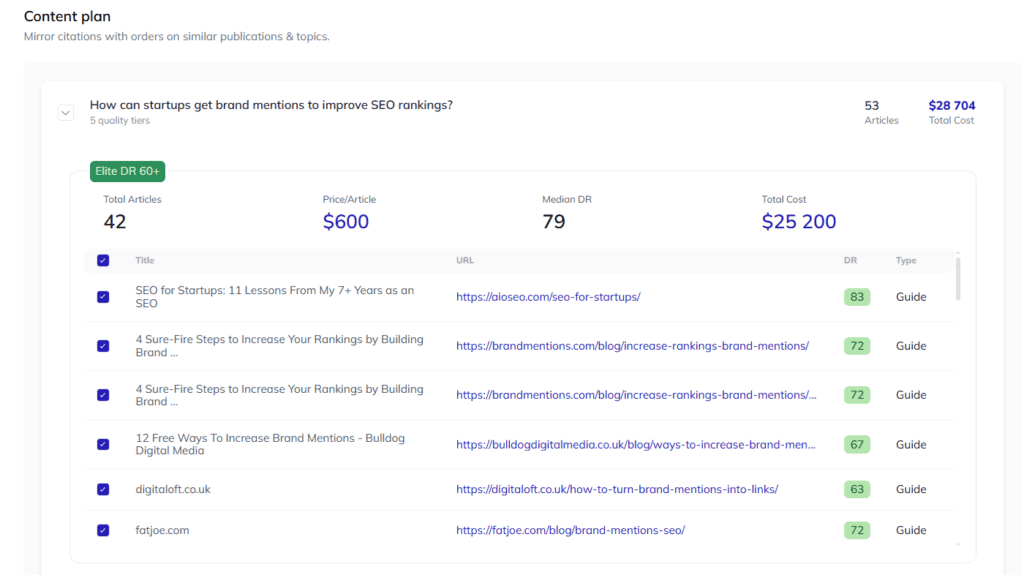
Once you review the opportunities, you approve the placements you want to target.
Then the team takes over the actual work: prospecting, outreach, follow-ups, negotiations, relationship building, and securing the backlink placement on your behalf.
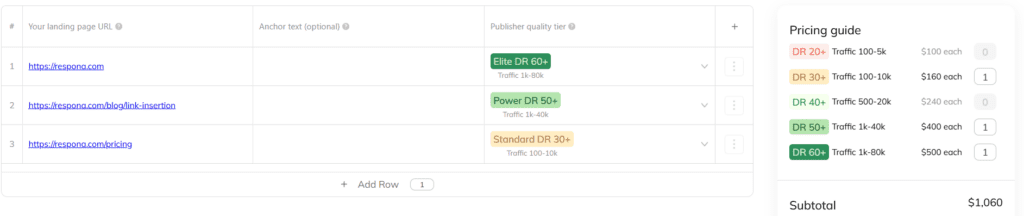
Of course, you can skip the campaign-by-campaign review and just order placements on articles within a domain rating and traffic range that works for you, if you prefer a more “shotgun” approach.
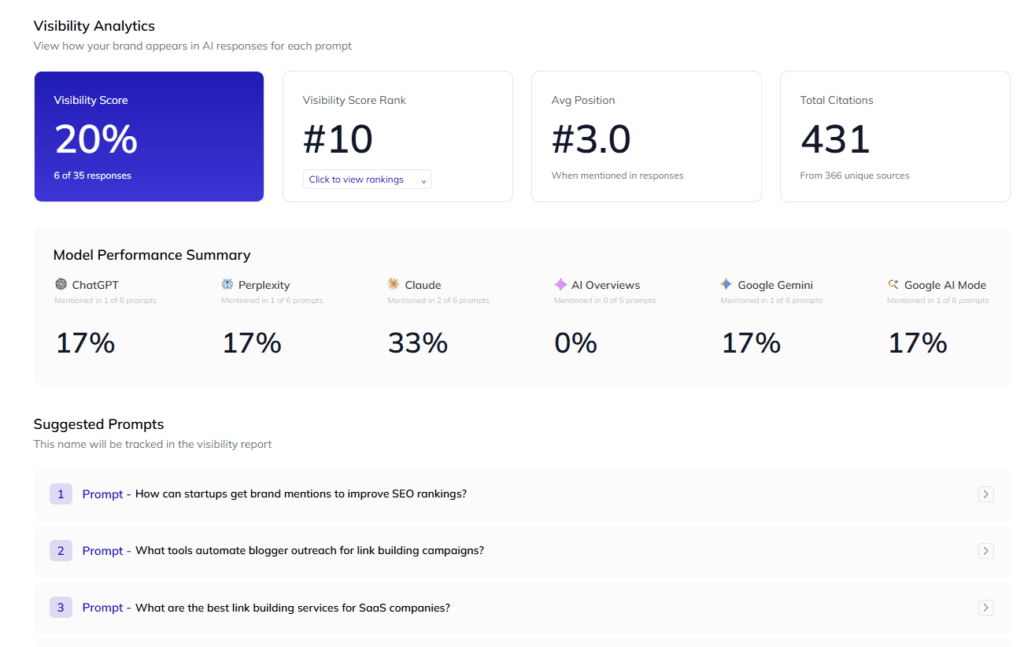
You can also track how your visibility changes over time, including for AI search queries where brand mentions and listicle placements matter more now than they did even a year ago.
So instead of managing outreach yourself or buying backlinks from a backlink marketplace, you get a managed link building process with clear placement review before anything goes live.
Link building cheat sheet
Now Over to You
SEO outreach is still one of the best ways to grow your organic visibility, earn high quality backlinks, and put your brand in front of new audiences.
But in 2026, running outreach campaigns consistently at scale takes more time than most marketing teams have.
If you’d rather skip the prospecting, the outreach, and the follow-ups, you can simply place an order and let Respona’s team handle the link building for you. Just share your target pages and keywords, and we’ll take it from there.
Frequently Asked Questions
What is SEO outreach?
SEO outreach is the process of contacting site owners, editors, and bloggers to earn backlinks that improve your rankings in search engines. It includes tactics like broken link building, guest blogging, link reclamation, and resource page outreach.
Is SEO outreach the same as email outreach?
Email outreach is the broader category of using cold email to connect with anyone for any purpose, while SEO outreach is the subset focused specifically on earning backlinks. Most outreach SEO work is run over email, so the two overlap heavily in practice.
How long does SEO outreach take to show results?
Most teams see the first placements within four to six weeks of launching a campaign. Visible ranking improvements usually take three to six months, depending on your niche, your starting domain rating, and the quality of links you acquire.
Do I need software to do SEO outreach?
A dedicated outreach tool helps you find emails, send personalized messages, automate follow-ups, and track replies in one place. You can technically run outreach from Gmail, but it gets messy fast once you’re managing more than 20 or 30 conversations.
Should I hire an SEO agency or run outreach in-house?
It depends on bandwidth. If your team has the time and skill to research prospects, write personalized emails, and follow up consistently, in-house works. If not, working with a done-for-you service like Respona is usually faster and more cost-effective than a generalist SEO agency.
How do I measure SEO outreach results?
Track the number of placements, the domain rating of referring sites, referral traffic in Google Analytics, and ranking changes for your target keywords. Together, those give you a clear picture of how outreach is moving your SEO performance.