
In this guide, we’re sharing 3 tactics for white hat link building that won’t break the bank.
If you’re starting out with link building, you’re going to need this guide.
Here’s what you’re going to learn what white hat link building is, how white hat backlink building is different from other tactics along with 3 white hat tactics that are easy to implement, even for beginners.
Let’s get into it.
Key Takeaways:
- White hat link building means earning backlinks through real outreach, valuable content, and relationships. No shortcuts, no link schemes, no link farms. It’s slower than the alternatives but the only kind that lasts.
- The biggest difference between these three approaches? Black hat violates Google’s guidelines outright. White hat works within them. Gray hat link building sits awkwardly in between, technically allowed but manipulative enough to be risky.
- Listicle placements are the highest-impact white hat backlinks you can land in 2026. A spot in a “best of” roundup earns you a quality backlink, sends real traffic from people who actually want what you offer, AND increasingly shows up as citations inside AI answer engines like ChatGPT and Perplexity.
- Quality backlinks take real time to build. Each one typically requires hours of prospecting, finding the right contact, writing personalized outreach, following up, and negotiating. If you can’t afford that time in-house, outsourcing to a pay-per-result service is the practical alternative.
- The websites ranking at the top of any competitive niche didn’t get there with link farms or any black hat tactic. They got there with a slow, deliberate approach that builds white hat links from an authoritative website in their space, one placement at a time.
Link building cheat sheet
What is White Hat Link Building?
If you know a thing or two about link building, you’ve probably heard of how time consuming and demanding it can be.
However, no matter how hard it might sound, link building is actually one of the most efficient ways to grow your organic traffic and get results from organic search faster.
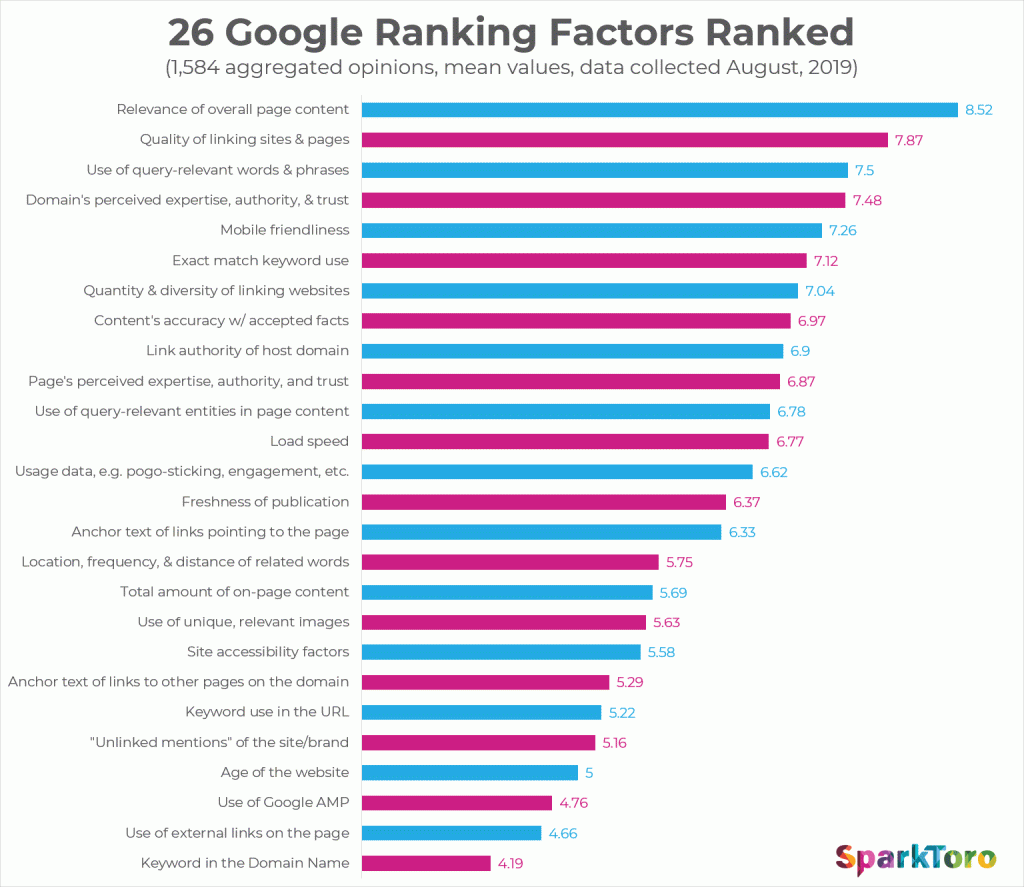
In fact, according to a 2019 survey by SparkToro, most white hat SEO professionals still believe that the quality of linking websites – AKA referring domains – is one of the most prominent search engine ranking factors.
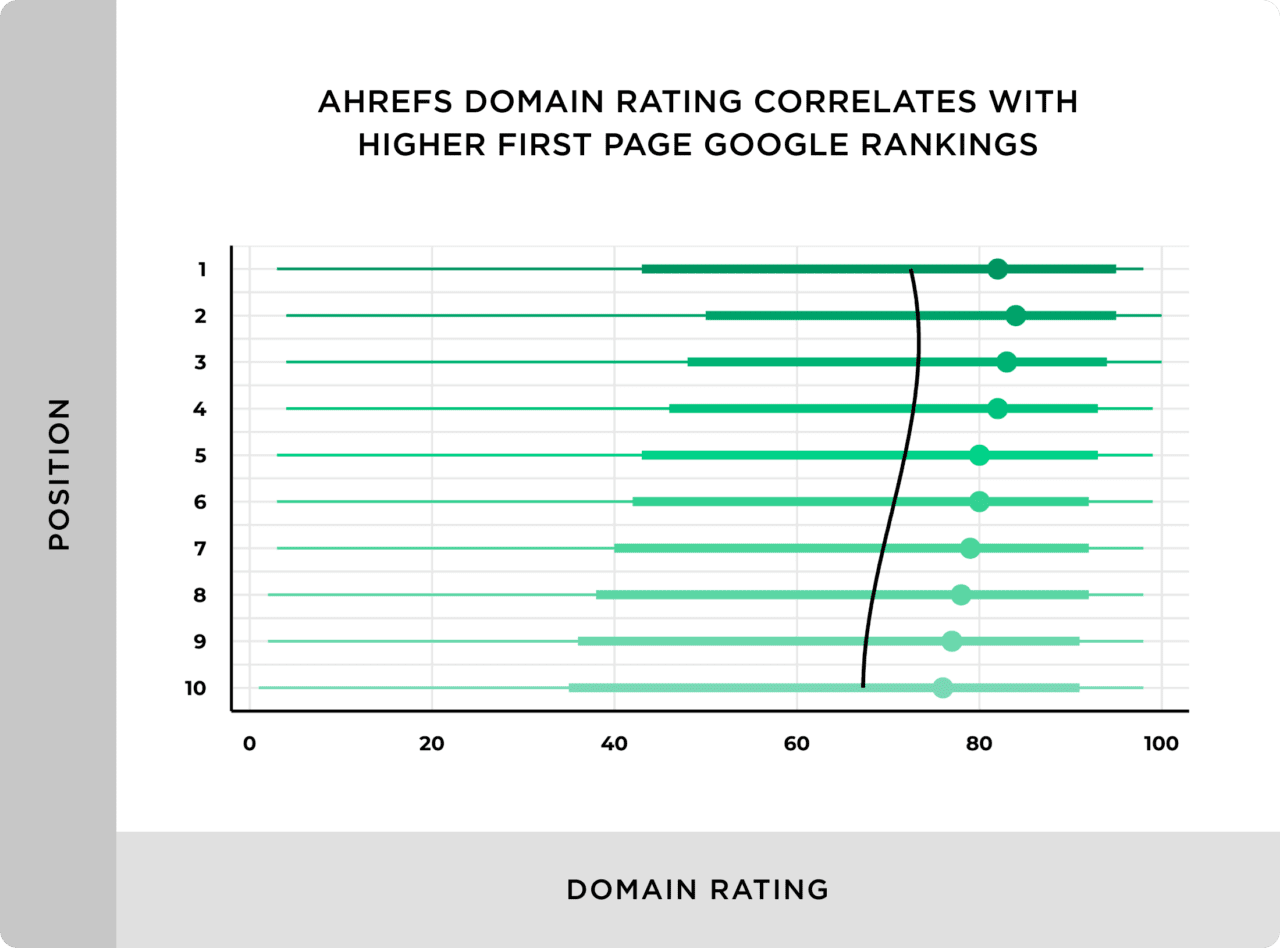
At the same time, according to a 2020 study of 11.8 million search results by Backlinko,
“A site’s overall link authority (as measured by Ahrefs Domain Rating) strongly correlates with higher rankings.”
What does that mean?
Well, practically it says that links matter a lot when it comes to getting organic traffic.
Also, when it comes to search engine optimization (more specifically, off-page SEO), one of the most prominent activities is link building.
In this post we’re focusing solely on a white hat SEO technique, white hat link building in particular.
The reason we’re focusing on white hat link building, although we’re also showing you how it differs from gray and black hat link building, is simple.
White hat is a legally not objectionable SEO strategy that boosts higher and more positive ratings by search engines.
Put another way, white hat is an efficient and ethical way of working within search engines’ conditions of acquiring higher visibility and getting higher search engine result page (SERP) positions.
We could say that white hat methods are the heroes; the good guys that can help you improve your search engine rankings while respecting the ranking factors search engines are looking for.
An example would be to look out for broken links on other websites.
After having identified any broken links, you can reach out to the person that had initially published them and let them know about it.
This will also give you the chance to suggest they should replace their broken links with links back to your content that might be similar.
The problem with broken link building, however, is that it’s not easily scalable. People tend to remove broken links from their site pretty quickly – similar to unlinked mentions that are so few and far between.
Another example would be to promote an infographic that you’ve created to relevant websites who might be interested in featuring your visualisation in one of their posts and linking back to your website.
For example, let’s say that you’ve published an infographic on your blog and want to start building links back to the page where the infographic is.
It only makes sense that you’ll find relevant websites that talk about this topic and reach out to them, e.g. to the webmaster of the website or someone with editorial access to the blog, and ask if they could take a look at your infographic.
The purpose here is to ask for dofollow links, which are the opposite of nofollow links, and help your page get the attention it deserves as well as acquire some referral traffic, if the linking page has traffic of its own.
As you’ll see when we get deeper into the three different white hat link building tactics a little further down in this post, white hat is all about targeted prospecting, crafting a personalized pitch, and managing the outreach process end-to-end.
To cut a long story short, outreach helps you find and acquire high-quality links from high authority websites and even generate brand mentions along the way.
Getting relevant links from websites that have a high domain authority (DA) can lead to increasing your overall domain authority and, as a result, getting you more visibility on the SERPs.
Let’s now discuss how white hat tactics differ from black and grey link building technique types.
The Difference Between Black, Grey, and White Hat Link Building Techniques
As we’ve already discussed, white hat techniques are, to put it simply, the ‘good’ ones.
The tactics that, although demanding, can help you rank higher organically and in a way that doesn’t violate Google’s guideliness.
Let’s now discuss grey hat link building.
Grey Hat Link Building
Grey hat link building is basically a combination of techniques that are white hat, so approved by the search engines, and others that are not the worst things you can do but are still manipulative and might put your business at risk.
In a few words, grey hat link building strategies might get you in a little trouble, although they’re not violating Google and Bing’s guidelines as much as black hat techniques do.
Some examples of gray hat SEO techniques are:
- Buying expired domains with a high number of links linking back to them
- Buying links to your site from other websites in bulk without adding the rel=”sponsored” tag
How about black hat link building?
Black Hat Link Building
Black hat SEO is that type of SEO you should try to stay well away from as it could lead to your business getting severe penalties from the search engines.
In some cases, the effects of such a penalty for your business may be permanent.
In one sentence, black hat tactics violate search engine guidelines.
Let’s take a look at what Google considers to be a violation of their guidelines.
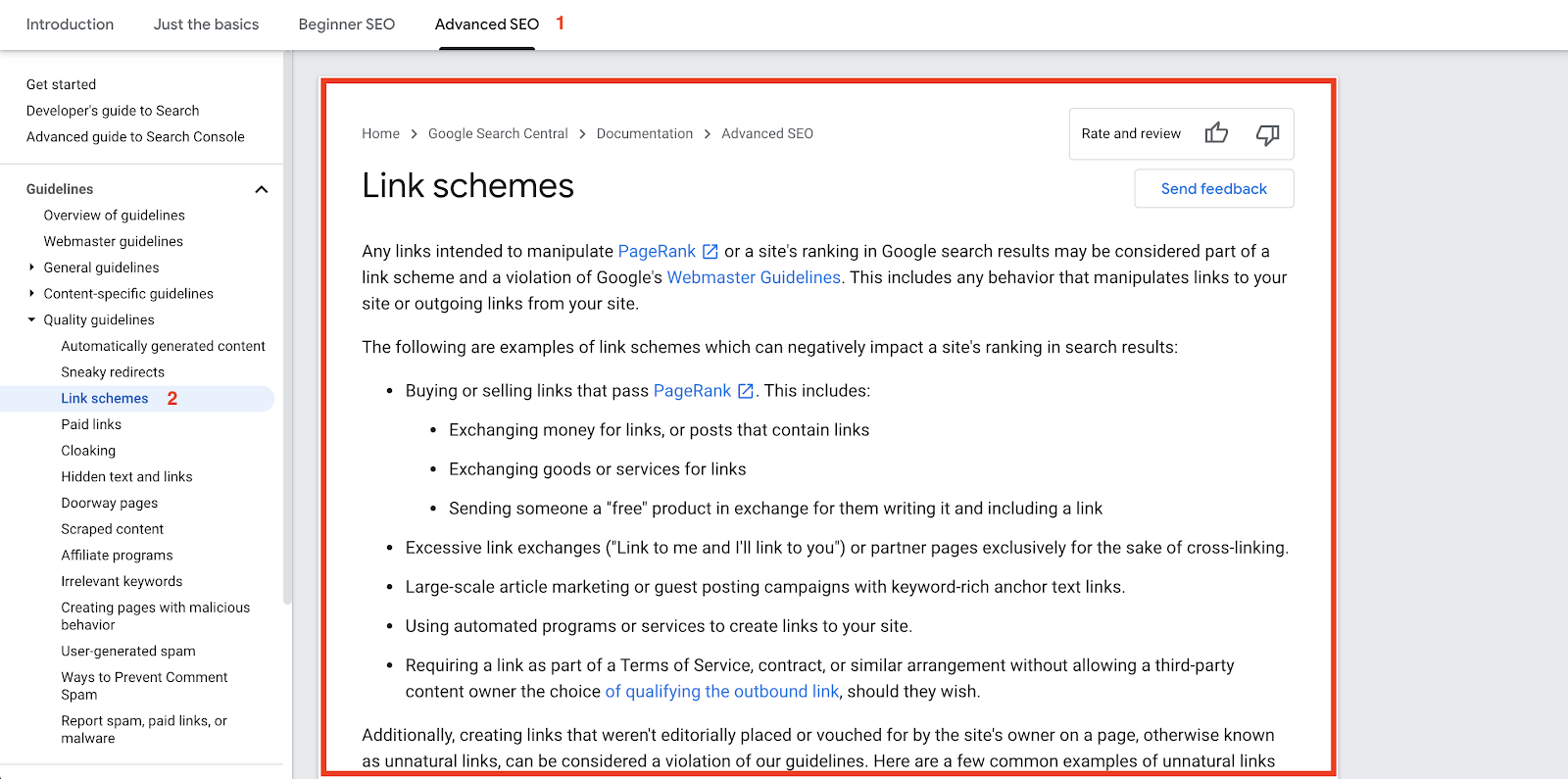
Author’s Note: To access the above page, you need to visit Google’s Search Central and from there click on “Link schemes”. This is part of Google’s “Advanced SEO”, but is enough to help you understand which practices are considered to be a link scheme by Google when it comes to SEO link building.
Here are a few examples:
- Hiding keywords and anchor texts in a blog post or other website page by turning the anchor text to the same color as the page background
- Cloaking, which is the process of presenting different content to the users than what you show the search engines
- Buying links on website networks that are presented to be high authority links but aren’t
- Click-through rate (CTR) manipulation
- Negative SEO services, such as toxic link attacks
- Participating in a private blog network (PBNs)
- Link farm posts or entire sites
- Paid link collaborations with no sponsored tag
- Using an automated link building service, such as a bot spamming social media and blog comments with your links
We understand that marketers and website owner teams might desperately want to boost their company’s high quality backlink profile, but they should also be aware of the risks.
Overall, using black and gray link building tactics and SEO strategies can be risky for your website and affiliate sites.
Professionals and brands who employ such tactics and methodologies may get away with it for a while, but sooner or later things will come out, and, in many cases, this may result in huge traffic, revenue, and job losses.
Whether you’re doing your own SEO or working with an SEO agency, keep in mind that Google’s algorithms are only getting stricter and smarter when it comes to the tactics one uses to get higher visibility and acquire links.
Moving on to our white hat link building strategies.
Tactic #1: Listicles
Listicles are the most valuable type of backlink you can land in 2026. Here’s why.
A spot in a high-ranking “best of” article does three things at once. It sends you direct referral traffic from people who are already in buying mode (they’re literally on a “best of” list looking for a solution).
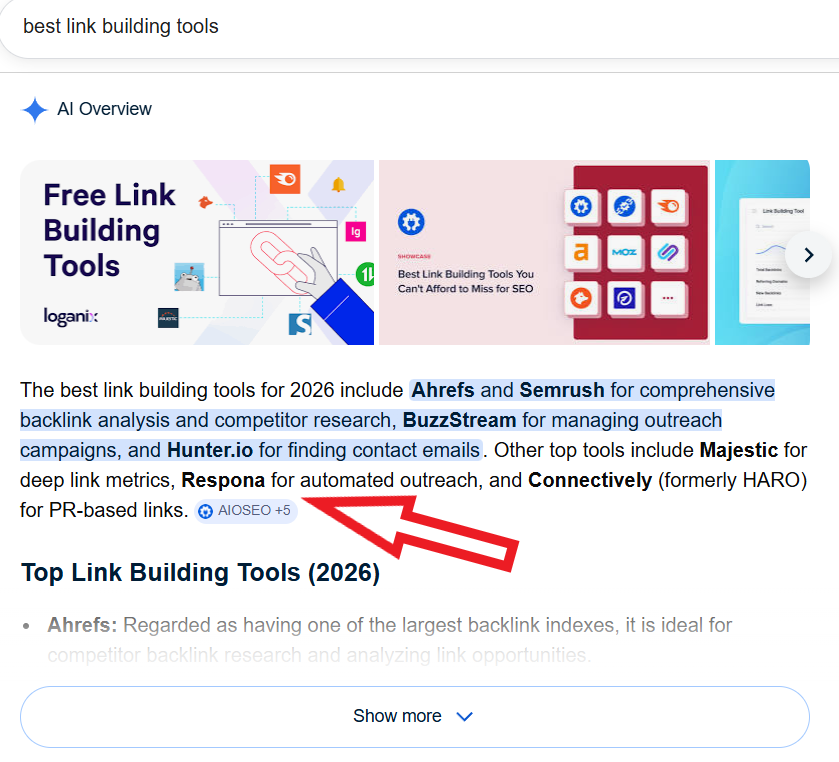
It feeds Google’s algorithms a clear, contextual ranking signal that improves your organic traffic. And, increasingly, it gets you cited inside AI answer engines like ChatGPT, Perplexity, and Google AI Overviews when users ask “what are the best [X] tools.”
One placement, three wins.
Finding listicles to target is the easy part. Open Google and use this search string:
intitle:("top" OR "best") intitle:(your keyword) -"your company"
Replace “your keyword” with whatever you do (e.g., “project management software,” “running shoes,” “CRM tools”) and “your company” with your brand name to filter out any articles that already feature you.
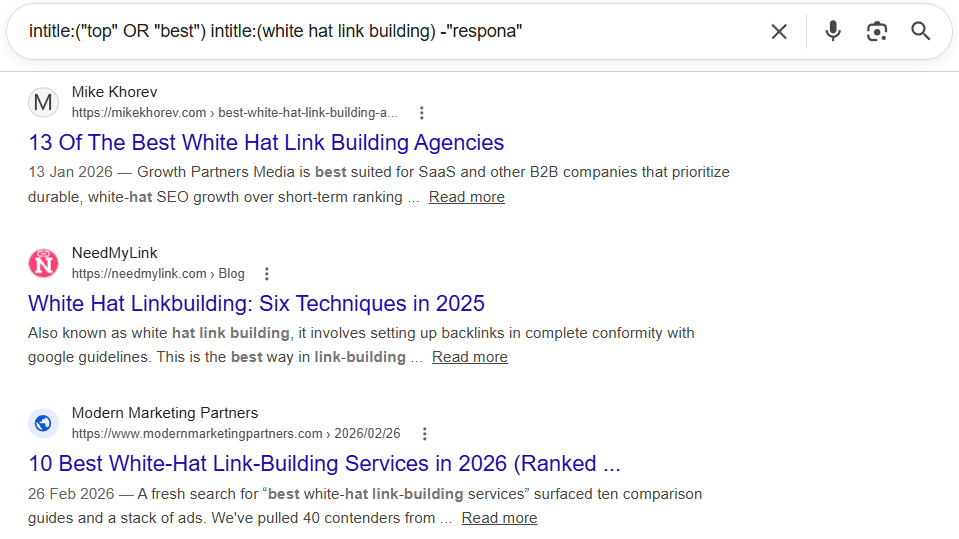
What this gives you is a clean list of listicles that rank for your category but haven’t included you yet. Each one is a link opportunity.
From there, the workflow looks like this:
- Find the right contact at each publication. Usually the article’s author, the site’s editor, or a senior content marketer.
- Find their email. Tools like Hunter, ContactOut, or LinkedIn Sales Nav work, or you can guess based on the publication’s typical email format.
- Reach out with a personalized pitch. Tell them why your product or service belongs in their list, what value it adds for their readers, and ideally offer something in return (a backlink from your own resources, a co-marketing opportunity, original data they can quote, etc.).
- Follow up. Most placements don’t happen on the first email. Two to three follow-ups over the course of two weeks typically converts the most.
- Get the placement live. Negotiate placement position, the surrounding copy, and the anchor text used.
Here’s the catch.
Each placement, done properly, takes at least an hour of work. Multiply that by the 30+ placements you’d need to move the needle on rankings in a competitive niche and you’re looking at quite a few hoursdedicated outreach work.
That’s why most teams either give up after a few weeks or hire a dedicated link builder.
There’s a third option: outsource to a pay-per-result link building service like Respona.
How it works:
Place your order with custom link requirements.
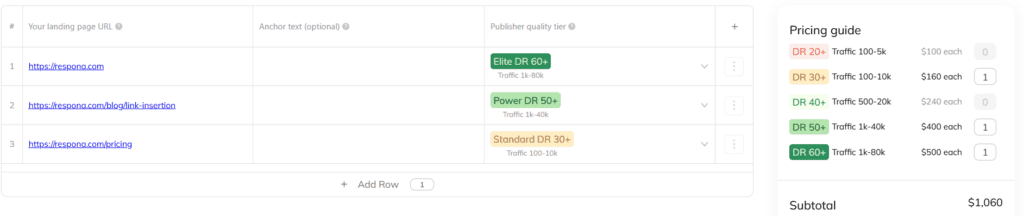
Drop in your target landing pages, target keywords, anchor text preferences, and the kinds of publications you want featured on. You can also request domain pre-approval so you know exactly which pages you’re going to be placed on before you’re live.
Check your current standings in AI search.
First, add the AI prompts you want to show up in and pick your answer engines of choice.
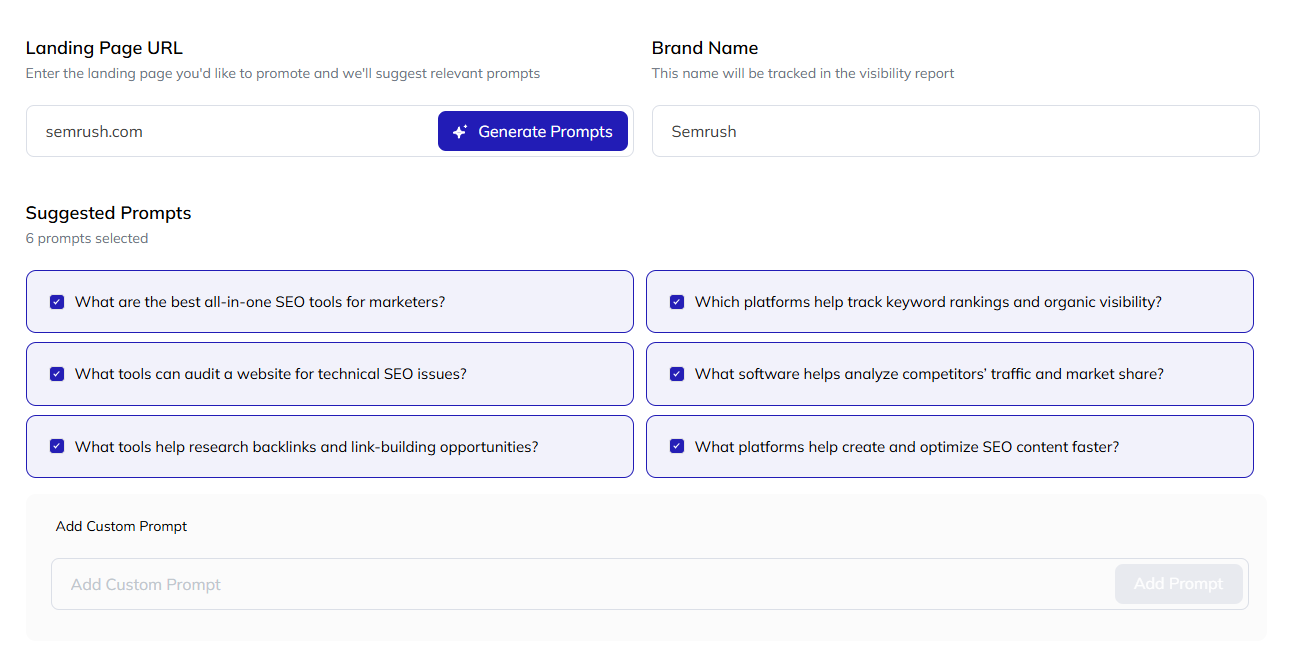
Then, Respona’s built-in AI visibility tracker willmonitor brand mentions across ChatGPT, Perplexity, Google AI Overviews, Gemini, Claude, and Copilot, so you see which prompts cite you, which cite your competitors, and where you have ground to make up.
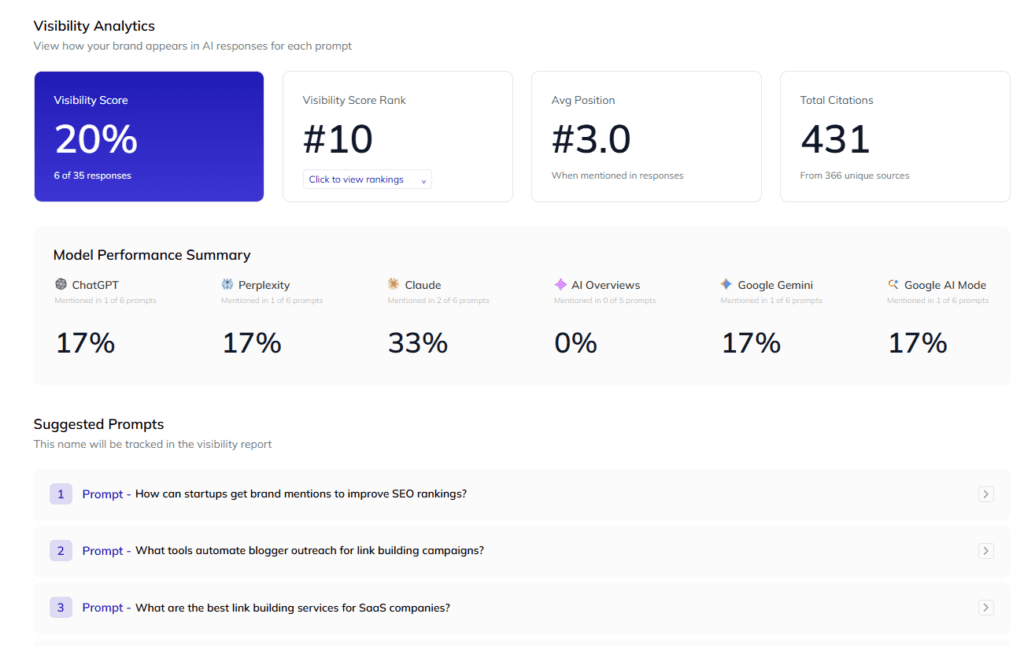
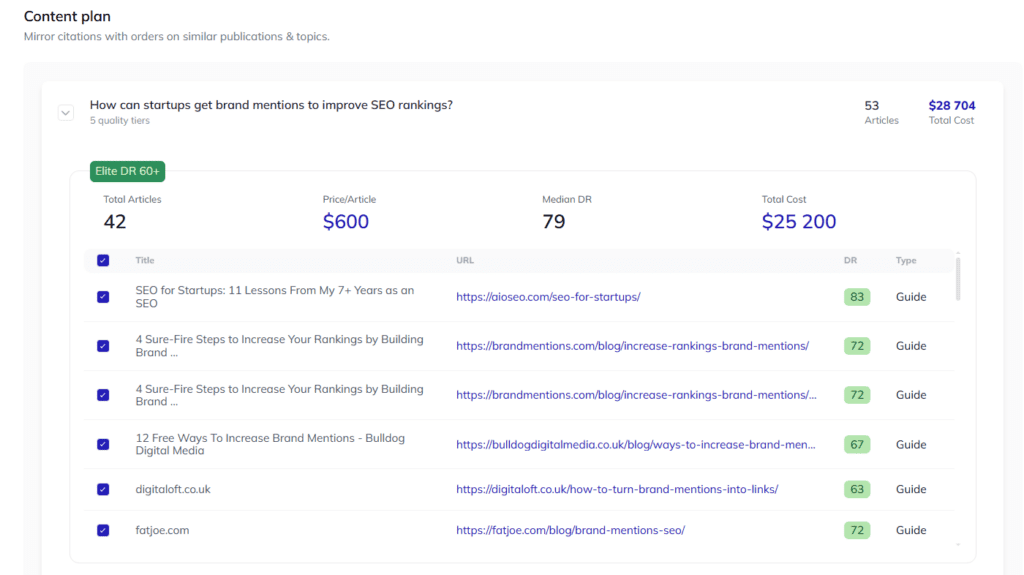
Review the link building action plan.
Respona alsogenerates a prioritized list of articles that already rank in Google AND already get cited inside AI engines for your target AI prompts. Each one is a high-value listicle to pursue.
Pay per result.
Respona’s team handles prospecting, pitching, follow-ups, and negotiating until each placement goes live.
Pricing starts at $100 per placement and scales by site authority. No retainer, no minimum, no contract.
You get the same listicle placements you would have built yourself, without burning your team’s time.
Tactic #2: Guest Post Outreach
For guest posting, you start in Google with these search strings:
intitle:"write for us" "your keyword"
intitle:"guest post" "your keyword"
intitle:"contribute" "your keyword"
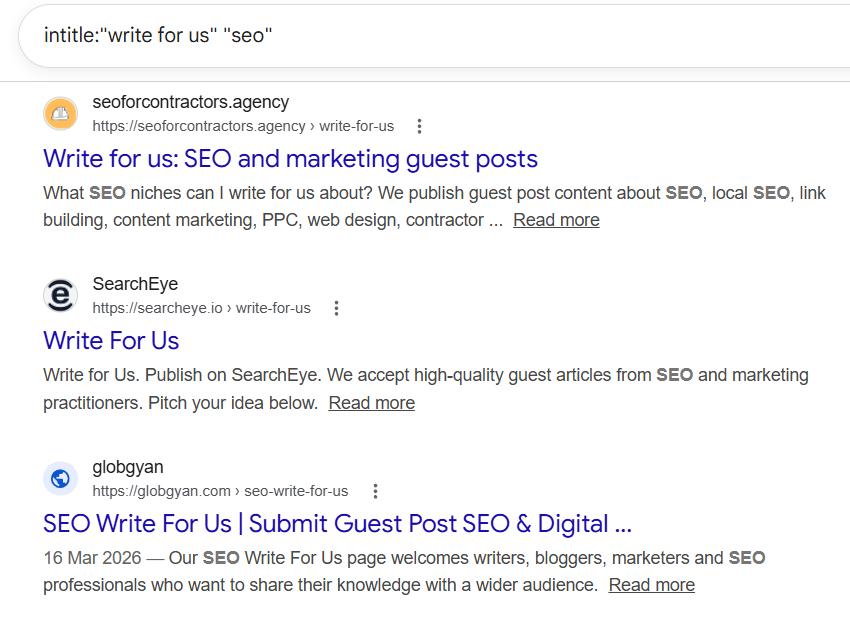
These pull up sites that explicitly accept guest posting submissions and cover your topic.
Click into the “write for us” page on each one, read their guidelines carefully, and pitch them a topic that fits both their content style and lets you naturally link back to a piece of content you’ve already published.
The big advantage of guest posting over other tactics is that you get full control over the article itself. You choose the topic.
You write the body. You place the link to your content in the most contextual spot.
The editor reviews and approves, but you’re not asking them to retroactively add a link.
And you can use these to set up indirect ABC exchanges as well.
Tactic #3: Link Insertion
Link insertion is when you ask a website owner to add your link to an existing article they’ve already published. The work for them is minimal (edit one article, add one link), which is why it often converts better than guest post outreach.
The trick is finding articles that mention your keyword but don’t directly compete with your content.
When you find a good candidate, contact the site owner with a specific request. And more importantly, outline what’s in it for them – a link in return, a guest post, a social shoutout, etc.
Free links are great but they’re rare.
Link building cheat sheet
Now Over to You
By now, you should have realized that there are various ways to do white hat link building for your website.
Not only that, but those ways are interesting and even fun, too.
They can help you establish relationships with likeminded people and expand your network within your niche or vertical.
If you’re ready to start using any of the tactics above but don’t have the in-house time to run hundreds of outreach campaigns yourself, give Respona a try.
We handle the entire link building process on a pay-per-result basis: prospecting, pitching, follow-ups, negotiation, and securing live backlinks on listicles and editorial features that drive both Google rankings and AI citations.
Frequently Asked Questions
What separates white hat backlinks from spam?
White hat backlinks are earned through legitimate outreach and valuable content. Low-quality backlinks come from black hat SEO tactics like link schemes, PBNs, and paid networks that violate Google’s terms. Gray hat backlinks sit between the two, technically allowed but enough to put you at risk. White hat backlinks take longer to build, but they’re the only kind that survive Google’s algorithm updates.
How long does white hat SEO take to see results?
Most white hat SEO campaigns take 3 to 6 months to show meaningful organic traffic gains. The reason is that white hat backlinks compound: each new placement strengthens your backlink profile, but search engines need time to crawl and weight each new signal. Plan for the long haul.
Can broken link building still work in 2026?
Yes. Broken link building is one of the slowest white hat tactics to scale (broken links get removed quickly), but each broken link you find and reach out about adds to your backlink profile. A free SEO tool that finds dead links across competitor sites makes the prospecting part faster, but the email outreach is still the bottleneck.
What’s a link building strategy that doesn’t violate Google’s guidelines?
Any approach that earns links through value works. The most effective combinations are guest posting + listicle outreach + broken link building, because they target different placements (new articles, existing roundups, a resource page in your niche, replacement links). Pick a link building strategy that fits your niche and team capacity, then execute consistently. Pair it with linkable assets like original research or custom illustrations so editors have something concrete to link to. Avoid black hat SEO methods like buying expired domains or running automated comment bots.
What is the skyscraper technique?
The skyscraper technique is a white hat strategy where you find a popular piece of content in your niche, create a better version, and reach out to everyone who linked to the original asking them to link to yours instead. Effective but resource-intensive. Done right, you earn natural links from sites that already cared about the topic.
Should I focus on backlinks from authoritative websites or just any relevant ones?
Both matter, but in 2026 the bar has moved. Valuable backlinks from an authoritative website with strong topical relevance to your niche carry far more weight than five backlinks from a random relevant website with no traffic. Quality of the linking site beats quantity, especially for white hat link building.