
With over 850,000 active podcasts and the number of podcast listeners growing year by year, podcasts are now one of the most prominent types of content people consume.
Podcasting is a win-win situation for both the hosts and the guests.
The host creates high-quality content that’ll drive more traffic to their episodes, while the guests get brand mentions, raise awareness of their expertise, and even get backlinks.
These are benefits that have driven you to want to appear as a podcast guest, but how do you make that happen?
We’ve got the answer to that plus, a free template at the end that’ll make podcast pitching a simple, repeatable process.
Without further ado, let’s get started.
Key Takeaways:
- The best podcast pitching starts with research, including listening to at least one recent episode and understanding what the podcast host cares about.
- Building familiarity through social media can improve your chances of getting a reply before you ever send your pitch.
- A successful pitch usually includes a clear topic, a unique perspective, and a reason why you are a good fit for that particular podcast.
- The more clearly you connect your expertise to the target audience, the easier it is for podcast hosts or a podcast producer to imagine you as a guest.
Table of Contents

Link building cheat sheet
Lessons From Sending Over 1,000 Podcast Email Pitches
In this part of our guide, we’re going to show you the most important lessons learned from sending email pitches to podcasters.
We strongly believe that each lesson is a valuable insight you can use, in order to have more chances of appearing on the right podcast for your personal or business brand.
Let’s get started.
Lesson #1: Listening to the podcast can help you better understand the host
Before you even start working on your podcast guest pitch email, remember that research is key.
That’s why the first lesson is all about understanding the podcast host.
Listening to a recent episode is one of the best ways to improve your podcast pitch because it helps you understand the host’s style, the depth of the conversations, and what kind of guests tend to work well on the show.
Assuming you’ve found shows in your niche that you believe you can offer value to its podcast listeners, the next step is to listen to as many episodes as you can.
This gives you a good understanding of what the host is like, what they’re passionate about, and what their field of expertise is so you can make your pitch as relatable as possible for them.
Let’s suppose that you’re a marketer or business owner and want to create the perfect pitch for Your Digital Marketing Coach; a favorite podcast in the digital marketing world hosted by Neal Schaffer.
You can browse the podcast episodes on its website and get a good idea of what they’re all about and what the host is like.
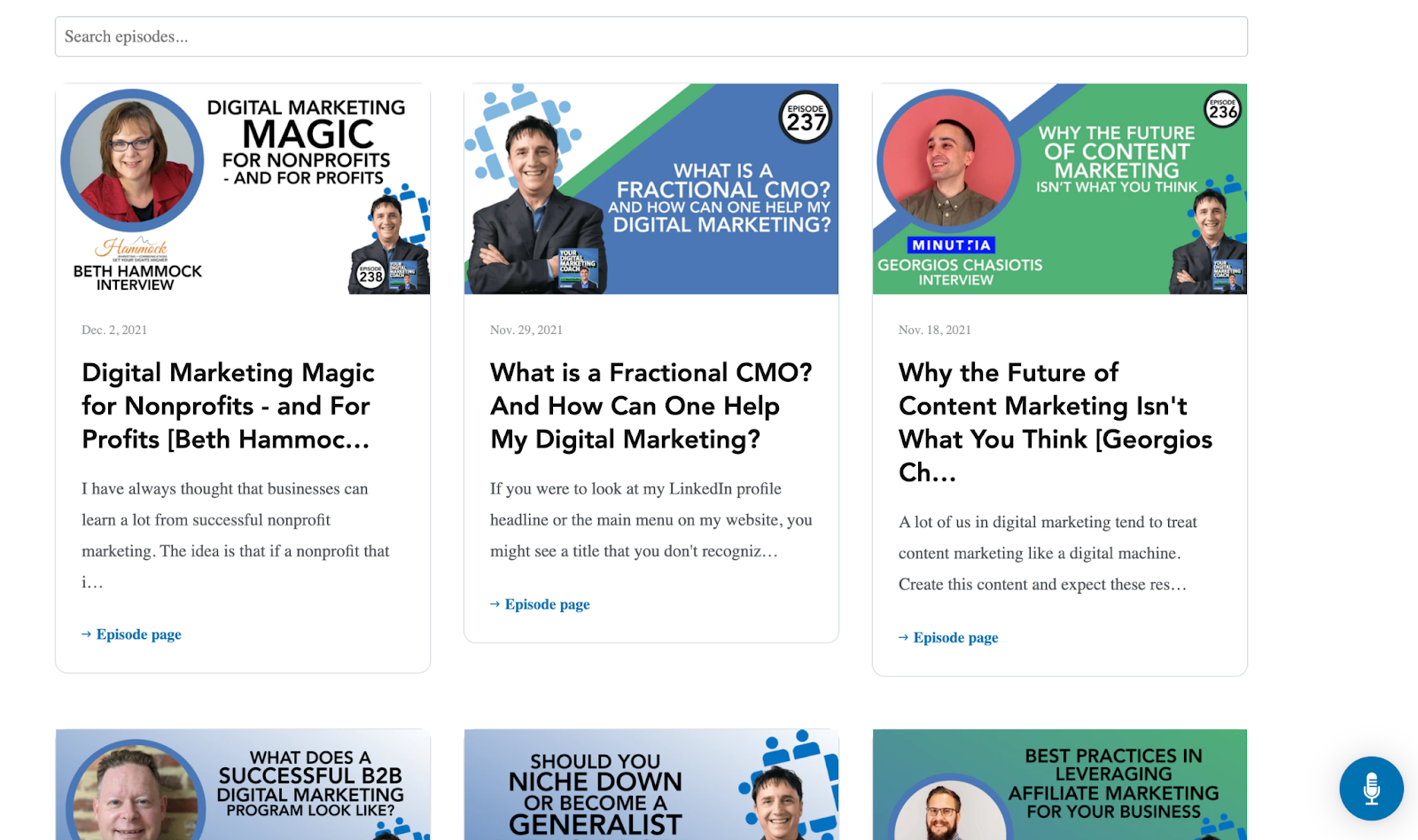
Author’s Note: You can also find a podcast’s episodes on its Spotify and Apple Podcast pages.
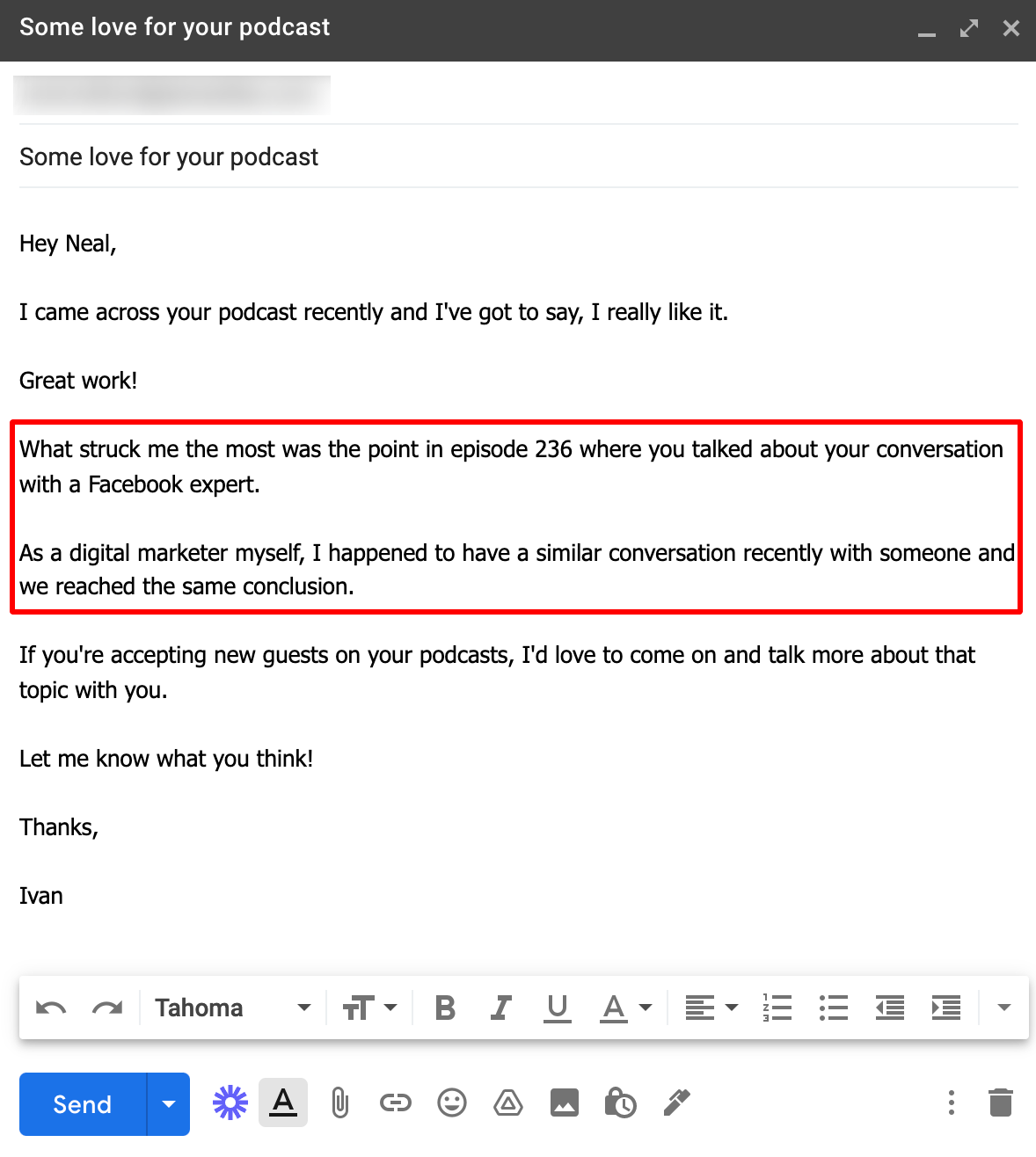
To give you an example, by listening to a recent episode 236, around the eighth minute in, the host refers to a conversation he had with a popular Facebook group expert.
This could potentially be a great way to get your foot in the door when creating your perfect podcast pitch, assuming you have a similar story to tell or even had a conversation with the same person once.
Your outreach email could look something like this:
Makes sense, right?
Overall, listening to a podcast before approaching the host for podcast guesting can provide you with valuable insights.
This also helps you avoid sending a generic pitch. If you can mention a specific episode, a story the host told, or a theme they keep revisiting, your pitch instantly feels more relevant.
Let’s continue.
Lesson #2: Connect with the host on social media to build a relationship prior to pitching
Cold email marketing is a challenge enough, and with the average response rate being at just 1%, marketers are constantly trying out new techniques that’ll make their outreach efforts more effective.
Social media can make podcast pitching feel warmer and more natural. If the host has already seen your name, your comments, or your posts, your email is more likely to feel familiar when it arrives.
One of those has proven to be relationship building.
By connecting with influencer hosts and on social media, like LinkedIn and Twitter, and sparking general conversations with them, they’re more likely to notice you before you even request anything from them.
Think about it; which of the two cold emails are you most likely to reply to?
An email from someone you’ve never heard of or interacted with before, or from a person you’re aware of and have built a relationship with?
Chances are, you’d reply to the second one.
Let’s continue with the same example as before and assume you’ve connected with Neal Schaffer on LinkedIn.
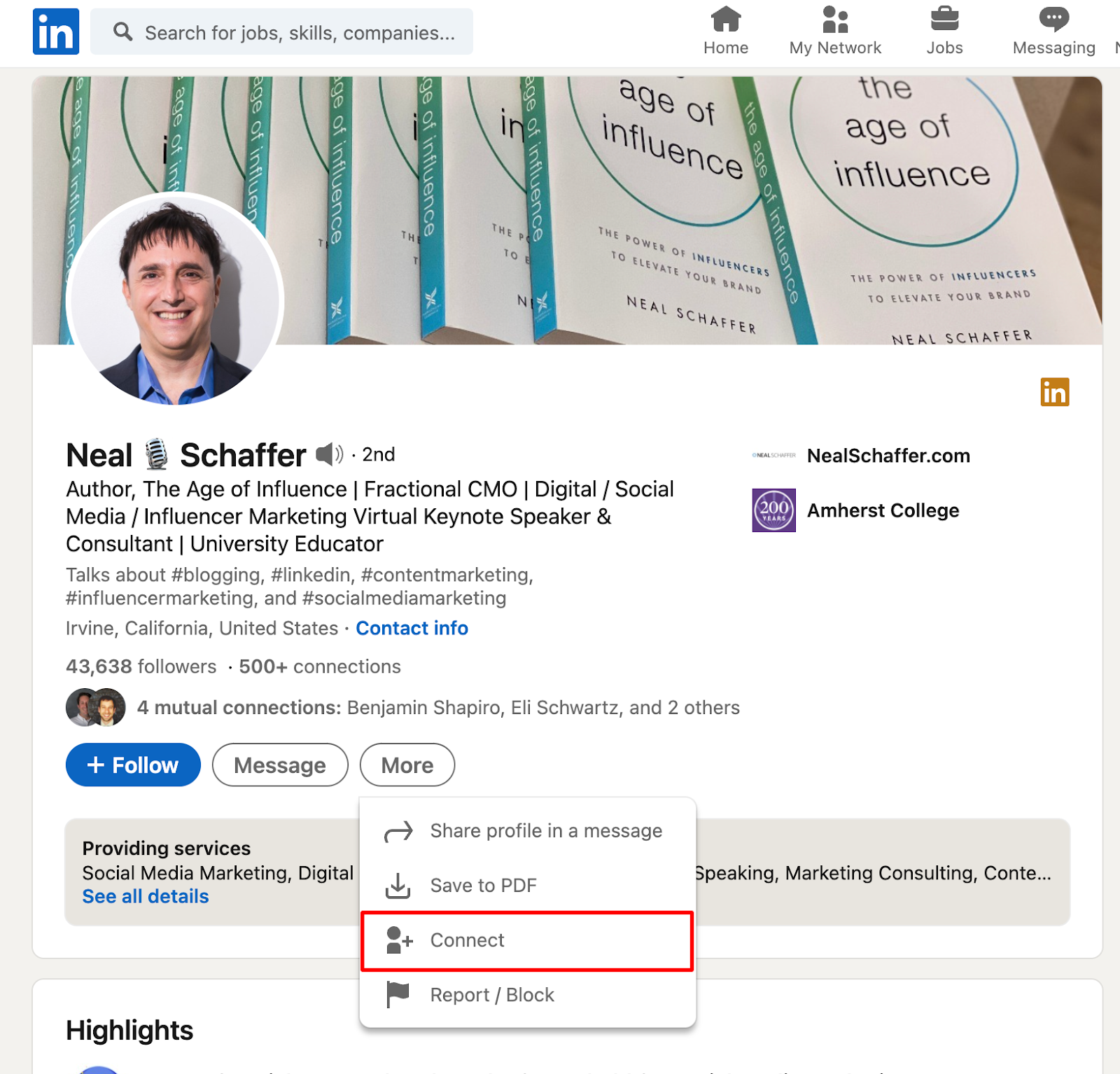
After a certain amount of time has passed and you’ve interacted with his posts and he’s had a chance to see yours – and ideally interacted with them too – this is fertile ground to cold email him.
Here’s what your email could look like:
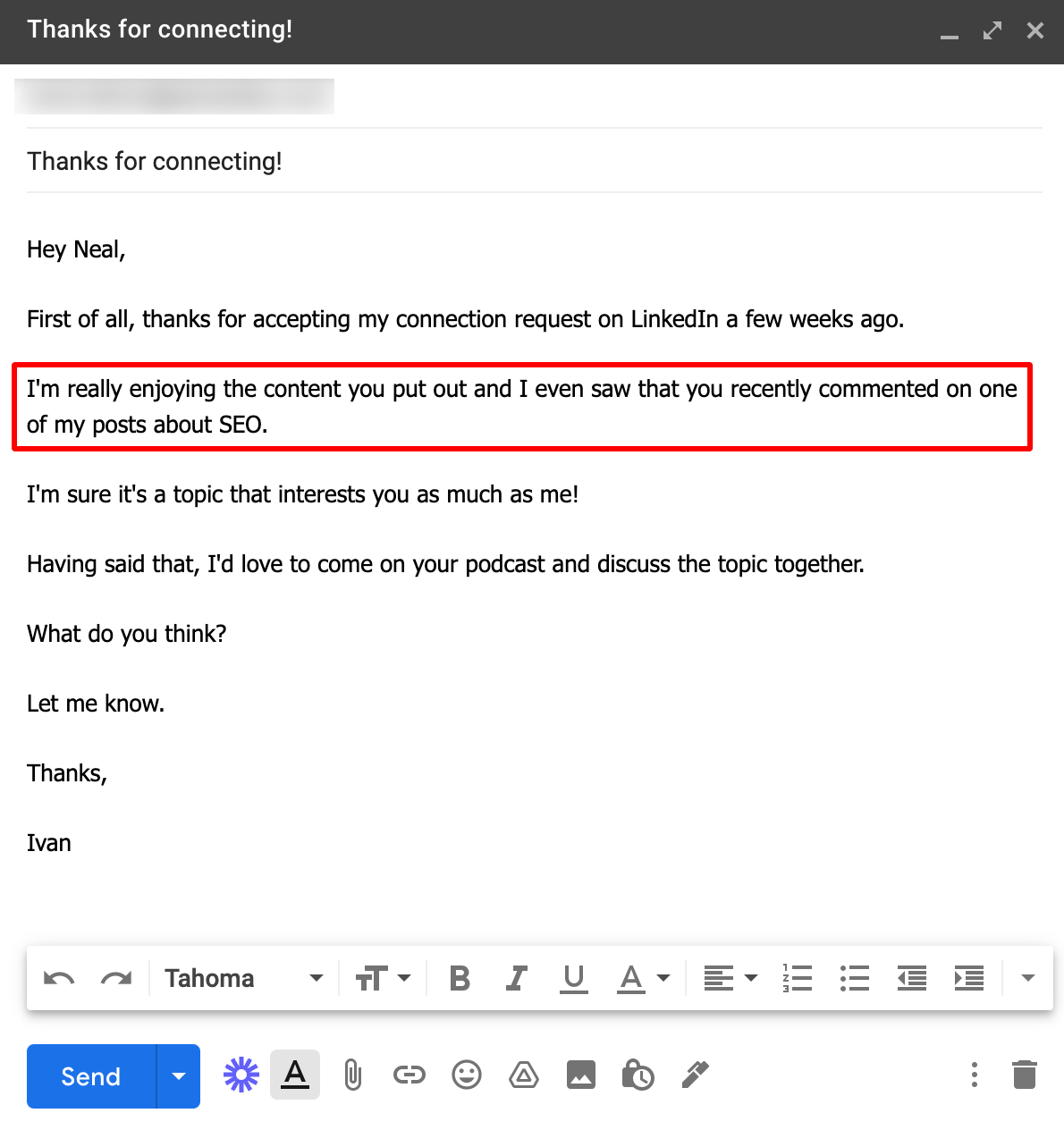
See what we did there?
By talking about the online relationship that’s been established, we’ve got more chances of getting a reply and potentially making a podcast guesting appearance in a popular podcast interview.
This works especially well when the host is active on LinkedIn, X, or another platform where podcast hosts regularly engage with their audience.
Even a small amount of familiarity can make the difference between a cold pitch and a more credible introduction.
To sum up, relationship marketing is something you should take into serious consideration before reaching out to someone; it can really make a difference when booking a good guest spot.
Moving on to the next lesson.
Lesson #3: Finding an “episode gap” makes your pitch more appealing
Offering free value is something that everyone appreciates and this is what this lesson is all about.
If you really want your pitch to work and appear on a certain podcast, then a good tactic is to find an episode gap and propose to fill it yourself.
An episode gap gives you one of the strongest possible angles for a podcast pitch email. Instead of saying “I would love to be on your show,” you are saying “I noticed a relevant topic your audience would likely care about, and I can help cover it.”
This basically means browsing through a podcast’s episodes searching for a podcast’s theme relevant to the subject but that hasn’t yet been covered.
Once you find a gap that would be a good fit and within your area of expertise, you can include it in your pitch as a proposed topic of discussion.
Even top podcasts haven’t covered every single topic in their niche, so if you look for an opportunity you’re bound to find one.
Let’s go with the same example as in the previous lessons.
Supposing you’re an expert in SEO and content marketing; one of the things it makes sense to talk about is topic clusters.
Now that we have our proposed talking points, it’s time to check if it’s been covered by Neal Schaffer’s popular podcast.
One way to do this is to browse the episodes one-by-one, but you can also use a search modifier to speed up the process; this is what ours would look like:
site:nealschaffer.com AND topic clusters
With it, we’re instructing Google to find all results from our selected website that are about topic clusters.
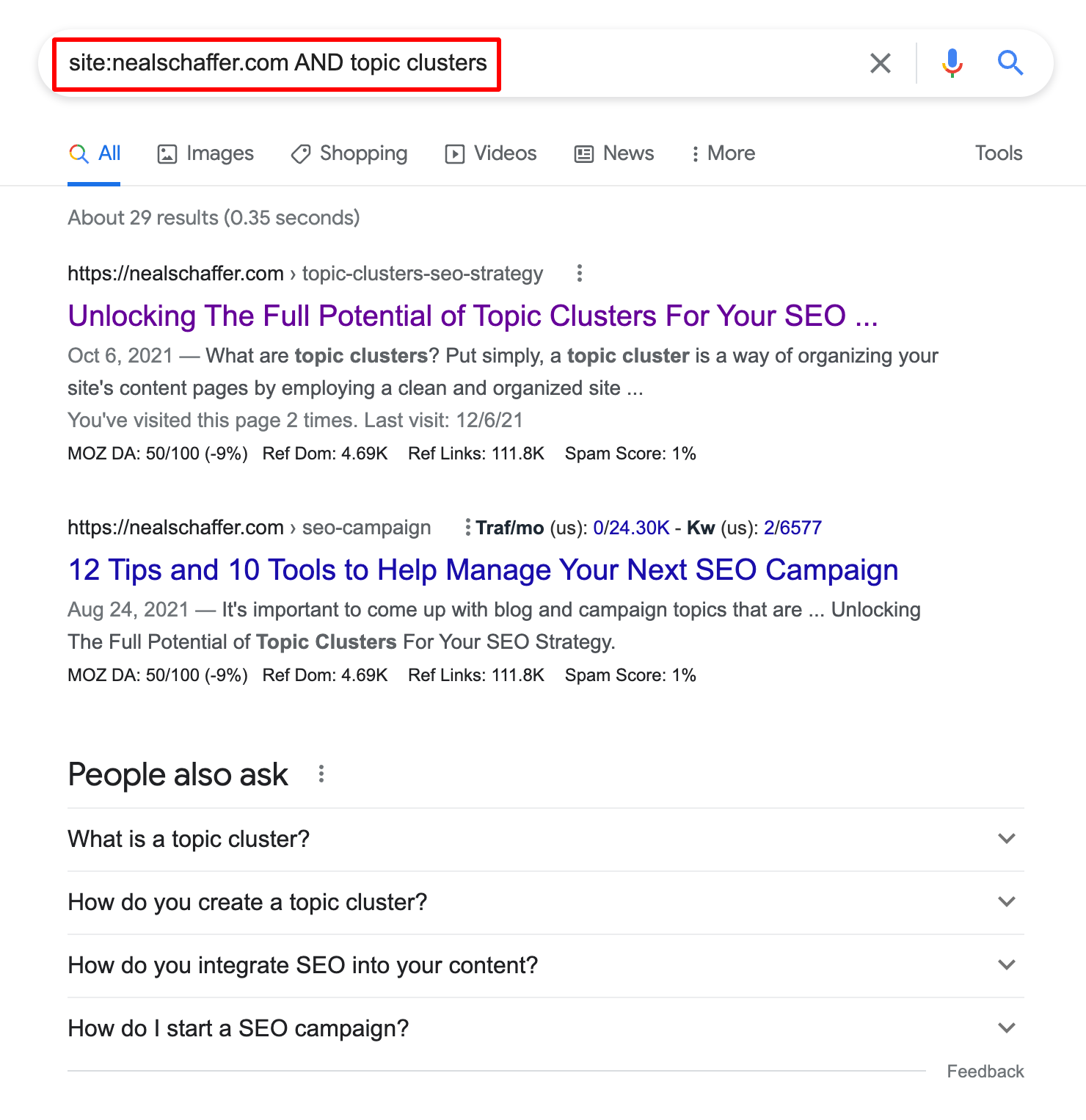
As you can see above, a few results come up but they’re all traditional media posts; meaning that there’s an episode gap for our subject.
We can talk about this in our compelling pitch email.
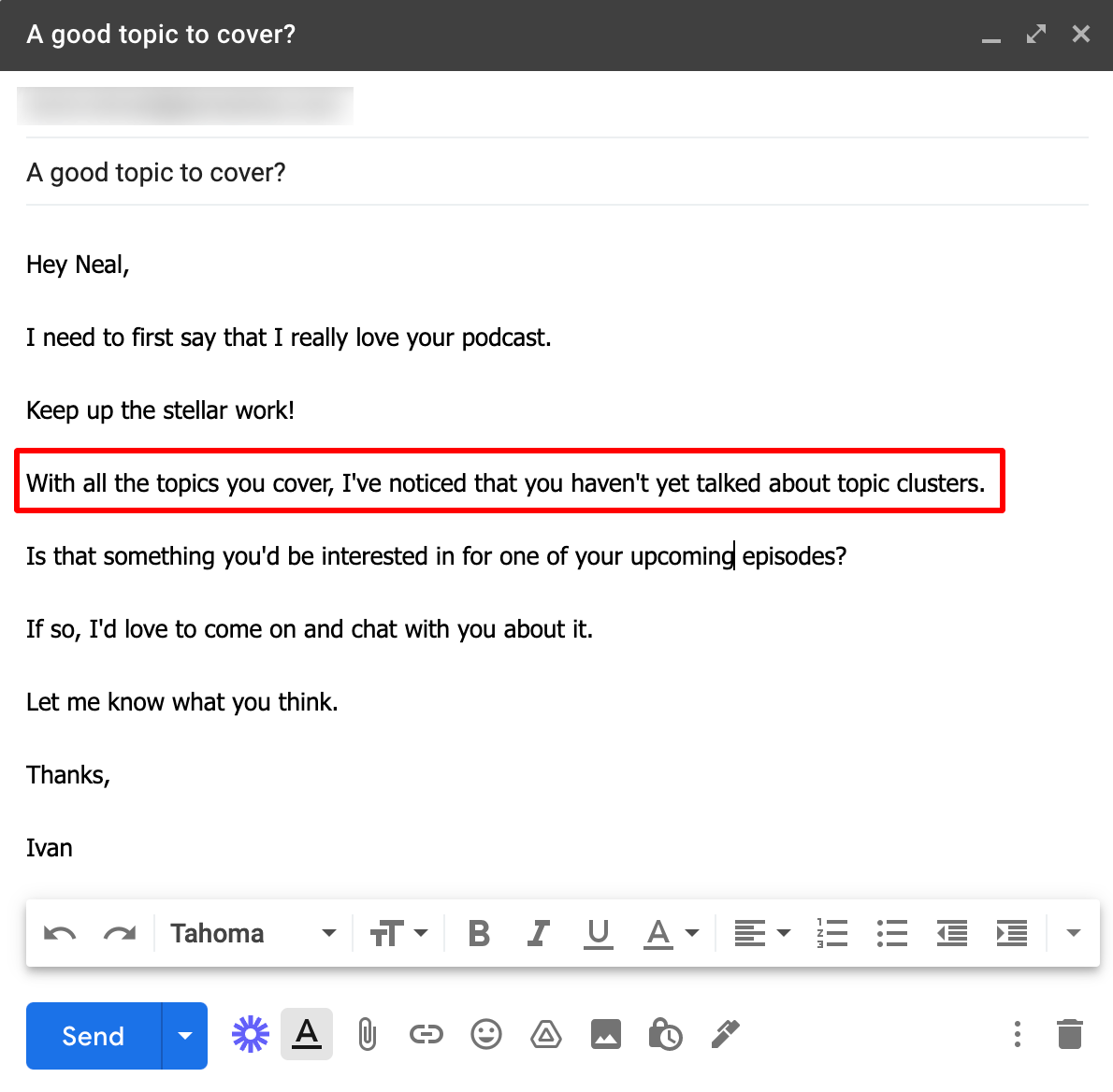
Make sure that the topic is relevant to the podcast and interesting enough for the podcast audience and your chances of being a potential guest will significantly increase.
This makes your pitch more useful because it is tied to the needs of the audience, not just your desire to get a podcast appearance.
Moving on to the next lesson.
Lesson #4: Showing what’s in it for the host can make your pitch more tempting
Pitching yourself to be a potential podcast guest is a request.
As with every request, asking for a favor or demanding something isn’t enough to be accepted by the other side.
Every good podcast pitch should answer a simple question: why should this host want me on the show? If the answer is only about your own exposure, the pitch will be much weaker.
Unless you’re very popular in your field and can bring a podcast a lot of attention, you’ll have to offer something else as an incentive.
For instance, you can propose to promote the episode you’ll appear in on your social media accounts, which will drive awareness to a new podcast audience.
If you’re a podcaster too, you can even offer the host the chance for them to appear on your own podcast; it’s a win-win situation for both sides then.
Whatever you have to offer, showing what’s in it for the host can make your pitch more appealing.
Here’s an example:
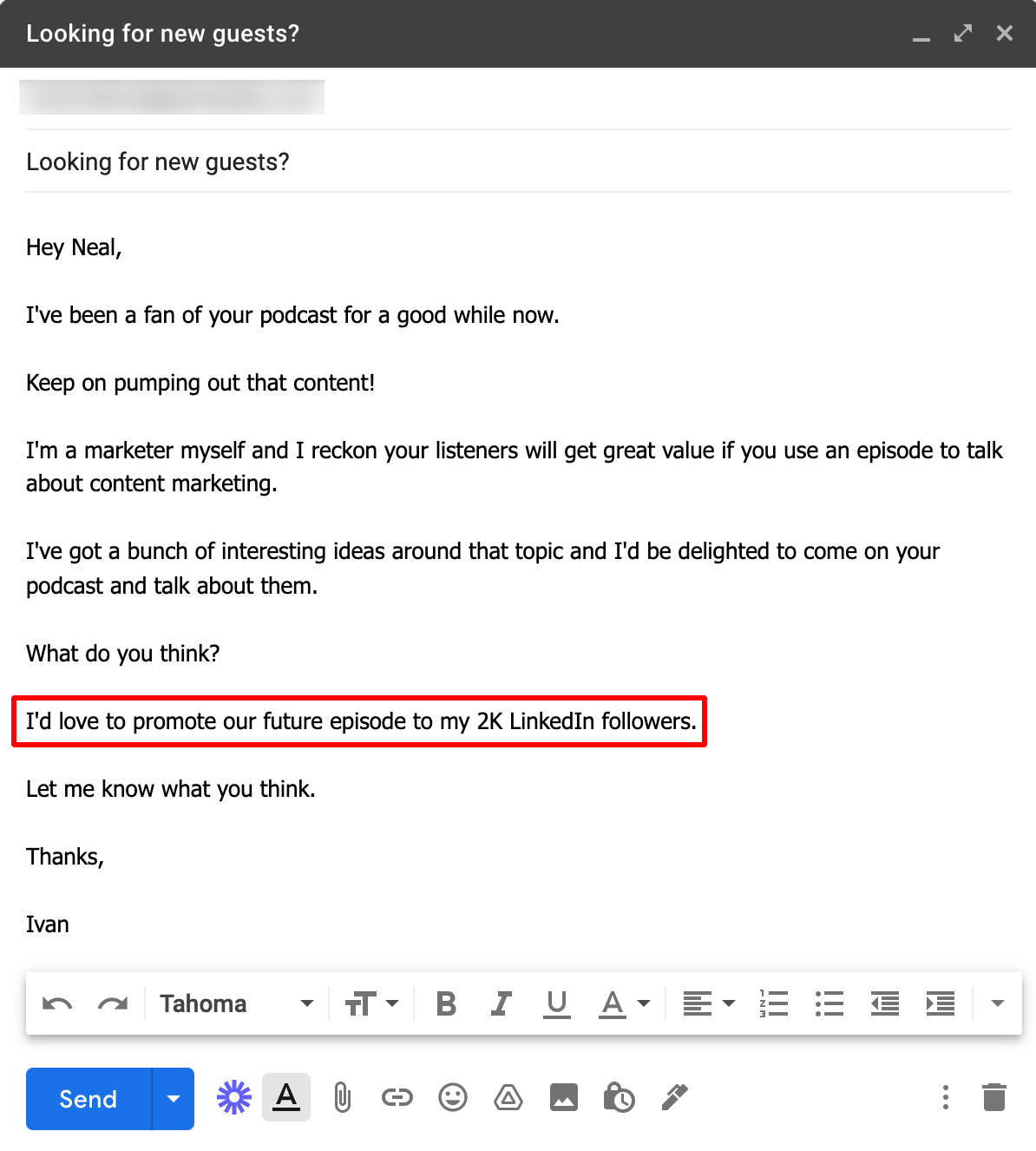
Overall, if you want to make your podcast pitch tempting, you need to offer an attractive incentive too.
The best incentives are the ones that help the host grow the episode’s reach, bring new listeners, or create a better experience for their audience.
Let’s continue.
Lesson #5: Sharing a topic can make things more specific
This lesson is something we’ve more or less included in every example we featured so far, but it’s important to point it out.
Whether you’re contacting a host or a podcast producer, it’s important for your pitch to be clear and to the point.
Specificity makes podcast pitching stronger. When you suggest clear talking points, the host can quickly understand your expertise and imagine the shape of the conversation.
This means you need to share one or more specific topics you can talk about on the podcast so that your email recipient knows what your expertise is and what kind of episodes you can work on together.
Plus, it’ll save some back and forth trying to come up with a good topic.
Here’s what a good podcast outreach email could look like:
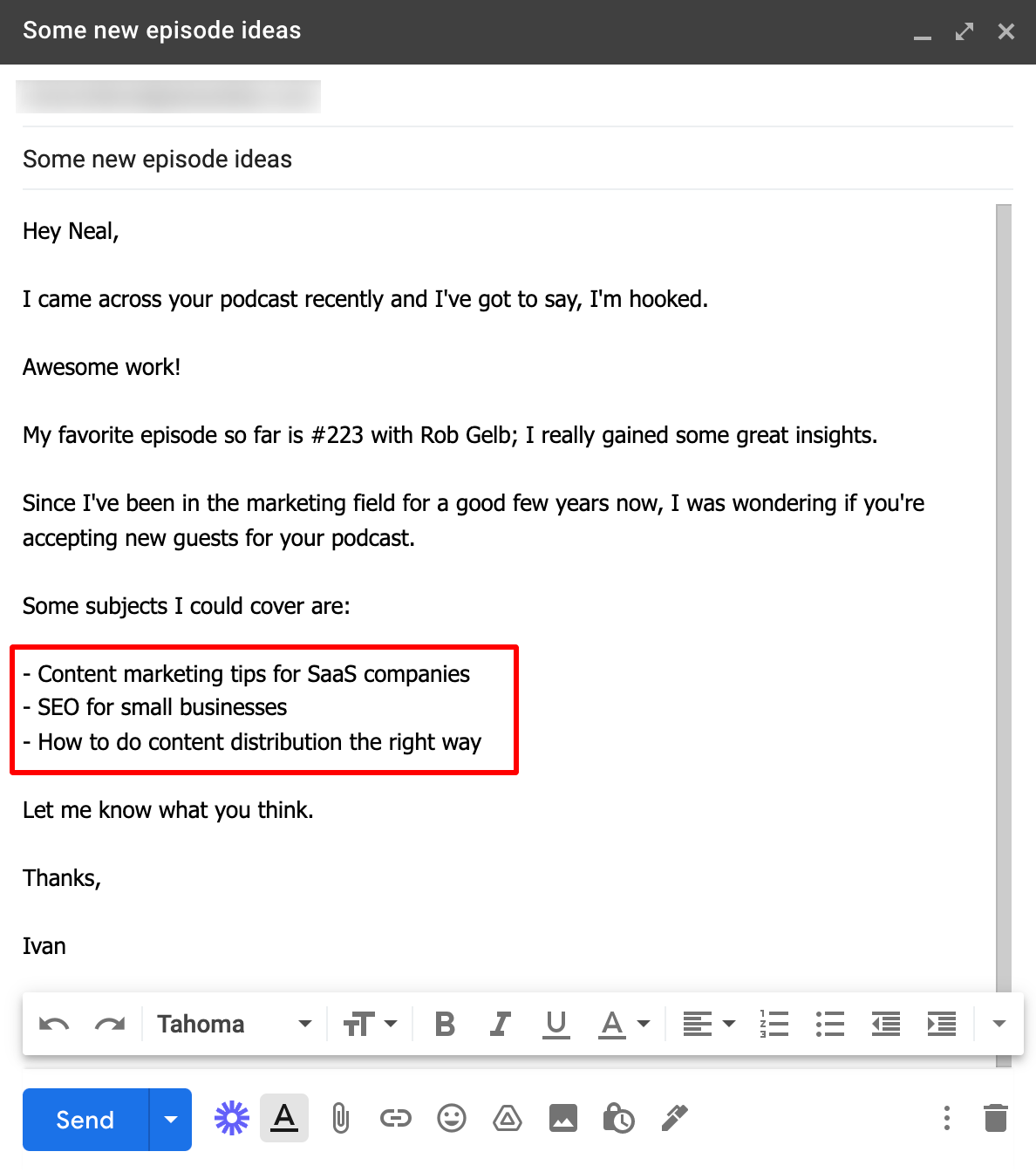
By providing some bullet points of suggested topics, your irrestistible podcast pitch is straightforward and has more chances of being accepted.
Author’s Tip: Try to make your suggested topics as specific as possible, instead of generalized ideas. A topic becomes much more compelling when it promises actionable insights, a unique perspective, or valuable insight the audience has not already heard many times before.
Moving on to the next lesson.
Lesson #6: Offering value through co-marketing activities helps your pitch stand out
One of the best ways to make your podcast pitch stand out is by offering value through co-marketing activities.
This is especially useful when you are not yet a well-known podcaster, creator, or speaker. Offering distribution, promotion, or cross-promotion can help make your pitch more attractive even if the host has never heard of you before.
In a nutshell, co-marketing campaigns provide two or more parties with the opportunity to promote an offer and share the results with each other.
In fact, according to research, 54% of companies say partnerships drive more than 20% of total company revenue.
This is why proposing a partnership or even a potential sponsorship in your pitch would be a great idea.
For example, you can offer to promote the podcast episode on your social media, run a podcast advertising campaign, or create some sort of giveaway or contest around it.
By offering a good incentive, you’ll drive awareness to both you and the host’s social accounts; this can be particularly useful if you’re pitching to a new podcast that’s building an audience.
Here’s how you can put these together in a cold email:
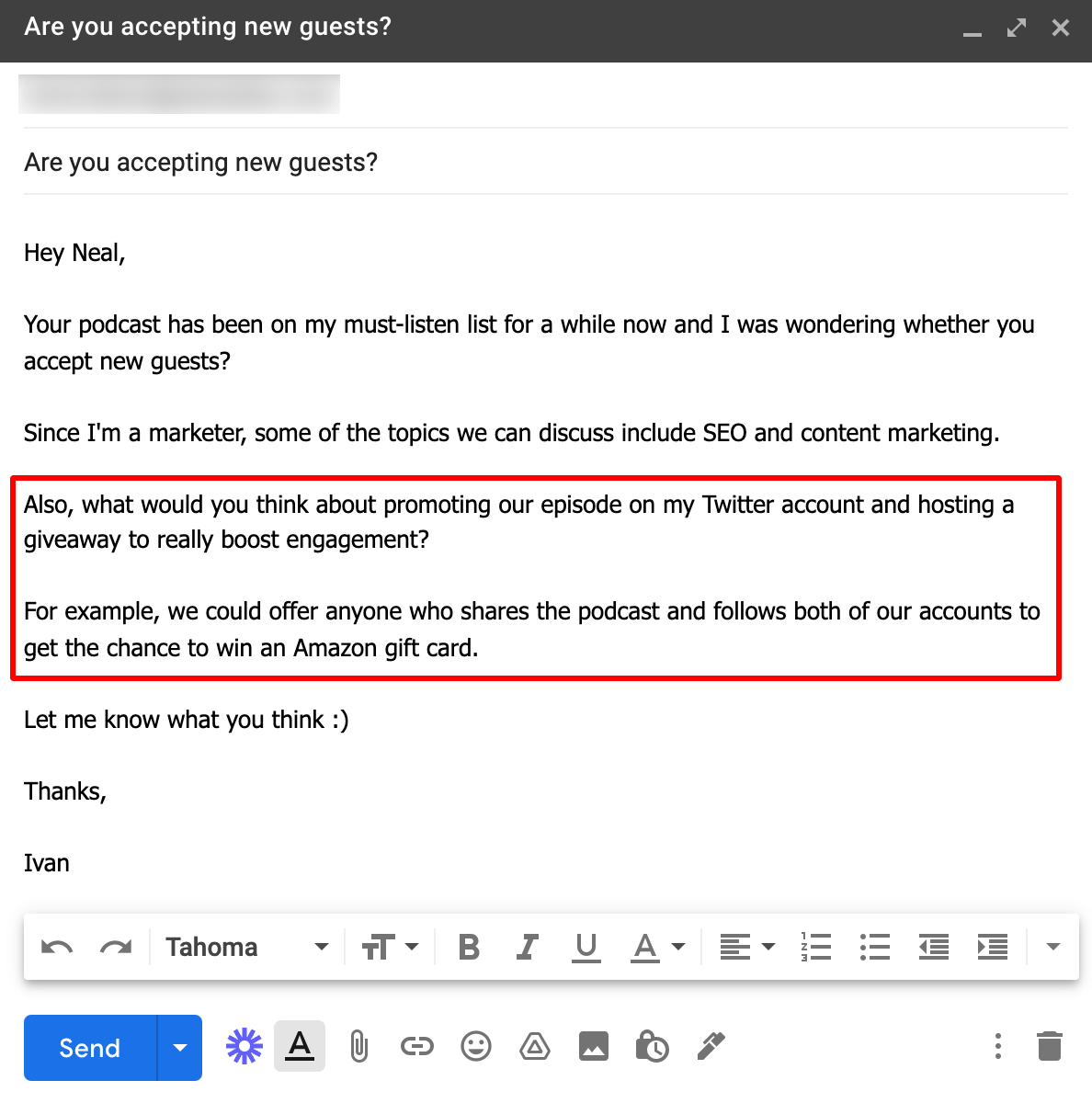
Obviously, the co-marketing activity could be anything you think is beneficial for both sides.
What’s definite is that it’ll make your outreach email stand out from the crowd.
Grab Our Podcast Pitch Template
In this last part of our guide, we’re going to briefly share with you our free template for podcast pitching.
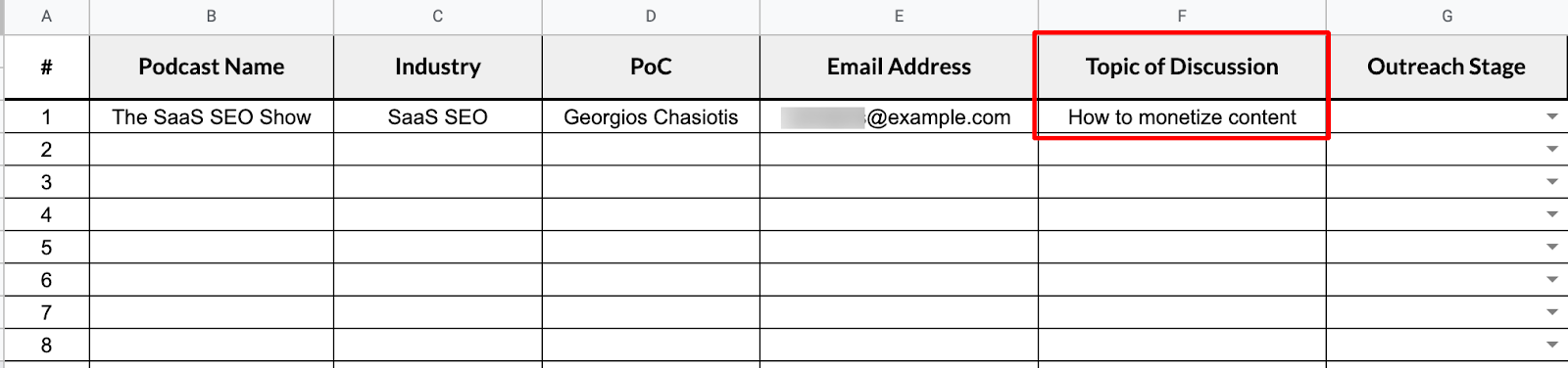
The first columns are to keep track of multiple podcasts you’ve contacted by entering their name and industry.
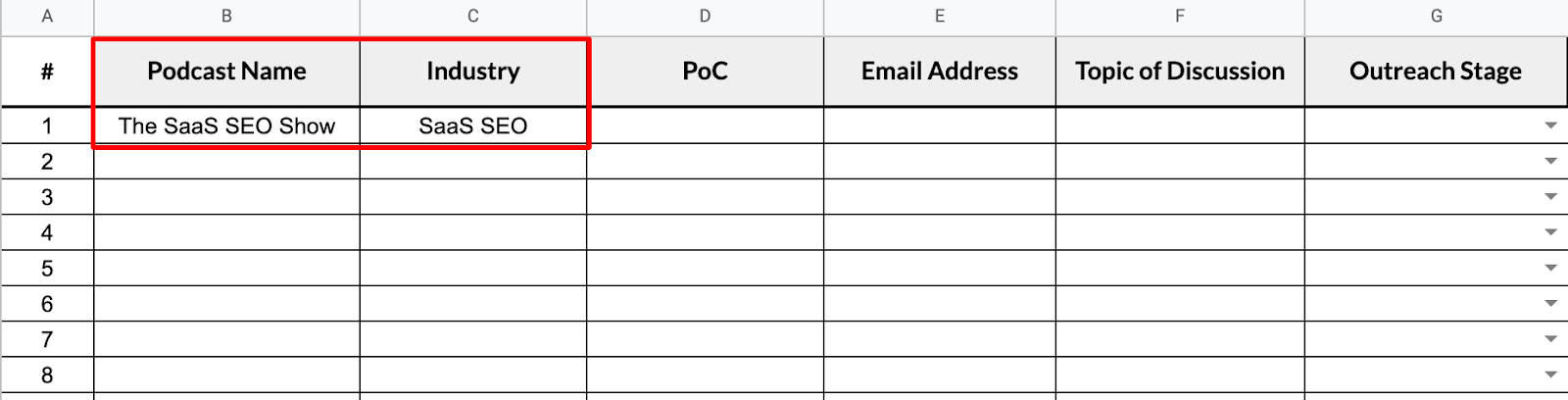
Author’s Note: All data included in these screenshots are for example purposes only.
Once you have those basic pieces of information ready, you can fill in who your PoC (point of contact) is, as well as their email address.
These are things Respona can easily help you identify as we saw earlier on, so it shouldn’t be a problem.
Simply use Respona to find them and then enter them in the template under columns D and E.
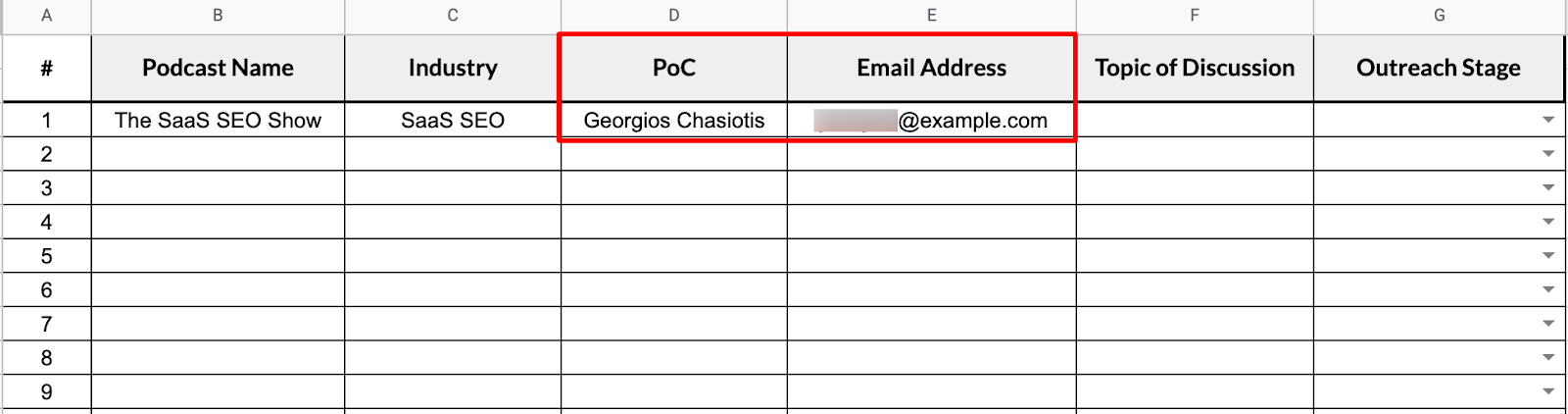
Simple, right?
After that, under column F, you can enter the topics of discussion and talking points you have in mind, in case your podcast pitch is successful.
Let’s assume that, in this case, your suggested topic is how to monetize content.
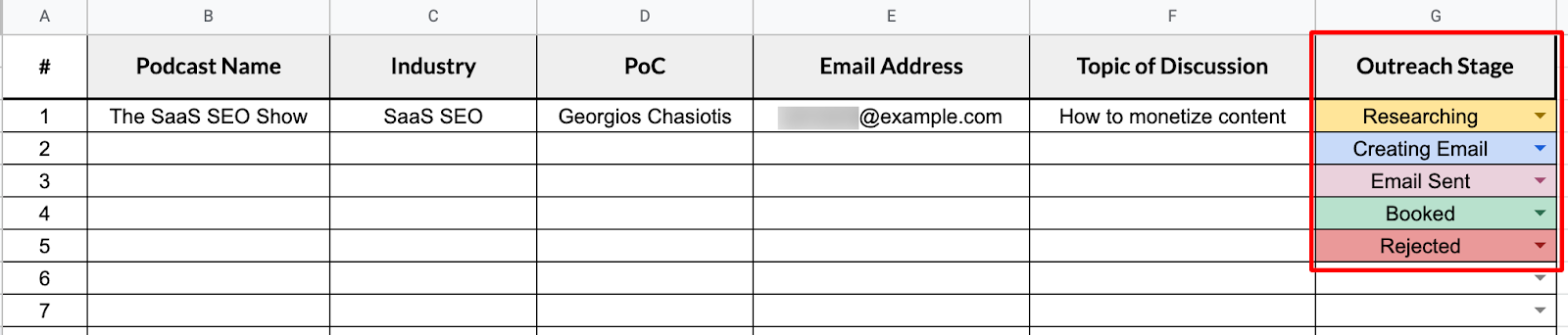
Moving on to column G, this is where you’ll be able to keep track of the stage your outreach efforts are at.
More specifically, we’ve added the following stages:
- Researching – you’re still doing your research
- Creating email – you’re in the process of creating your cold emails
- Email sent – your email has been sent and you’re waiting for a response
- Booked – your podcast pitch was successful
- Rejected – your podcast pitch wasn’t successful
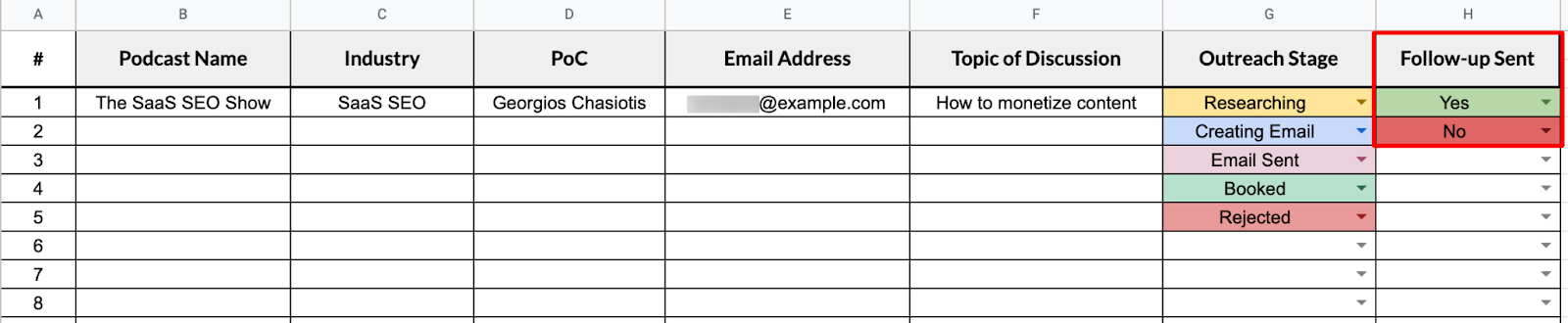
Last but not least, under column H, you can enter whether a follow-up email has been sent or not so you can monitor your responses.
It’s as simple as that.
You can now have the most important information of your podcast outreach efforts all in one place.
Let’s wrap things up with some final words.
Link building cheat sheet
Now Over to You
There you have it.
You now have a clearer process for how to pitch a podcast, from researching the host and audience to structuring a stronger email and tracking your outreach properly. A good pitch is not just about asking for airtime. It is about showing why your expertise, your topic, and your perspective are a good fit for that specific show.
That same principle applies to link building outreach.
If you want to earn backlinks, get featured on relevant websites, and build authority through smart outreach, you need more than a generic pitch.
You need the right prospects, the right message, the right positioning, and a process that turns outreach into real results.
If you would rather not manage all of that in-house, our team can help.
Our done-for-you link building helps brands earn high-quality backlinks through personalized outreach, relationship-driven prospecting, and strategic content promotion.
Instead of handling prospecting, pitching, follow-ups, and outreach management yourself, you can rely on our team to manage the process from start to finish.
Frequently Asked Questions (FAQ)
How do you pitch a podcast successfully?
To pitch a podcast successfully, research the show first, understand the host and audience, and send a personalized podcast pitch that clearly explains your expertise, suggested topic, and why you are a good fit for that specific podcast.
What should a podcast pitch include?
A strong podcast pitch should include a short introduction, a clear reason for reaching out, a few suggested topics, and a quick explanation of why those topics would be valuable to the audience. It should also make clear why you would be a strong podcast guest.
How long should a podcast pitch email be?
A podcast pitch email should usually be short and direct. Most podcast hosts do not want a long biography. Focus on relevance, clarity, and a strong angle rather than length.
How do I know if a podcast is the right fit?
The right podcast is one where your expertise matches the interests of the audience, the themes of the show, and the style of the host. Listening to a recent episode is one of the fastest ways to judge fit.
Should I connect with podcast hosts before pitching?
Yes, when possible. Connecting through social media before reaching out can help build familiarity and make your pitch feel warmer and more credible.